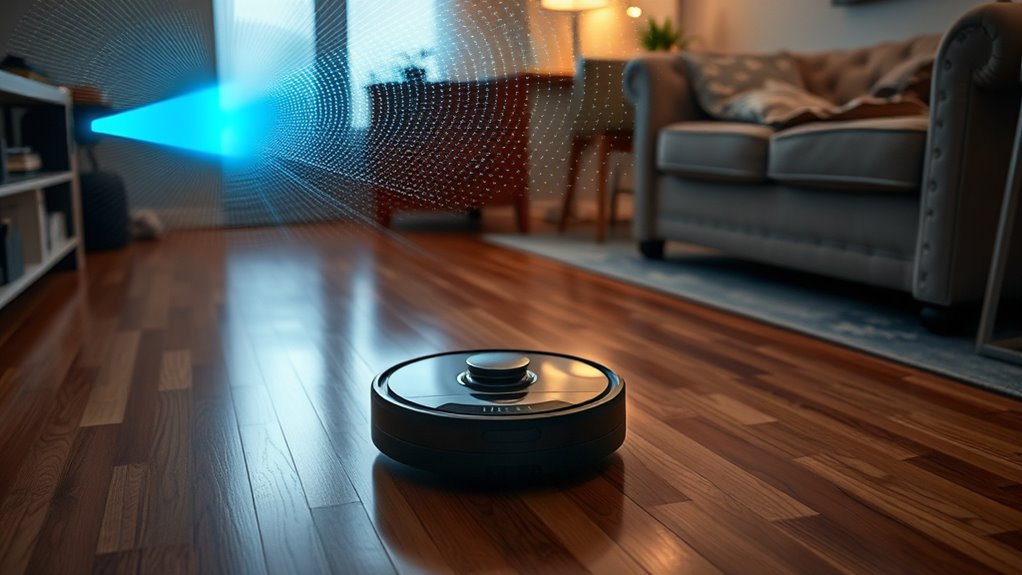

Lidar uses laser beams to scan your home, creating detailed 3D maps that help your robot navigate accurately, even in low-light conditions. Camera-based systems rely on visual data, which can be affected by lighting and sometimes lead to misjudgments of objects. While lidar offers precise obstacle detection and reliable navigation, camera systems are improving with AI but still depend more on environment conditions. If you keep exploring, you’ll discover how each technology impacts your vacuum’s performance.
Key Takeaways
- Lidar uses laser beams for precise 3D environment mapping, ensuring accurate obstacle detection regardless of lighting.
- Camera-based systems rely on visual data, which can be affected by lighting conditions and may lead to misjudgments.
- Lidar provides consistent navigation with fewer collisions and better route planning in complex or dark environments.
- Camera systems leverage AI and image processing to improve obstacle recognition but are more environment-dependent.
- Overall, lidar offers higher sensor accuracy and reliability for seamless navigation compared to camera-based mapping.
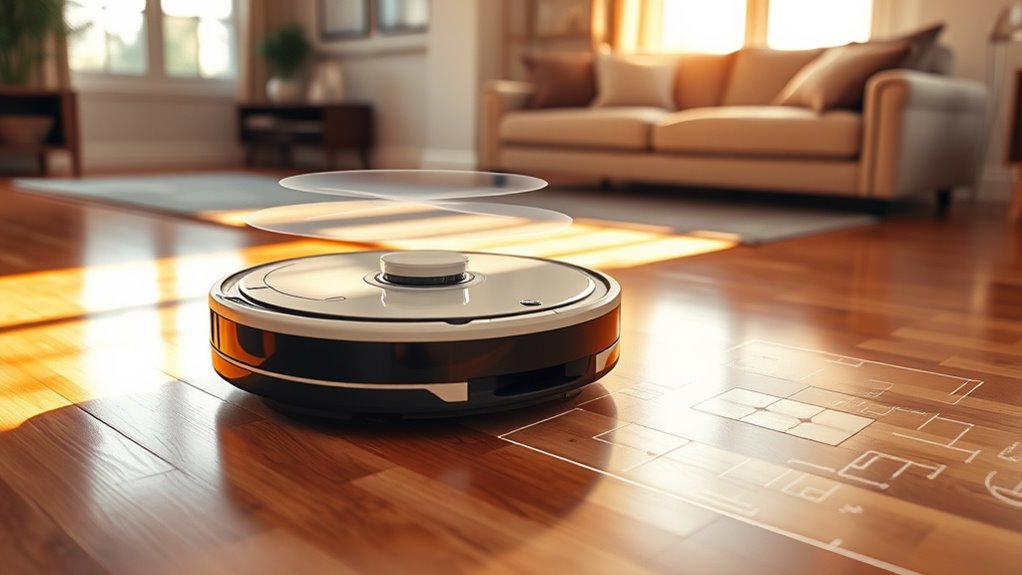
When choosing a robot vacuum, understanding how it maps your space can make a big difference in cleaning efficiency. One key factor to consider is the technology it uses to navigate, especially how it detects obstacles and creates a map of your home. Sensor accuracy plays a pivotal role here, as it determines how well the vacuum perceives its environment. Accurate sensors ensure the robot can identify walls, furniture, and other objects precisely, reducing the chances of missed spots or collisions. Obstacle detection is essential for smooth navigation; the better the obstacle detection, the fewer bumps and the more efficient the cleaning process becomes.
In robot vacuums that rely on lidar, the sensor accuracy is typically high. Lidar uses laser beams to scan the environment, creating detailed 3D maps of your space. This technology allows the vacuum to measure distances accurately and detect obstacles even in low-light conditions. As a result, lidar-powered vacuums can navigate complex layouts with minimal errors, ensuring thorough coverage. Their obstacle detection is precise, enabling them to recognize objects like cords, shoes, or pet bowls, and maneuver around them seamlessly. This level of accuracy helps prevent collisions and allows for smarter, more efficient cleaning routes. Moreover, lidar technology generally offers better sensor precision compared to camera-based systems, which enhances overall navigation performance.
On the other hand, camera-based mapping systems use visual data captured through sensors or cameras to map your environment. These systems tend to be more dependent on lighting conditions and image processing, which can sometimes affect sensor accuracy. While cameras can provide rich visual information, their obstacle detection might not be as reliable in dim or overly bright settings. This can lead to occasional misjudgments about the position or size of objects, possibly causing the vacuum to bump into things or leave areas uncleaned. However, advances in image processing and AI have improved camera-based navigation, making them more capable of detecting obstacles and adapting to different environments.
Lidar robot vacuum
As an affiliate, we earn on qualifying purchases.
As an affiliate, we earn on qualifying purchases.
Frequently Asked Questions
Which Mapping Method Is More Cost-Effective for Consumers?
You’ll find that camera-based mapping is more cost-effective for consumers due to lower price comparison and installation costs. Cameras are generally cheaper to produce and install, making vacuums more affordable upfront. While lidar offers more precise navigation, its higher price and installation costs make it less accessible for budget-conscious buyers. So, if you’re looking for an affordable option, a robot vacuum with camera mapping is likely your best choice.
How Do Lighting Conditions Affect Camera-Based Navigation?
Imagine your vacuum’s camera struggling as shadows lengthen or lights flicker—lighting challenges directly affect image quality. Low light or uneven lighting can cause the camera to misread surroundings, leading to navigation errors or missed spots. Bright glare or poor illumination create blind spots, making it harder for the robot to map accurately. You’ll notice it may slow down, hesitate, or miss areas altogether, reducing cleaning efficiency.
Can Lidar Systems Detect Small Objects or Obstacles?
Lidar systems can detect small objects or obstacles, but their effectiveness depends on sensor resolution. High-resolution lidar offers better obstacle detection, allowing you to identify tiny items in your path. However, lower-resolution systems might miss small obstacles, potentially causing issues during navigation. To guarantee smooth operation, look for a robot vacuum with a lidar sensor designed for detailed obstacle detection, especially if you have clutter or small items on your floors.
What Maintenance Is Required for Lidar Sensors?
You need to regularly clean your lidar sensors to guarantee peak performance. It’s also vital to perform sensor calibration periodically, especially if you notice navigation issues. Dust buildup can interfere with sensor accuracy, so gently wipe the lidar with a soft cloth and avoid harsh chemicals. Maintaining these simple steps helps your robot vacuum navigate effectively, proving that proper upkeep sustains device longevity and accuracy.
Are There Hybrid Systems Combining Lidar and Cameras?
Yes, many robot vacuums use hybrid systems that combine lidar and cameras through sensor fusion and system integration. This approach enhances navigation accuracy, obstacle detection, and environment mapping. By blending data from both sensors, you get improved performance, especially in complex or dynamic spaces. These hybrid systems allow your vacuum to adapt better to different conditions, making cleaning more efficient and reliable while minimizing navigation errors.
camera mapping robot vacuum
As an affiliate, we earn on qualifying purchases.
As an affiliate, we earn on qualifying purchases.
Conclusion
So, whether you trust a laser beam or a camera’s eye, your robot vacuum’s got it covered. Lidar’s precision or camera’s vision—either way, they navigate your chaos with a touch of tech wizardry. Because, honestly, who needs a human’s judgment when your robot’s algorithms can outsmart your clutter? Just sit back, relax, and marvel at the future of cleaning—where even the messiest floors get a high-tech makeover, all without a single coffee spill.
robot vacuum with laser navigation
As an affiliate, we earn on qualifying purchases.
As an affiliate, we earn on qualifying purchases.
robot vacuum obstacle detection
As an affiliate, we earn on qualifying purchases.
As an affiliate, we earn on qualifying purchases.