
TL;DR

Get home appliances delivered free with Prime
- Fast, free delivery on millions of items
- Prime Video, Amazon Music and more included
- Member-only deals all year
Apple and Amazon have introduced new smart displays that could serve as shared household screens for calendars, smart-home controls and other family tasks. A hands-on report found promising hardware and software, but said full testing is still needed; the devices also differ in how much they rely on personal phones and accounts.
Apple and Amazon have introduced new smart displays that could work as shared screens for household tasks, including checking calendars, controlling connected devices and reviewing who is at the door, as explored in this comparison of Apple’s HomeView display. In a hands-on report, The Verge’s reviewer said Apple’s $299 HomeView and Amazon’s $499.99 Echo Show 16 appear to address long-standing shortcomings in the category, while stressing that both still need fuller testing.
The devices bring more capable hardware to smart displays, a product category that has often combined voice assistants with limited touchscreen features. HomeView uses Apple’s A18 chip and a Liquid Retina display. Amazon’s rebuilt Echo Show 16 uses a MediaTek processor and the Nanomatte display also used in the company’s new Alexa Tablet. The report argues that stronger components may make these screens more useful for everyday interaction, rather than serving mainly as speakers with displays.
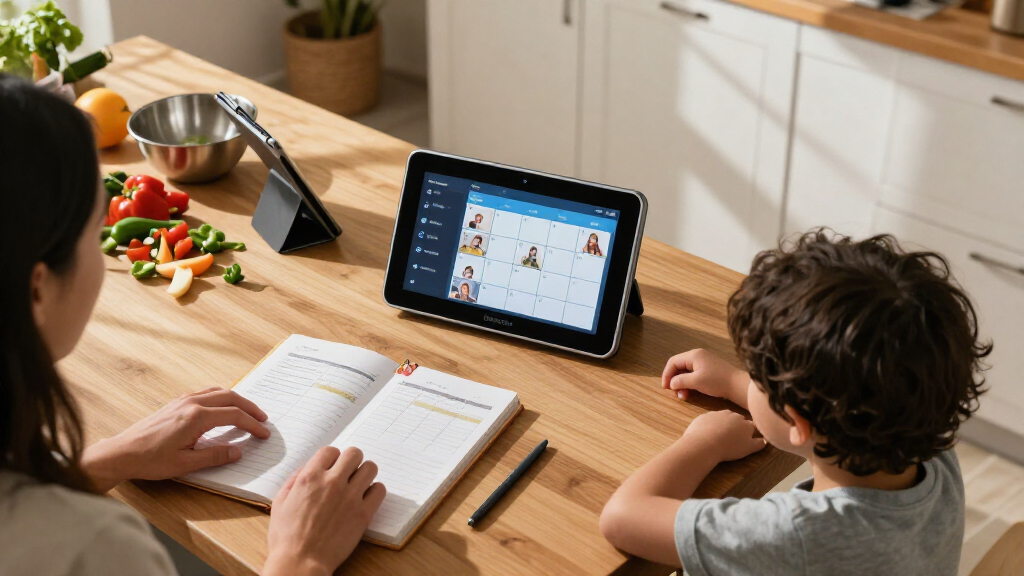
Their intended role is not to replace a laptop for schoolwork or bill payments. Instead, the reviewer describes them as a possible communal household computer: a fixed screen for practical information and controls that family members can reach without first finding a personal device. Amazon’s Echo Show 16 includes a family-management home screen with a meal-planning feature, as well as calendar and smart-home dashboard options. HomeView has built-in apps, while some other functions rely on a connected iPhone.
The products take different approaches to shared use. The report says Amazon designed the Echo Show 16 to work as a household device without requiring a phone for setup, although a phone can help. HomeView is more closely tied to the iPhone and to recognizing individual users. In an Apple demonstration described by The Verge, Siri used information from text messages to anticipate a friend’s arrival and prepare a coffee machine. That capability was a demo, not an independently verified result from extended testing.
Many household details—calendars, grocery lists, meal plans and chores—are managed on one person’s phone. A fixed, shared display could make that information and smart-home controls easier for everyone in a household to access. It could also provide a single place to check a door camera, adjust a thermostat or change lighting, rather than requiring people to use separate apps and devices.
The report connects the products’ arrival to demand for communal screens, pointing to the popularity of devices such as the Skylight Calendar. A tablet can fill some of the same functions, but the reviewer says tablets bring drawbacks: limited multiuser support and the risk that a battery-powered device gets carried away and left uncharged. A wall- or counter-based display with an always-available interface may suit shared routines better, if it proves dependable and simple to use.
Price is a meaningful barrier. The report compares the new products with older devices that cost $85 for an Echo Show 5 and $99 for a Nest Hub in 2023. HomeView costs three times as much as those earlier models, and the Echo Show 16 is more expensive still. The added hardware and household features may give buyers a clearer reason to consider a smart display, but the report does not establish whether those benefits justify the prices for most families.
Products Worth Considering

eufy Security SoloCam S340 3K Dual-Lens Solar Security Camera

Bose Smart Soundbar 700 with Alexa, Black

eufy Security SoloCam E42 4K Solar Security Camera with AI Motion Tracking
As an affiliate, we earn on qualifying purchases.
Why Earlier Smart Displays Fell Short
Three years before this report, The Verge’s reviewer wrote that smart displays had become stuck with underpowered devices that tried to do too much without doing individual tasks well. The new launches are framed as a response to that problem: stronger processors, improved displays and software designed around shared household information.
The reviewer had also regarded Google’s Pixel Tablet, which could serve as a tablet or a smart display, as a possible next step for the category. In their household, the detachable screen and what they described as weak smart-home support proved problematic. The report says Google reportedly canceled the device’s successor 18 months later. It does not establish that the new Apple and Amazon products will avoid similar usability issues; the reviewer says their assessment is preliminary.
“These could finally turn the smart display into what it should have been all along: the family computer.”
— The Verge reviewer
What Longer Testing Must Establish
The report is based on brief hands-on time, not a full review of either product. It remains unclear how reliably the displays handle multiple household members, whether their interfaces remain easy to use over time, and how well their smart-home functions work outside company demonstrations. The report does not provide independent performance tests, battery or connectivity findings, or a detailed comparison of supported apps and services.
Some showcased capabilities should also be treated as demonstrations rather than confirmed everyday performance. Apple’s example involving messages, a predicted arrival and coffee preparation illustrates the company’s approach, but the report does not show that the feature has been tested in routine use. Amazon’s presence sensing and Ring-camera example likewise does not establish how consistently the system identifies activity or how it handles household privacy. The extent of the devices’ multiuser features, software support and availability details is not fully specified in the supplied report.
Full Reviews and Real-Home Use
The next useful evidence will come from extended product testing in real households. That should show whether family members can access shared information without friction, whether personal features stay appropriately tied to individual users, and whether smart-home controls work consistently. Buyers will also need clearer information about supported services, privacy settings, setup requirements and ongoing software support.
Until those points are tested, the launches mark a promising shift in the smart-display pitch, not proof that the devices have become indispensable family computers. The Verge reviewer’s current conclusion is that both appear to solve several long-running design problems, but whether either is worth its price remains open.
Key Questions
What are Apple HomeView and the Echo Show 16 intended to do?
They are smart displays intended to provide a shared household screen for tasks such as checking calendars, managing smart-home devices and viewing door-camera information. The report does not present them as replacements for computers used for homework or paying bills.
How much do the two devices cost?
The report lists the HomeView at $299 and the Echo Show 16 at $499.99. It does not include a complete account of regional pricing, promotions or additional costs.
How do their approaches differ?
The report describes Amazon’s Echo Show 16 as a household-focused device that can be set up without a phone. Apple’s HomeView is more closely linked to the iPhone and individual user recognition, with some functions depending on a nearby phone.
Have the devices been fully tested?
No. The Verge assessment cited here is based on brief hands-on time. The reviewer says proper testing is still needed to judge how well the displays work in everyday household use.
Source: theverge.com