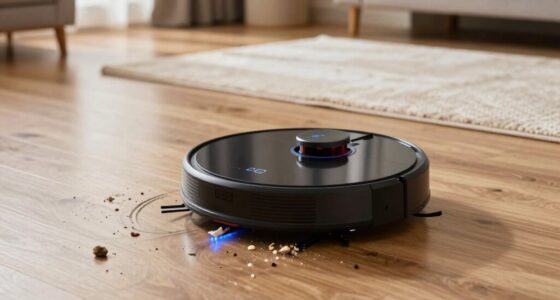
In robot vacuums, ‘AI’ mainly means the ability to map your home and identify obstacles, not thinking like a human. These devices use sensors and machine learning to detect furniture, cords, and even moving pets, adjusting their path accordingly. The sophistication of this AI varies, impacting how well the vacuum can navigate cluttered or narrow spaces. To understand if your vacuum’s AI can handle your environment, look into its mapping and obstacle recognition features—you’ll find more insights ahead.
Key Takeaways
- AI in robot vacuums mainly involves obstacle detection and navigation, not human-like decision-making or thinking.
- Proper sensor calibration and environmental mapping are crucial for accurate obstacle avoidance.
- Advanced AI enables vacuums to learn layouts, recognize moving objects, and optimize cleaning paths over time.
- Limitations such as clutter, reflective surfaces, and tight spaces can affect AI-driven obstacle detection accuracy.
- Higher AI levels improve obstacle recognition and navigation in complex environments, but require more processing power.
What Does ‘AI’ Really Mean in Robot Vacuums?

Many people assume that when a robot vacuum is labeled as having “AI,” it means it can think and make decisions like a human. In reality, AI in these devices mainly involves robot mapping and obstacle identification. The vacuum uses sensors and cameras to create a digital map of your space, allowing it to navigate efficiently. It can identify obstacles like furniture, cords, or toys, and adjust its path to avoid them. This process isn’t about consciousness but about programmed algorithms that interpret sensor data. AI navigation algorithms help the vacuum recognize where it’s been and where it needs to go, improving cleaning coverage. Glycolic acid benefits are a good reminder that understanding the capabilities of a device is important for safe and effective use. Additionally, the use of contrast ratio in projectors plays a significant role in how clear and vibrant the images appear, similar to how AI enhances navigation accuracy. Furthermore, the development of sensor technology continues to improve the precision of obstacle detection in these devices. So, while it’s impressive, the “AI” in robot vacuums is more about smart navigation than true thinking.
How Do Sensors and Machine Learning Power AI Navigation?

Sensors and machine learning work together to give robot vacuums smart navigation skills. Sensors detect obstacles, surfaces, and room boundaries, but they need proper sensor calibration to guarantee accuracy. When sensors are correctly calibrated, the robot can interpret its environment reliably. Proper calibration is crucial for maintaining consistent performance in different environments and keeping the robot’s navigation reliable. Regular sensor calibration also helps prevent navigation errors caused by environmental factors or sensor drift. Vetted machine learning algorithms analyze this sensor data to identify patterns and make decisions, continually improving navigation over time. These algorithms allow the vacuum to distinguish between different objects and adapt to changing environments. As you use the vacuum, it learns from its experiences, refining its movements for more efficient cleaning. This synergy between calibrated sensors and machine learning enables your robot vacuum to navigate more intelligently, avoiding collisions and optimizing cleaning routes without human intervention. Additionally, sensor calibration ensures navigation accuracy, which directly impacts the vacuum’s overall efficiency and reliability.
What Obstacles Can AI Robot Vacuums Detect and Dodge?

AI robot vacuums can detect common household obstacles like furniture, shoes, and cords to keep your space clean. They also recognize unusual and moving objects, such as pets or children, to avoid accidents. Understanding what these vacuums can identify helps you see how effectively they navigate your home. Additionally, some models incorporate urban traffic confidence techniques, which enhance their ability to handle complex environments and unexpected obstacles. These advanced navigation algorithms further improve obstacle detection and routing efficiency. Incorporating sensor technology allows these vacuums to better interpret their surroundings and adapt to changing conditions within your home, including real-time obstacle recognition that improves overall performance. By utilizing environmental mapping, these devices can create detailed layouts of your space, facilitating better navigation and obstacle avoidance.
Common Household Obstacles
Robot vacuums are designed to detect and avoid a variety of common household obstacles to guarantee efficient cleaning. In a smart home environment, they navigate around furniture, cords, and shoes effortlessly. They can identify and steer clear of walls, thresholds, and low-lying objects that might block their path. Pet interaction is also accounted for; many models recognize pet bowls, toys, and even animals, preventing collisions or disturbances. This ensures your space stays tidy without constant supervision. This ability to adapt to typical household items keeps your cleaning routine smooth and hassle-free. Additionally, they often incorporate elements of spirituality and success, encouraging positive interactions with your environment to promote a harmonious living space. Modern models also utilize AI-powered mapping, which enhances obstacle detection accuracy and allows for more efficient cleaning routes. Incorporating advanced sensor technology further improves their ability to detect obstacles promptly, ensuring thorough coverage without collisions. These innovations are part of a broader trend toward smart home automation, which enhances overall convenience and safety. Moreover, these technologies help in preventing accidents, making the cleaning process safer for both pets and humans.
Unusual and Dynamic Objects
While most robot vacuums excel at avoiding static household objects, their ability to detect and dodge unusual or moving items is continually improving. Advanced sensor calibration enhances obstacle classification, enabling your vacuum to identify and respond to dynamic objects. It can recognize things like pets, toys, or even a person walking through the room. These vacuums adapt to unexpected changes in their environment, avoiding collisions with moving objects in real time. Some models use infrared or ultrasonic sensors to track motion, while others rely on AI algorithms that refine obstacle classification over time. As a result, your vacuum becomes smarter and more responsive, maintaining efficiency even in unpredictable situations. The combination of sensor calibration and obstacle classification is key to maneuvering complex, dynamic environments seamlessly. sensor calibration helps improve obstacle detection accuracy, allowing the vacuum to better distinguish between different types of objects and movements.
How to Recognize Genuine AI Features in Your Robot Vacuum?

To determine if your robot vacuum truly uses AI, look for features that adapt and improve over time based on your cleaning habits. Genuine AI-powered vacuums often show enhanced mapping accuracy, enabling them to create detailed floor plans and navigate efficiently. They learn the layout of your home, avoiding repeated mistakes and optimizing paths. Additionally, AI can improve battery efficiency by adjusting cleaning routes and schedules based on usage patterns, helping the vacuum conserve power and extend runtime. These smart features go beyond basic sensors, indicating that the device actively analyzes and responds to its environment. If your vacuum updates its navigation or cleaning routines over time, it’s a strong sign that AI is at work, making your cleaning more effective and personalized. Proper system design ensures these features function safely and reliably. Furthermore, adaptive learning capabilities demonstrate that the vacuum can evolve its performance to meet changing home conditions.
What Are the Limits of AI in Obstacle Avoidance?
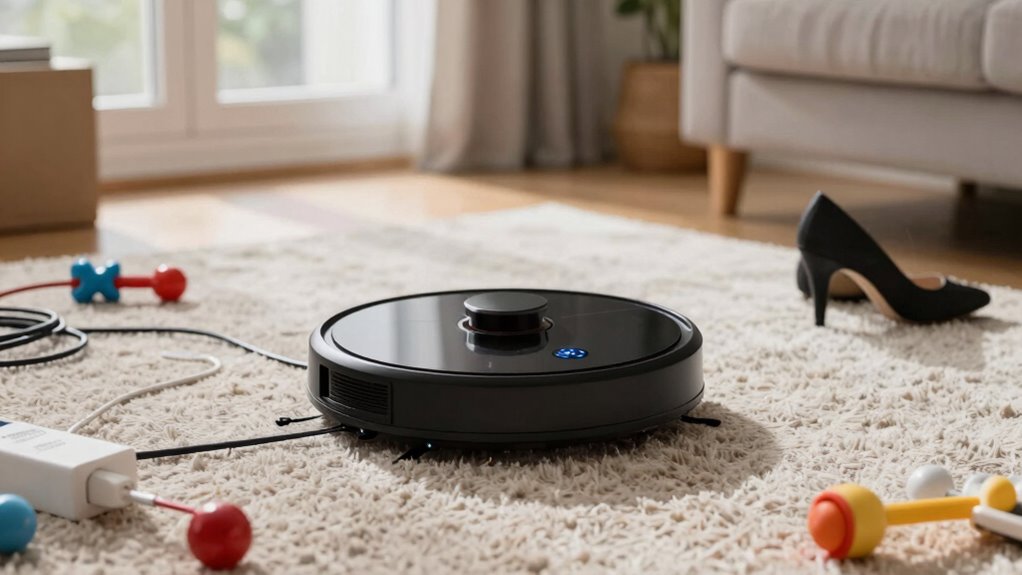
Have you ever wondered about the limitations of AI in obstacle avoidance? While AI has improved, it’s not perfect. Here are some key challenges:
- Mapping accuracy can falter in cluttered or dynamic environments, leading to missed obstacles.
- Limited battery endurance restricts how much the AI can scan and adapt in one charge.
- Small or transparent objects might evade detection altogether.
- Rapidly changing layouts can confuse the system, causing navigation errors.
- Light conditions and reflections can distort sensor data, reducing obstacle recognition reliability.
These factors mean AI isn’t foolproof. It struggles with precise mapping, especially in complex spaces, and has constraints due to battery life, impacting its ability to continuously improve obstacle avoidance performance.
How Your Home’s Layout Affects AI Navigation Performance?
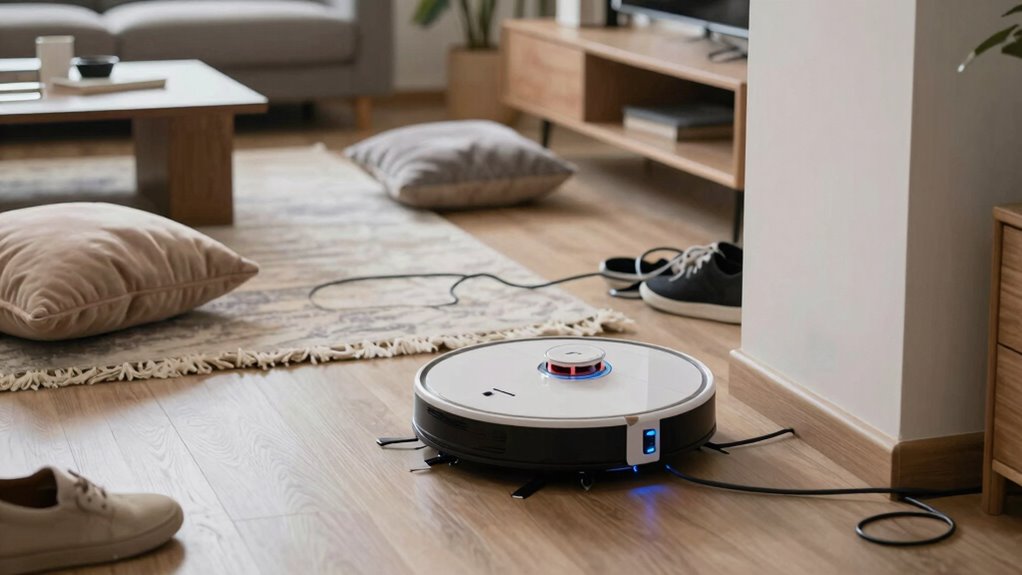
Your home’s layout plays a big role in how well your robot vacuum navigates. Variations in floor types, furniture placement, and narrow spaces can challenge its sensors and algorithms. Understanding these factors helps you optimize your space for better AI performance.
Floor Type Variability
Different floor types can substantially impact how well a robot vacuum navigates your home. Hard floors like tile or hardwood allow smooth movement, making dirt detection easier and conserving battery life. Conversely, thick carpets or rugs challenge the AI’s obstacle avoidance, requiring the vacuum to adjust suction power and navigation strategies. Variability in floor surfaces affects how effectively your robot detects dirt and manages its battery, especially during longer cleaning sessions.
Consider these factors:
- Carpet fibers can obscure dirt, making detection harder
- Hard floors enable better sensor accuracy for navigation
- Multiple surface shifts can confuse AI mapping
- Thick rugs may cause the vacuum to slow down or stop
- Consistent flooring reduces navigation errors and improves efficiency
Furniture Arrangement Impact
The layout of furniture in your home directly influences how effectively a robot vacuum can navigate and clean. A well-organized furniture arrangement creates clear pathways, allowing obstacle placement to be minimal and predictable. When furniture is arranged haphazardly or tightly packed, the robot’s sensors and AI struggle to differentiate between obstacles, leading to missed spots or repeated bumping. Strategic placement of larger furniture pieces can help the vacuum map your space more accurately, improving overall efficiency. Conversely, cluttered or irregular furniture setups increase navigation difficulty, causing the AI to slow down or get stuck. Understanding how your furniture arrangement impacts obstacle placement helps you optimize your home’s layout, ensuring your robot vacuum performs at its best.
Narrow Space Challenges
Narrow spaces in your home can substantially challenge a robot vacuum’s navigation and cleaning efficiency. These narrow space challenges often hinder smooth movement, especially in tight corridor navigation. When hallways or between furniture are too cramped, the vacuum may get stuck or miss spots. AI struggles with precise maneuvering in tight gaps, reducing cleaning coverage. To improve performance, consider decluttering or rearranging furniture to create more room. Additionally, some vacuums now feature sensors that better detect and adapt to confined spaces. Properly addressing these narrow space challenges ensures your robot can navigate efficiently without getting trapped or missing debris. The key is understanding your home’s layout and choosing a model with advanced navigation tailored for tight spaces.
Which Level of AI Is Right for Your Cleaning Needs?

Are you wondering which level of AI best suits your cleaning routine? The right AI depends on your home’s needs and your expectations. Basic AI models use simple sensor calibration to navigate open spaces, making them suitable for straightforward cleaning tasks. If your home has cluttered areas or narrow spaces, advanced AI with better obstacle avoidance can adapt more efficiently. Keep in mind that higher AI levels often require more processing power, which can impact battery life. If you prefer quick, routine cleanings, a model with moderate AI features might suffice. For deep cleaning and complex layouts, investing in a robot vacuum with sophisticated AI ensures thorough coverage and smarter navigation, saving you time and effort in the long run.
Frequently Asked Questions
How Does AI Differ Between Budget and Premium Robot Vacuums?
You’ll notice that AI in premium robot vacuums offers better mapping accuracy and obstacle recognition than budget models. Premium models actively learn your space, creating detailed maps to optimize cleaning paths, while budget ones rely on basic sensors. This means your high-end vacuum avoids obstacles more effectively and covers areas more thoroughly. If you want smarter cleaning, investing in a premium robot vacuum with advanced AI features makes a noticeable difference.
Can AI Improve Obstacle Detection Over Time?
While it might seem like a simple upgrade, AI in robot vacuums actually evolves through machine learning, gradually enhancing obstacle detection. Over time, your device refines its sensor calibration, making it better at recognizing objects and maneuvering tricky spaces. This continuous improvement means your vacuum becomes smarter, more efficient, and less likely to bump into things, providing a smoother cleaning experience as it learns from each encounter.
What Maintenance Is Required for AI Sensors?
You need to regularly clean dust from your AI sensors to keep them functioning properly. Sensor calibration is also essential; follow your robot vacuum’s instructions for recalibrating sensors when you notice missed obstacles or inaccurate detection. By maintaining clean sensors and recalibrating when needed, you guarantee your robot’s AI continues to perform at its best, avoiding obstacles effectively and prolonging its lifespan.
Do AI Robot Vacuums Learn Your Home’s Layout Automatically?
Think of your robot vacuum like a curious explorer. It can learn your home’s layout automatically, improving its mapping accuracy over time. As it navigates, it uses sensor calibration to refine its understanding, ensuring thorough cleaning. With each run, it remembers where furniture and obstacles are, making future passes more efficient. So yes, your AI robot vacuum learns your home’s layout, becoming smarter and more precise with every cleaning adventure.
How Secure Is Data Collected by AI in Robot Vacuums?
Your data collected by AI in robot vacuums is generally secure thanks to data encryption, which protects your privacy. However, privacy concerns still exist, especially if the manufacturer shares data or experiences a security breach. To stay safe, choose brands with strong security measures and clear privacy policies. Regularly update your device’s software to guarantee maximum protection and minimize risks related to your personal information.
Conclusion
Understanding the true capabilities of AI in robot vacuums helps you choose the right one for your home. For example, if you have a cluttered space, a model with advanced sensors and machine learning can adapt and avoid obstacles more effectively. Remember, no robot is perfect, but knowing AI’s limits guarantees you set realistic expectations. With the right features, your vacuum can keep your home cleaner and more efficient, making life easier.