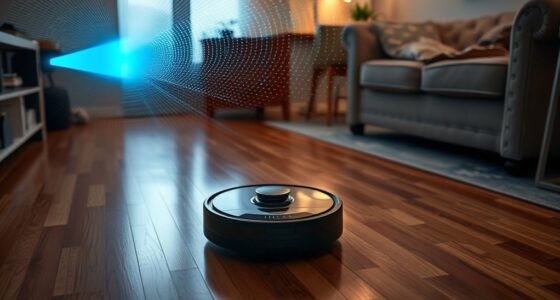

Object recognition in robot vacuums helps you avoid obstacles by using calibrated sensors like lidar, infrared, or ultrasonic detectors. These sensors accurately identify static objects, such as furniture, and dynamic ones like pets or people, updating maps in real time. Proper calibration guarantees the sensors detect obstacles precisely, preventing collisions and missed spots. This seamless detection allows your vacuum to navigate smoothly and clean efficiently. Keep exploring to discover how calibration and mapping work together for peak performance.
Key Takeaways
- Accurate sensor calibration is essential for reliable obstacle detection and avoidance.
- Obstacle mapping creates real-time environmental layouts to navigate around static and dynamic objects.
- Differentiating static from moving objects helps robots adapt their paths and prevent collisions.
- Integration of calibration and mapping ensures precise navigation and thorough cleaning coverage.
- Proper object recognition enhances efficiency by enabling the robot to avoid obstacles and optimize routes.
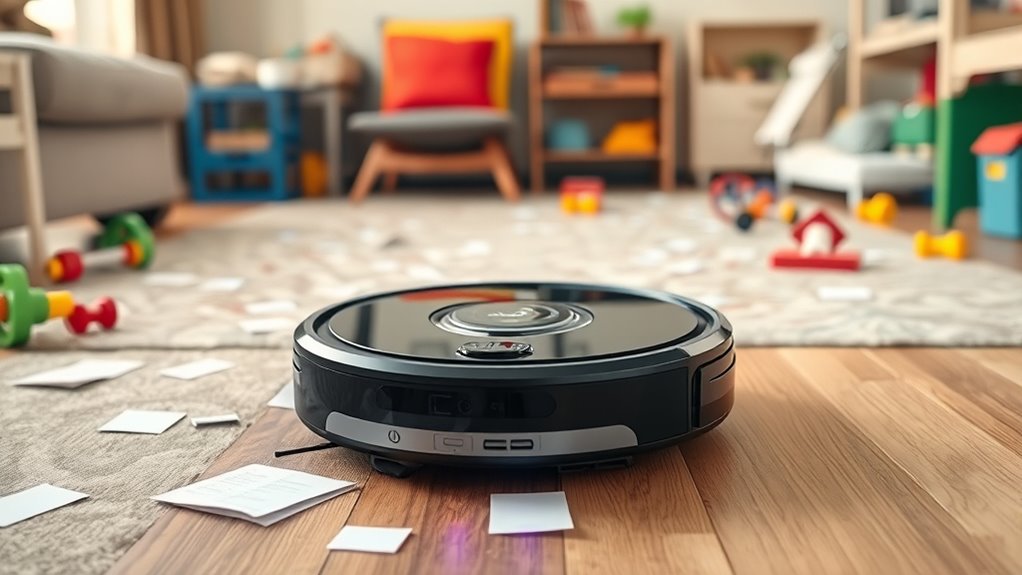
Have you ever wondered how robot vacuums can steer through your home so efficiently? It often seems like they have an uncanny ability to dodge furniture, avoid walls, and clean every corner without human intervention. The secret lies in their advanced object recognition capabilities, which depend heavily on sensor calibration and obstacle mapping. Proper sensor calibration ensures that the robot’s sensors provide accurate readings, which is fundamental for reliable navigation. When sensors are properly calibrated, the vacuum can interpret distances and detect objects with precision, reducing the risk of collisions or missed spots. Faulty calibration might cause the robot to misjudge obstacles or ignore certain areas, so maintaining this calibration is key to effective object recognition.
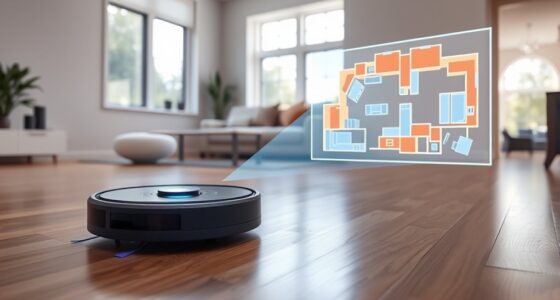
Obstacle mapping is another critical component. Once the sensors are correctly calibrated, the robot begins to build a detailed map of its environment. Using data from infrared, ultrasonic, or lidar sensors, it creates a real-time map that highlights the location of furniture, walls, and other objects. This map isn’t static; it constantly updates as the robot moves, allowing it to adapt to changes like moved furniture or new obstacles. When the robot encounters a new object, it analyzes its shape, size, and position, updating its map accordingly. This process helps it plan the most efficient cleaning route while avoiding obstacles confidently.
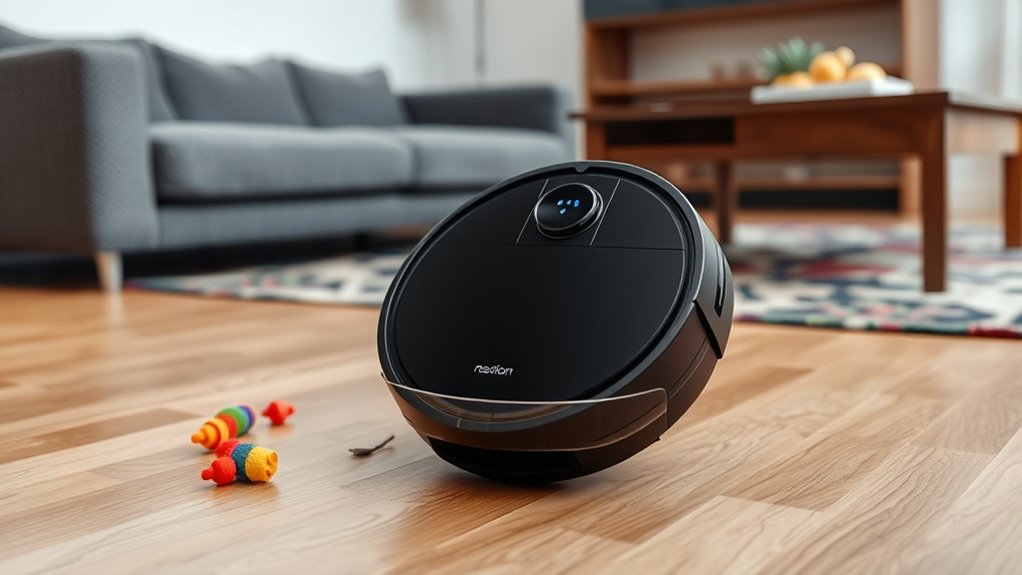
The integration of sensor calibration and obstacle mapping allows your robot vacuum to distinguish between static and dynamic objects. Static objects, like furniture, are mapped and avoided consistently, while dynamic objects, like pets or humans, are detected in real-time and steered around. As the robot recognizes these obstacles, it adjusts its path seamlessly, preventing collisions and ensuring thorough cleaning. These systems also enable the vacuum to recognize different types of objects; for instance, it can identify a cable or a pair of slippers and decide whether to go around or carefully maneuver over or past them.
In essence, your robot’s ability to recognize objects and avoid obstacles hinges on finely tuned sensors and sophisticated obstacle mapping algorithms. Regularly checking and recalibrating sensors helps maintain accuracy, while the obstacle mapping process ensures your vacuum intelligently navigates your space. Additionally, properly sensor calibration can prevent inaccurate readings that might otherwise lead to missed spots or collisions. This combination allows for a smooth, efficient cleaning experience, minimizing mishaps and maximizing coverage. It’s this seamless integration of sensor calibration and obstacle mapping that makes your robot vacuum not just a device, but a smart assistant capable of navigating your home with impressive precision.
Frequently Asked Questions
How Do Robot Vacuums Distinguish Between Pets and Furniture?
You can help your robot vacuum distinguish between pets and furniture through pet identification and furniture differentiation. The vacuum uses sensors and cameras to recognize movement, shapes, and sizes, allowing it to identify pets compared to stationary furniture. When it detects a pet, it adjusts its cleaning path or avoids the area altogether. Regularly updating the vacuum’s software also improves its ability to accurately distinguish between pets and furniture.
Can Object Recognition Adapt to New or Moved Objects Over Time?
Think of your robot vacuum as a curious explorer that learns as it navigates. Yes, it adapts to new or moved objects through adaptive learning and environmental mapping. Over time, it updates its mental map, like a seasoned sailor adjusting to shifting tides. This continuous learning helps it recognize changes, avoid obstacles, and keep your space tidy, making each cleaning session smarter and more efficient than the last.
What Are the Limitations of Current Object Detection Technologies?
You should know that current object detection technologies face limitations due to sensor accuracy and algorithm constraints. Sensors might misjudge distances or miss objects in poor lighting, while algorithms can struggle with complex or cluttered environments. These issues can cause your robot vacuum to miss obstacles or react late, reducing efficiency. Continuous improvements are ongoing, but these inherent limitations still challenge perfect obstacle avoidance and recognition.
How Do Robot Vacuums Handle Transparent or Reflective Objects?
You might think the robot vacuum has a crystal ball, but transparent challenges and reflective surfaces still trip it up. These surfaces confuse sensors, causing missed or false detections. To tackle this, newer models use advanced cameras and smarter algorithms to better interpret reflective surfaces and transparent objects. While they’re getting better, you still might need to manually guide or clear tricky areas for ideal cleaning.
Are There Privacy Concerns With Robot Vacuum Cameras?
Yes, there are privacy concerns with robot vacuum cameras. You might worry about camera privacy and data security since these devices collect images and videos of your home. To protect yourself, guarantee your vacuum has secure data encryption and privacy settings. Regularly update its firmware, and review privacy policies. Being aware of how your data is stored and shared helps you maintain control and keeps your home secure.
Conclusion
In the end, mastering object recognition turns your robot vacuum into a vigilant guardian, constantly aware of its surroundings. With advanced sensors and smart algorithms, it’s like giving your device eyes and ears, ensuring obstacles never catch it off guard. As the saying goes, “a stitch in time saves nine”—early obstacle detection keeps your floors spotless and your device safe. Embrace these innovations, and watch your robot become a true obstacle-avoiding marvel.