This checklist is for homeowners who want to make more informed choices about home energy use while reviewing appliances and controls. It covers options for heating and cooling, hot water, cooking, moisture management, laundry, and monitoring electricity use. Treat each pick as a starting point for checking whether a product suits your home—not as a guarantee of energy savings.

Get home appliances delivered free with Prime
- Fast, free delivery on millions of items
- Prime Video, Amazon Music and more included
- Member-only deals all year
The checklist is organized by appliance category, with a selected product name, what to look for, and a quick fit assessment for each slot. Some product names may describe a different kind of equipment than the category heading, so verify the product type and specifications before buying. Confirm exact model details with the manufacturer or seller.
Use the checklist by first identifying your home’s needs, then checking dimensions and compatibility, installation requirements, and the product’s stated features. For major equipment, consult a qualified professional about your home’s systems and electrical or plumbing setup. Compare candidates using the same requirements, and prioritize a correct fit over a feature you are unlikely to use.
Smart Thermostat
A thermostat can be a useful place to start when reviewing home comfort controls because it sits between your heating and cooling equipment and the people using it. The Honeywell T10+ Pro Smart Thermostat with RedLINK 3.0 Indoor Air Sensor names both a smart thermostat and an indoor air sensor, making those the first features to investigate. Check the exact model documentation to understand what is included, how the sensor works with the thermostat, and whether the functions match your household’s needs.
A common mistake is choosing a thermostat based on its smart features without checking system compatibility. Before purchase, identify your existing equipment and wiring, then confirm support with the manufacturer or a qualified installer. Also check the thermostat’s physical dimensions, placement requirements, and any app, network, or account requirements. If you want to use an indoor sensor, consider where it can be placed and whether that location represents the room or area you want to monitor. Do not assume a thermostat will control every system type or accessory simply because it is described as smart; confirm the supported configuration for the exact model.
What to look for:
- Confirm compatibility with your existing heating and cooling system.
- Verify whether the indoor air sensor is included and supported by the exact model.
- Check wiring and installation requirements before purchase.
- Review placement guidance for the thermostat and sensor.
- Confirm any app, network, or account requirements.
Honeywell T10+ Pro Smart Thermostat with RedLINK 3.0 Indoor Air Sensor
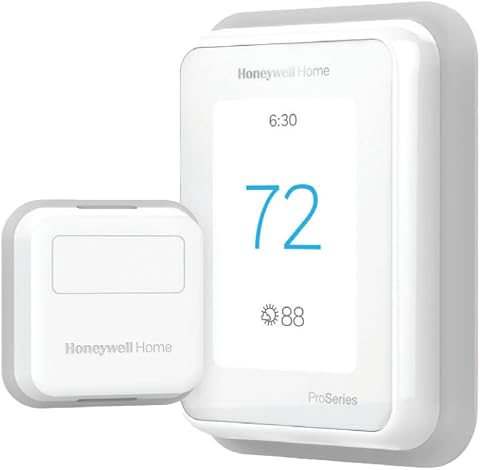
The Honeywell T10+ Pro Smart Thermostat Kit offers customizable room-by-room heating and cooling control with a 7-day programmable touchscreen. It supports RedLINK 3.0 integration for up to 20 indoor sensors to monitor temperature, humidity, and motion, enabling smart scheduling and geofencing capabilities.
Pros:
- Supports up to 20 RedLINK 3.0 sensors for precise room-by-room temperature and humidity control
- Features geofencing technology to automatically adjust temperatures based on smartphone location
- Compatible with a wide range of 24 VAC systems including heat pumps and dual fuel
- Easy integration of humidification and ventilation accessories without running new wires
Cons:
- Requires specific compatible sensors (C7189R3002 or C7189R2002) for full functionality
- Some advanced features like 4-heat support require additional EIM module
Best for: Homes seeking a smart thermostat and indoor sensor in one product family.
Not ideal for: Buyers who have not confirmed system or wiring compatibility.
Bottom line: Check the exact model’s compatibility and sensor details before choosing this thermostat.
Heat Pump Water Heater
The listed pick for this slot is the Goodman GPH1460H41 14 SEER Packaged Heat Pump, R-410A, 5 Tons. Its name describes a packaged heat pump, not a water heater, so it should not be treated as a heat pump water heater without confirmation from the manufacturer. That mismatch matters: water heating and space conditioning are different jobs, with different connections, installation needs, and sizing considerations. Begin by checking the exact model and intended application rather than relying on the category heading.
A frequent buying mistake is assuming that a product containing the words “heat pump” can serve any heat-pump-related purpose. For a water-heating purchase, verify that the model is specifically designed to heat water and that its capacity and installation requirements suit the household. For this named product, confirm whether it is instead intended for a space-conditioning system, and consult an HVAC professional about the home’s equipment and configuration. Check model documentation for required electrical, refrigerant, duct, and placement details as applicable. Do not order by category alone: match the product’s actual function to the job you need done, and resolve the product-category mismatch before comparing options.
What to look for:
- Confirm whether this exact model is intended for water heating or space conditioning.
- Match the product’s stated function to the appliance slot you need to fill.
- Verify model number and specifications with the manufacturer or seller.
- Ask a qualified professional to assess system and installation compatibility.
- Do not assume a heat pump for one application can replace equipment for another.
Goodman GPH1460H41 14 SEER Packaged Heat Pump, R-410A, 5 Tons

This Goodman packaged heat pump offers 14 SEER efficiency, R-410A refrigerant, and a 5-ton capacity. It is designed for reliable, long-lasting performance in heating and cooling applications.
Pros:
- High efficiency with 14 SEER rating
- Reliable and long-lasting performance
- Suitable for heating and cooling
Cons:
- Limited detailed features provided
- No price or customer ratings available
Best for: Shoppers who can confirm this model’s intended application before proceeding.
Not ideal for: Anyone seeking a water heater without verifying that this is one.
Bottom line: The listed name describes a packaged heat pump, so confirm its purpose before considering it for water heating.
Induction Cooktop
The Portable 1800W Induction Cooktop with 9 Power Levels identifies itself as a portable induction cooking option and lists its wattage and power levels. Those details give shoppers a useful starting point, but they do not establish what cookware it supports, how large its cooking surface is, or what electrical setup it requires. Check the product documentation for those specifics and consider how you plan to use it—such as as a secondary cooking surface or as part of a temporary setup.
A common mistake is buying an induction cooktop before checking cookware compatibility. Confirm that your pots and pans are suitable for induction according to the cooktop’s instructions, and compare the cooking area with the size of cookware you regularly use. Also check the unit’s footprint, ventilation and clearance guidance, cord and outlet requirements, and the manufacturer’s instructions for cleaning and operation. The listed 1800W figure should be considered alongside your home’s available outlet and intended use; do not assume any outlet or circuit is appropriate without checking the manual. Fit and electrical requirements are more important than choosing a specific number of power levels if the cooktop cannot work safely and conveniently in your intended location.
What to look for:
- Check cookware compatibility in the manufacturer’s instructions.
- Compare cooking-surface dimensions with your usual cookware.
- Verify electrical and outlet requirements for the intended location.
- Review clearance, ventilation, and operating guidance.
- Consider whether the portable footprint suits your available counter or storage space.
Portable 1800W Induction Cooktop with 9 Power Levels

This portable countertop induction cooktop offers 9 power levels from 200W to 1800W, controlled with touch buttons and a slider. It features a 3-hour timer, a large LED display, and a child safety lock, with a compact white design for kitchens, dorms, RVs, and other spaces.
Pros:
- Nine power levels for flexible cooking
- Timer stops heating when the set time is reached
- Child lock helps prevent accidental operation
- Compact design suits kitchens, dorms, and RVs
Cons:
- Requires magnetic induction-compatible cookware
Best for: Shoppers looking for a portable cooktop and willing to confirm cookware fit.
Not ideal for: Anyone who needs a built-in cooktop or has not checked electrical requirements.
Bottom line: Verify cookware, dimensions, and outlet requirements before choosing this portable induction cooktop.
ENERGY STAR Dehumidifier
The listed product is the ZAFRO 7500 Sq.Ft Dehumidifier for Basement, Max 150 Pints/Day, Energy. Its name includes a stated coverage area and maximum daily capacity, but the name ends after “Energy,” so the full product description and certification status are not clear from the provided wording. Do not infer that it is ENERGY STAR certified from the category heading or the partial product name. Check the exact model listing and official documentation for its full name, specifications, and any certification information.
For a dehumidifier, shoppers should first consider the space and the moisture problem they want to address. Compare the room or basement area with the manufacturer’s stated coverage guidance, and verify what conditions the listed capacity refers to. Common mistakes include assuming a coverage figure guarantees performance in every home, overlooking drainage and placement needs, or selecting a unit without checking its controls and operating instructions. Review dimensions, reservoir or drainage arrangements, noise information if provided, and the manufacturer’s care requirements. If ENERGY STAR status is important to your checklist, verify certification for the exact model using a reliable official source rather than relying on a category label or incomplete product title.
What to look for:
- Confirm the full product name and exact model number.
- Verify ENERGY STAR certification for the exact model if required.
- Compare the stated coverage guidance with the room or basement conditions.
- Check capacity details and the conditions used for that rating.
- Review drainage, placement, dimensions, and maintenance instructions.
ZAFRO 7500 Sq.Ft Dehumidifier for Basement, Max 150 Pints/Day, Energy Star
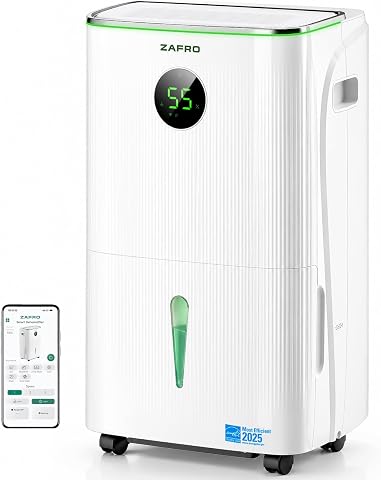
The ZAFRO dehumidifier is designed for large spaces up to 7500 sq.ft., effectively removing up to 150 pints of moisture per day. It features energy-efficient operation, smart WiFi control, multiple modes, and a large water tank for continuous use, making it suitable for basements, living areas, and humid environments.
Pros:
- Powerful dehumidification suitable for large spaces up to 7500 sq.ft.
- Energy-efficient operation with low noise levels (40 dB)
- Smart WiFi control and customizable modes for convenience
- Large water tank with continuous drainage option
Cons:
- May be bulky for smaller spaces
- Complex features might require some setup time
- Higher initial cost due to advanced features
Best for: Shoppers who can verify the exact model and its certification status.
Not ideal for: Anyone relying on the category heading alone as proof of certification.
Bottom line: Check the full listing and verify certification for this exact dehumidifier before buying.
Heat Pump Clothes Dryer
The Samsung 5.3 cu. ft. Bespoke AI Laundry Ventless Heat Pump Dryer Combo is described in its name as a ventless heat pump dryer combo. That makes it important to verify exactly which laundry functions the product includes and how the unit is configured; the word “combo” should not be taken as a substitute for model documentation. Check the full model number, product dimensions, and installation guide so you know whether it fits your laundry space and meets the household’s laundry needs.
One common mistake is focusing on capacity while overlooking the machine’s footprint, access route, and utility requirements. Measure the intended location, including clearance for doors, hoses, and service access, and check that the product can be moved through hallways and doorways. Review the manufacturer’s instructions for electrical connection, water or drain connections if applicable, venting, and installation. Confirm the stated capacity and cycle features for the exact configuration, and make sure the product’s laundry functions match what you expect from a dryer combo. Measure before ordering, and ask the seller or installer to resolve any uncertainty about setup, connections, or included components.
What to look for:
- Verify the exact model number and included laundry functions.
- Measure the installation space and delivery path.
- Check electrical, water, drainage, and installation requirements in the manual.
- Confirm clearance and service-access needs.
- Review capacity and cycle details for the exact configuration.
Samsung 5.3 cu. ft. Bespoke AI Laundry Ventless Heat Pump Dryer Combo All-in-One

The Samsung Bespoke AI Laundry Ventless Combo combines a washer and dryer in one compact unit, offering fast 98-minute cycles with intelligent AI wash and dry detection. It features a ventless heat pump dryer, auto dispense system, and easy installation with a standard 120V outlet, making laundry more efficient and space-saving.
Pros:
- All-in-one washer and dryer saves space and time
- Fast cycle completion in just 98 minutes
- Vented-less heat pump drying for easy installation anywhere
Cons:
- Requires water line and drain hose installation
- Limited to standard 120V outlets, may not suit all homes
- Potentially higher upfront cost compared to traditional units
Best for: Shoppers considering a ventless heat pump dryer and able to confirm installation fit.
Not ideal for: Homes with limited installation access or unverified utility connections.
Bottom line: Confirm the exact combo functions, measurements, and connections before arranging installation.
Smart Power Strip
The listed pick is the Emporia Vue 3 Home Energy Monitor – Real-Time Electricity Usage and Po. The provided name describes a home energy monitor, but it is cut off and does not establish that the product is a smart power strip. These devices serve different roles: a monitor is intended to help observe electricity use, while a power strip is used to connect multiple devices. Check the complete product name and model documentation before deciding whether this item belongs in the power-strip slot.
A common buying mistake is assuming that all products associated with electricity monitoring can switch or control devices like a smart power strip. Verify the product’s actual function, installation method, compatibility requirements, and whether it monitors whole-home usage or individual connected loads. If your goal is to manage devices at a plug, confirm that the product is specifically a power strip and check its outlets, controls, and electrical ratings. If your goal is broader energy monitoring, check the monitor’s installation requirements and compatibility with your home’s electrical panel or other specified setup. Match the tool to the task before purchasing, and have electrical work assessed by a qualified professional when needed.
What to look for:
- Confirm the complete product name and exact model number.
- Verify whether it is a home energy monitor or a smart power strip.
- Check installation and electrical compatibility requirements.
- For a power strip, confirm outlet count, controls, and ratings.
- For a monitor, verify what usage it tracks and how it connects.
Emporia Vue 3 Home Energy Monitor – Real-Time Electricity Usage and Power Consum

The Emporia Vue 3 is a UL-listed home energy monitor that provides real-time energy data and supports solar and net metering. It installs in the circuit panel and helps users automate and manage energy consumption to reduce costs and improve safety.
Pros:
- UL-certified for safety and reliability
- Supports real-time energy monitoring and automation
- Includes multiple sensors for critical load monitoring
- Compatible with iPhone, Android, and web apps
Cons:
- Requires Wi-Fi connection for full functionality
- Additional sensor needed for 3-phase systems with earthed neutral
- Data retention limited to 7 days for 1-minute intervals
Best for: Shoppers who first determine whether they need monitoring or plug-level control.
Not ideal for: Anyone expecting a power strip based only on this category heading.
Bottom line: The listed name identifies an energy monitor, so confirm the product type before buying.
For a budget-first buying order, start with the need that affects your home most, then confirm that the listed product actually serves that purpose. Resolve the water-heater and power-strip category mismatches first, verify the dehumidifier’s full model and certification, and check compatibility before moving on to installation planning for major equipment. Add costs only after confirming the right product and any required professional work.
You do not need to replace every appliance at once. Use this checklist to verify fit, function, and requirements one decision at a time, and rely on exact model documentation when a product name is incomplete or unclear. With careful measuring and compatibility checks, you can build a more suitable appliance plan for your home.