
TL;DR

Get home appliances delivered free — and shop member deals
- Fast, free delivery on millions of items
- Access to Prime Big Deal Days deals on October 6–7
- Prime Video, Amazon Music and more included
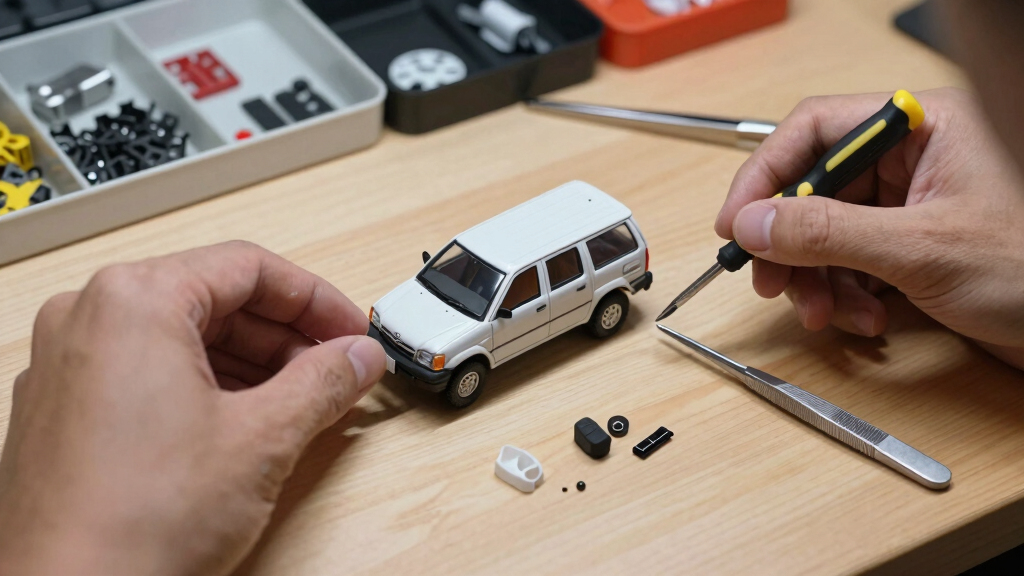
A hobbyist has successfully built a 1:150 scale Toyota ProBox remote control car featuring working lights, steering, and driving functions. The project uses miniature motors, salvaged watch gears, and infrared remote control. This development showcases advanced micro-model engineering for scale model enthusiasts.
A hobbyist has built a fully functional 1:150 scale Toyota ProBox remote control car, equipped with working lights, steering, and driving capabilities. This project highlights advances in micro-model engineering and remote control technology, making it a notable development for scale model enthusiasts and hobbyists.
The project involves converting a miniature Toyota ProBox model into a remote-controlled vehicle with detailed operational features. The builder installed a tiny 25 mAh Li-polymer battery, two small motors for steering and driving, and used gears salvaged from mechanical watches. Position tracking is managed via photoreflectors, and the car is controlled through an infrared SMD receiver module. Powering and programming are facilitated through terminals on the bottom of the model.
In a demonstration video, the car successfully navigates a miniature track, with operational headlamps, tail lights, blinkers, and stop lights, including a rear top light. Schematics and software for the project are publicly available via links provided by the builder, encouraging others to replicate or build upon the design.
Micro-Scale Engineering Advances in RC Models
This development exemplifies how hobbyists are pushing the boundaries of micro-scale engineering, integrating complex functions like lighting and precise control into tiny models. It highlights potential for more realistic, functional scale models in educational, entertainment, and display contexts, inspiring innovation in miniature robotics and remote control technology.
As an affiliate, we earn on qualifying purchases.
Progress in Miniature Remote Control Vehicles
Recent years have seen increased interest in micro remote control models, with enthusiasts exploring miniature motors, gears, and control systems. Previous projects include small-scale cars with basic movement, but the current build demonstrates full operational features, including lighting and precise steering, at a 1:150 scale. The use of salvaged watch gears and simple infrared control signals reflects ongoing efforts to make micro-models more functional and accessible for hobbyists.
“This project showcases the potential for highly detailed, functional micro RC vehicles using readily available components and innovative engineering techniques.”
— an anonymous researcher
As an affiliate, we earn on qualifying purchases.
Remaining Technical Challenges and Limitations
It is not yet clear how durable or scalable this micro-assembly is for long-term use or mass production. Details about the stability of the electronics and the potential for adding more features remain unconfirmed. The builder has not disclosed the full extent of the software control system or the limits of the current prototype.
As an affiliate, we earn on qualifying purchases.
Future Improvements and Community Engagement
The builder plans to refine the design for increased durability and additional features, such as more advanced sensors or autonomous functions. Further testing and community sharing of schematics and software are expected to encourage replication and innovation among hobbyists. Upcoming steps include documenting the build process more comprehensively and exploring ways to miniaturize components further.
As an affiliate, we earn on qualifying purchases.
Key Questions
How difficult is it to build a 1:150 scale RC car like this?
Building such a micro RC car requires advanced microelectronics skills, familiarity with small-scale motors, and access to miniature components. It is suitable for experienced hobbyists with technical knowledge in electronics and mechanical assembly.
What materials are used in constructing this tiny vehicle?
The project uses salvaged watch gears for gears, a small Li-polymer battery, tiny motors, photoreflectors for position sensing, and infrared modules for remote control. The chassis and body are scaled-down models of the Toyota ProBox.
Can this micro RC car be operated outdoors?
While the prototype demonstrates indoor operation, outdoor use may be limited due to its small size and sensitivity to environmental factors like wind and uneven surfaces. Further testing is needed to confirm outdoor viability.
Are the schematics and software for this build publicly available?
Yes, the builder has provided links to schematics and software on Google Drive, encouraging others to replicate or modify the design.
What are the potential applications of such micro-scale RC vehicles?
Potential applications include educational tools, miniature displays, robotics research, and hobbyist projects exploring micro-mechanics and control systems.
Source: Hackaday
NFL season / tailgating Picks
team gear
As an affiliate, we earn on qualifying purchases.