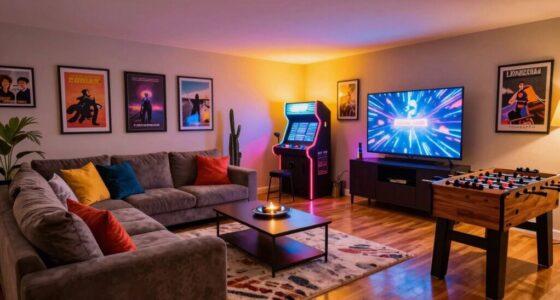
To create true immersion, position your front speakers at about 22-30 degrees toward your listening spot and make certain they are at ear level. Place rear surround speakers slightly behind and to the sides at around 110 degrees, facing inward. Overhead and Atmos speakers should be just above ear level, aimed carefully for height cues. Paying attention to angles, placement, and calibration is key—continue exploring to master perfect surround sound setup.

Get home appliances delivered free — and shop member deals
- Fast, free delivery on millions of items
- Access to Prime Big Deal Days deals on October 6–7
- Prime Video, Amazon Music and more included
Key Takeaways
- Position front left and right speakers at 22-30 degrees toward the listening spot for balanced sound and immersion.
- Place surround speakers at 100-110 degrees behind and to the side, facing toward the listening area for accurate imaging.
- Align tweeters at ear level when seated, tilting speakers slightly for optimal sound dispersion.
- Use an equilateral triangle setup with the listening position and speakers for natural soundstage and depth.
- Calibrate speaker angles and levels regularly to fine-tune immersion and ensure precise surround sound.
surround sound speaker placement kit
As an affiliate, we earn on qualifying purchases.
As an affiliate, we earn on qualifying purchases.
Why Proper Speaker Angles Are Key to Immersive Surround Sound

Proper speaker angles are essential because they determine how sound waves reach your ears, creating a realistic and immersive experience. When you calibrate your speakers correctly, you guarantee each sound is precisely directed, enhancing clarity and depth. Acoustic treatment also plays a vital role by minimizing reflections and echoes that can distort audio. By angling your speakers properly, you optimize the interaction between these treatments and the sound waves, resulting in a balanced, natural soundstage. This setup helps you perceive audio as intended, with clear separation and accurate positioning of effects. Without proper angles, even the best calibration and acoustic treatments can fall short, leading to a flat or distracting listening environment. Attention to speaker angles is crucial for achieving the true surround sound immersion you’re aiming for. Additionally, understanding speaker placement principles can further refine your setup for optimal audio performance, ensuring a more cohesive and realistic listening experience.
home theater speaker calibration tools
As an affiliate, we earn on qualifying purchases.
As an affiliate, we earn on qualifying purchases.
How to Position Your Front Left and Right Speakers for Best Effect

To get the best sound, you need to position your front left and right speakers at the right angles. Keep their placement symmetrical and at ear level for even sound distribution. Proper positioning enhances clarity and creates a balanced, immersive listening experience.
Optimal Speaker Angles
Achieving the best sound experience depends heavily on how you angle your front left and right speakers. Proper speaker angles ensure ideal soundstage and clarity. Keep these tips in mind:
- Angle speakers at approximately 22-30 degrees toward your listening position for immersive effects.
- Position speakers at ear level, considering speaker height relative to your seated position.
- Account for room acoustics by avoiding reflections; use soft furnishings to absorb unwanted sound.
- Maintain equal distance from the listening spot to each speaker for balanced sound.
- Remember that room acoustics can significantly influence sound quality, so consider integrating acoustic treatments into your space.
- To optimize your setup further, consider speaker placement techniques that enhance overall audio performance.
Symmetry and Placement
Positioning your front left and right speakers symmetrically creates a balanced soundstage that enhances your listening experience. Achieving good speaker symmetry ensures that sound reaches your ears evenly, preventing one side from overpowering the other. Proper placement balance is key: position your speakers at equal distances from your listening position, ideally forming an equilateral triangle with you. Keep both speakers at the same height and angle them slightly inward for ideal imaging. Avoid skewed placement, which can lead to a cluttered or imbalanced sound. With symmetrical positioning, you’ll notice clearer stereo separation and better immersion, making your audio environment more engaging and accurate. Consistent speaker symmetry and thoughtful placement are essential for a truly immersive surround sound experience. Additionally, regularly checking for equipment calibration helps maintain optimal sound quality. Ensuring your room acoustics are optimized can further improve sound clarity and immersion, and incorporating acoustic treatment can help control reflections for even better results. Proper speaker placement is fundamental to achieving a realistic and immersive audio experience, and understanding how sound waves interact with your space can aid in fine-tuning your setup.
height adjustable bookshelf speakers
As an affiliate, we earn on qualifying purchases.
As an affiliate, we earn on qualifying purchases.
Placing and Aligning Rear Surround Speakers for Full Envelopment

To achieve full envelopment, you need to place your rear surround speakers at the perfect height and distance from your seating area. Ensuring they are aligned at the precise angles will create a seamless sound field. Proper placement and alignment are key to immersing yourself in the surround experience. Additionally, using mount leveling kits can help maintain optimal speaker positioning and prevent misalignment over time. Regularly verifying speaker alignment ensures consistent sound quality and optimal immersion during your viewing sessions. Furthermore, adopting sound calibration techniques can fine-tune your system for more accurate and immersive audio performance. Consider also speaker placement techniques to enhance the overall surround sound effect and achieve a more natural, immersive environment.
Optimal Rear Placement
For ideal rear surround sound, placing and aligning your speakers carefully is essential to create a seamless and immersive listening experience. To achieve this, consider these key points:
- Position your rear speakers slightly behind and to the side of your listening area, aiming for a 110-120 degree angle.
- Keep the speakers at ear level for clear sound imaging.
- Adjust the rear speaker angles to avoid direct sound hitting listeners, preventing harshness.
- Pay attention to subwoofer placement, ensuring it doesn’t interfere with rear speaker positioning for balanced bass.
- Regularly check and maintain your speakers to prevent issues like warp that can affect sound quality.
- Proper placement enhances full envelopment, while strategic subwoofer positioning complements surround sound effects.
Focusing on speaker calibration techniques can further optimize your sound environment for a truly immersive experience.
Precise Angle Alignment
Achieving full envelopment relies heavily on precisely aligning the angles of your rear surround speakers. Proper speaker calibration ensures they are positioned at the correct height and angle, creating seamless sound immersion. Use a protractor or a calibration tool to set each speaker’s angle accurately, typically between 100° and 110° from your listening position. Acoustic treatments, like diffusers or absorbers, can reduce reflections that interfere with accurate sound delivery, enhancing clarity. Confirm the speakers face directly toward your listening area minimizes phase issues and maintains sound coherence. Regular calibration checks help maintain ideal alignment over time, especially after rearranging furniture or upgrading equipment. Additionally, understanding the Free Floating concept can help optimize your speaker placement by minimizing unwanted vibrations and resonance. Proper speaker placement is crucial for achieving the desired immersive experience, as it directly influences soundstage and directionality. Being aware of room acoustics can further improve sound quality by reducing echo and reverberation. Incorporating Acoustic treatments can also help control reflections and improve overall sound clarity. Precise angle alignment, combined with good acoustic treatments, guarantees your surround system delivers the immersive experience you seek.
surround sound speaker angle guide
As an affiliate, we earn on qualifying purchases.
As an affiliate, we earn on qualifying purchases.
Adjusting Speaker Height and Tilt for Optimal Sound Quality

Adjusting the height and tilt of your speakers can make a significant difference in sound quality. Proper speaker height guarantees the sound reaches your ears directly, creating clearer dialogue and richer audio. To optimize this, consider these steps:
- Set the speaker height so the tweeters are at ear level when seated.
- Use stands or mounts to achieve precise positioning.
- Adjust the speaker tilt to direct sound toward your listening position.
- Fine-tune the tilt for balanced sound dispersion across the listening area.
- Remember that proper placement can help minimize unwanted reflections and optimize overall sound quality outdoor cooling fans and usage tips.
Arranging Overhead and Atmos Speakers for 3D Sound

Proper placement of overhead and Atmos speakers is key to creating immersive 3D sound. Focus on height optimization by positioning these speakers slightly above ear level, aiming for a seamless integration with your existing surround setup. To achieve the best effect, calibrate your sound system carefully, ensuring Atmos speakers are angled correctly toward your listening position. Calibration enhances height cues and maintains a balanced soundstage. Keep in mind that precise placement prevents sound from becoming diffuse or disconnected, maintaining clarity and immersion. Use a sound calibration tool or system to fine-tune the levels and angles, ensuring that overhead effects are accurately rendered. When arranged correctly, Atmos speakers will deliver a true sense of height, enriching your overall listening experience. Additionally, understanding consumer deals can help you find cost-effective ways to upgrade your home theater system without overspending. For optimal results, consider the speaker angles that best suit your room’s acoustics and layout. Proper speaker placement is essential for achieving realistic and convincing 3D sound, so take the time to experiment with different configurations.
Common Mistakes That Reduce Your Surround Sound Quality

One common mistake that can considerably diminish your surround sound quality is placing speakers too close together or too far apart, which distorts the intended soundstage. Poor speaker calibration can lead to imbalanced audio, reducing immersion. Ignoring room acoustics can cause echoes and dead spots, muddying the sound. To avoid these issues, ensure you:
- Properly calibrate your speakers for level and delay settings
- Position speakers at appropriate angles, not too close or far
- Account for room acoustics by adding treatments or diffusers
- Maintain consistent distance between all speakers to achieve balanced sound
How to Test and Fine-Tune Your Speaker Angles for Maximum Immersion

To achieve maximum immersion, you need to test and fine-tune your speaker angles carefully. Start by using calibration tools like a sound level meter or room correction software to guarantee each speaker is balanced correctly. Once calibrated, perform listening tests with familiar audio tracks that highlight surround effects. Focus on how precisely sounds come from their intended directions and whether the soundfield feels immersive. Adjust the angles slightly—usually a few degrees—based on what you hear, then re-test. Repeat this process until the sound feels natural and well-placed. Remember, small tweaks can considerably enhance the sense of immersion. Consistent testing and fine-tuning help you optimize your setup for the most realistic and enveloping surround sound experience.
Frequently Asked Questions
How Do Room Acoustics Affect Optimal Speaker Angles?
Room acoustics profoundly influence your ideal speaker angles. With proper acoustic treatment, you reduce unwanted reflections that can distort sound, allowing you to position your speakers for maximum immersion. Reflection management helps you find the right angles, preventing sound from bouncing unpredictably. By adjusting your speaker angles based on your room’s acoustics, you’ll enjoy clearer, more accurate surround sound that feels truly immersive.
What Is the Ideal Distance Between Speakers for Balanced Sound?
You should place your speakers about 6 to 10 feet apart, creating a cozy “speaker family” that fosters balanced sound. Keep the speaker height at ear level for clarity and immersion. Too close, and you risk a muddy mess; too far, and you’ll feel like you’re listening through a tunnel. Finding the sweet spot guarantees your soundstage feels natural, not like a poorly arranged furniture disaster.
Can Furniture Placement Impact Surround Sound Effectiveness?
Furniture placement definitely impacts surround sound effectiveness. If you place large pieces or clutter near your speakers, furniture interference can block or muffle sound, reducing immersion. Also, consider your room shape; irregular or oddly shaped rooms can cause sound reflections and dead spots. To optimize, position furniture to avoid blocking speakers, and arrange your room to promote even sound distribution, ensuring every seat gets a balanced, immersive experience.
How Do Speaker Angles Differ for Gaming Versus Movie Setups?
For gaming, you should angle speakers more directly towards your listening position to enhance soundstage imaging and create quick, precise audio cues. In movie setups, wider angles help produce a more immersive experience with richer surround sound. Proper speaker calibration adjusts for these differences, ensuring peak sound clarity and placement. Adjusting angles based on your setup and content type helps you achieve the best immersive experience, whether gaming or watching movies.
What Tools or Apps Can Assist in Perfecting Speaker Alignment?
Think of your room as a symphony, and perfect speaker alignment as tuning each instrument. Calibration software and alignment tools act like your conductor’s baton, helping you fine-tune your setup. Apps like REW (Room EQ Wizard) or Dirac Live guide you through precise speaker positioning and calibration, ensuring every sound wave hits your ears just right. With these tools, you create an immersive audio experience that feels like the music is playing just for you.
Conclusion
Think of your speakers as the guiding stars of your home theater, shaping a universe of sound around you. When you align them just right, they become a constellation of clarity and immersion, pulling you into the story. With careful placement and a keen ear, you craft a space where every whisper and explosion feels real. Your perfect setup isn’t just equipment—it’s the celestial map that leads you into a world of true cinematic wonder.
Fall yard work Picks
leaf blowers
As an affiliate, we earn on qualifying purchases.