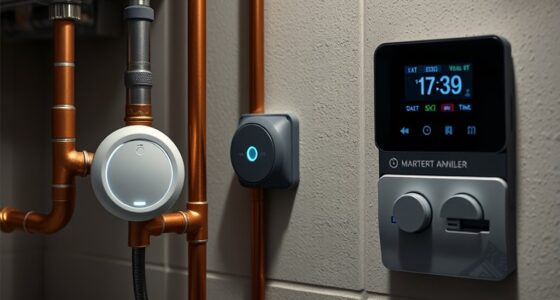
If you want to simplify your smart home, a smart hub centralizes control and voice commands, reducing the need to juggle multiple apps. It offers a cohesive interface for managing security, devices, and automation, making daily routines more seamless. While individual apps provide detailed control over specific devices, they can feel fragmented. Choosing between them depends on whether you prioritize ease or in-depth customization. Keep exploring to see which option best suits your needs.
Key Takeaways
- Smart hubs provide centralized voice control and security management, reducing the need for multiple apps.
- Individual apps offer device-specific customization and granular control but may require multiple interfaces.
- Hubs simplify daily routines with seamless integration, while apps allow detailed feature adjustments.
- Hubs enhance security by consolidating cameras, alarms, and sensors into a single interface.
- The choice depends on prioritizing ease of use and security versus device-specific customization.
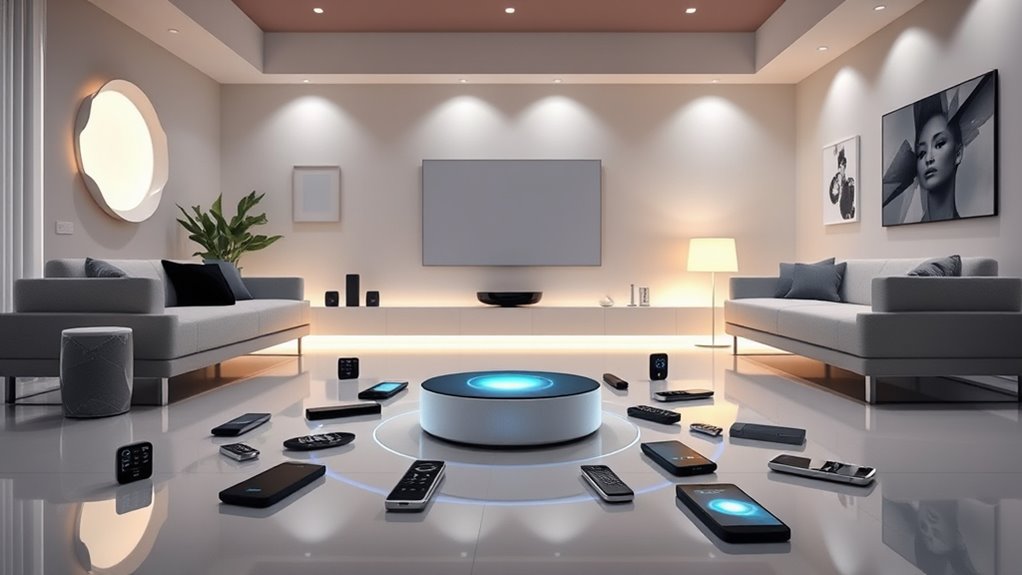
Smart hubs and individual apps each offer unique advantages for managing your connected devices, but choosing between them depends on your needs. When it comes to voice control, smart hubs often excel because they serve as a centralized point that can interpret your commands across multiple devices. You can simply speak to your hub, and it processes your request, whether you want to adjust the thermostat, turn on the lights, or lock the door. This seamless voice control simplifies daily routines and makes managing your smart home more intuitive. Additionally, many smart hubs come equipped with robust security integration features. They can connect with security cameras, alarms, and sensors, giving you a comprehensive overview of your home’s safety from one interface. With a hub, you’re more likely to receive real-time alerts and have the ability to control security systems remotely, all through a single platform.
In contrast, individual apps give you direct control over specific devices or brands, which can be advantageous if you prefer a more tailored approach. For example, you might use one app for your smart lights, another for your security cameras, and a third for your smart locks. While this setup can sometimes feel fragmented, it allows you to optimize each device’s features without compromise. Voice control is still possible through these apps if they support voice assistants like Alexa, Google Assistant, or Siri, but it requires setting up each app individually and may not offer the same level of integration as a smart hub.
The decision largely hinges on how you want to interact with your smart home. If you value simplicity, centralized control, and a cohesive voice command experience, a smart hub is generally the better choice. It reduces the need to juggle multiple apps and ensures that your devices work together smoothly. On the other hand, if you’re an enthusiast who appreciates customizing device-specific features or already invested in certain brands, individual apps might suit you better. They provide granular control and often get updates faster, but they can complicate your setup. Ultimately, your choice depends on whether you prioritize ease of use and security integration or customization and device-specific management. Both options have their merits, but understanding your priorities will help you create a smart home that truly fits your lifestyle.
Additionally, integrating a home theater projector with your smart system can create a more immersive entertainment experience, making it easier to control everything from a single interface.
smart home hub with voice control
As an affiliate, we earn on qualifying purchases.
As an affiliate, we earn on qualifying purchases.
Frequently Asked Questions
Can Smart Hubs Integrate With Multiple Brands Seamlessly?
Yes, smart hubs can integrate with multiple brands seamlessly, but brand compatibility varies. You might face integration challenges if a device isn’t compatible or uses different protocols. To avoid this, choose a hub that supports a wide range of brands and standards like Zigbee or Z-Wave. This way, you guarantee smoother integration, minimizing compatibility issues and making your smart home setup more unified and easier to control.
Are There Security Risks With Centralized Smart Hubs?
Yes, there are cybersecurity concerns with centralized smart hubs. When you rely on a single hub, it becomes a prime target for hackers, risking unauthorized access to your devices. Privacy implications also arise, as sensitive data flows through one system, increasing exposure. To mitigate these risks, guarantee your hub has strong passwords, regular updates, and robust encryption. Staying vigilant helps protect your smart home from potential threats.
How Do Update Processes Differ Between Hubs and Apps?
Firmware updates for smart hubs are often automated and centrally managed, making it easier for you to keep everything up-to-date. With apps, updates usually require manual downloads and installations on each device, which can be time-consuming and lead to compatibility challenges. Hubs streamline the process, reducing the risk of missed updates, while individual apps demand your active involvement to ensure all devices stay secure and functional.
What Is the Cost Difference Over Time?
You might think smart hubs are more expensive upfront, but over time, they can lead to significant cost savings. With centralized control, you reduce ongoing expenses like multiple app subscriptions and device incompatibility issues. Conversely, individual apps often incur higher cumulative costs for updates and maintenance. So, investing in a smart hub may lower your long-term expenses, offering a more economical solution and simplifying your smart home ecosystem.
Do Hubs Support Automation Routines Across Devices?
Yes, hubs support automation routines across devices, making it easier for you to manage multiple smart gadgets. With voice control, you can activate routines seamlessly, and broad device compatibility guarantees your hub works with various brands. This centralization allows you to set up complex automations that trigger multiple devices simultaneously, simplifying your smart home experience and reducing the need for manual control.
home security camera hub
As an affiliate, we earn on qualifying purchases.
As an affiliate, we earn on qualifying purchases.
Conclusion
Ultimately, choosing between smart hubs and individual apps feels like deciding whether to command an army or speak to each soldier one by one. Smart hubs can turn your entire smart home into a synchronized, unstoppable force—making chaos vanish in seconds. Don’t settle for juggling countless apps or missing out on seamless control; embrace the power of a smart hub and transform your home into a flawlessly coordinated fortress. It’s not just convenience—it’s the future at your fingertips.
smart home automation hub
As an affiliate, we earn on qualifying purchases.
As an affiliate, we earn on qualifying purchases.
smart home device control app
As an affiliate, we earn on qualifying purchases.
As an affiliate, we earn on qualifying purchases.