
Mapping multiple floors is complex because you need detailed layouts, accurate pathways, and clear labels for staircases, elevators, and rooms. You must design intuitive wayfinding that reflects real-world movement, incorporating signage and landmarks for easy navigation. Elevators should be well-placed and integrated with real-time status updates to improve flow and accessibility. Planning for emergencies and alternative routes guarantees safety. Exploring these challenges and solutions further can help you create effective, user-friendly multi-floor maps.
Key Takeaways
- Accurately representing vertical transitions like staircases and elevators is essential for seamless multi-floor navigation.
- Detailed indoor mapping must account for complex layouts, obstacles, and pathways across all floors.
- Integrating real-time data such as elevator status enhances map reliability and user experience.
- Designing clear signage and landmarks aids wayfinding and reduces confusion in multi-level buildings.
- Planning alternative routes, including stairs and accessible pathways, ensures safety during emergencies or elevator outages.
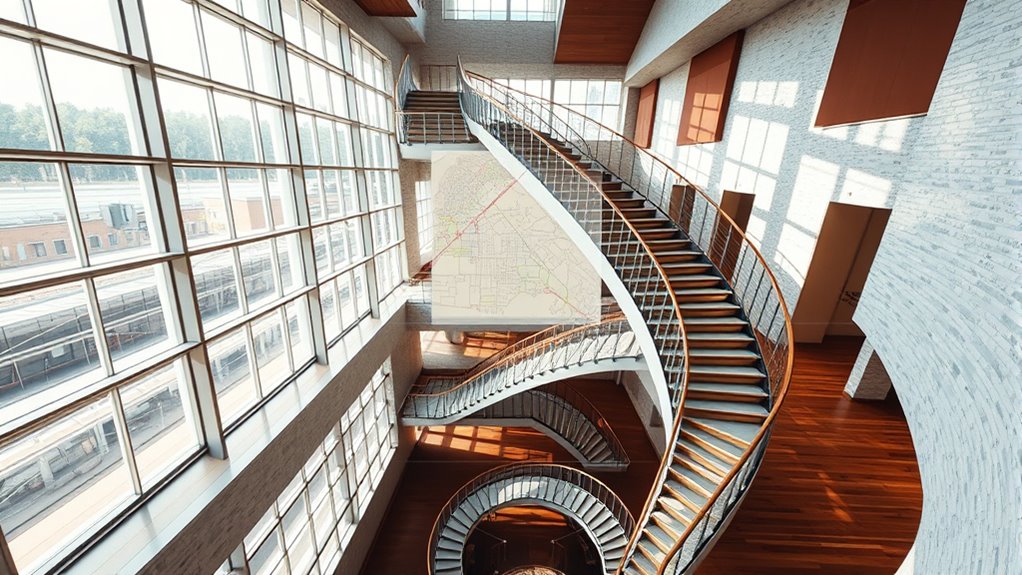
Have you ever wondered how to create an accurate map of a building with multiple floors? It might seem straightforward at first—just draw a few diagrams and label the floors—but when you dig deeper, you’ll realize the complexity involved. One of the main challenges is designing effective interior wayfinding that guides users seamlessly through each level. You need to account for staircases, hallways, doorways, and various obstacles to make sure the map is both detailed and easy to follow. It’s essential to contemplate how people move within the space and guarantee that your map reflects real-world pathways accurately. This means collecting detailed data about every corridor, room, and transition point, so users don’t get lost or confused. Incorporating clear signage, landmarks, and directional cues can greatly enhance the user experience, especially when navigating complex layouts.
Another critical aspect is elevator integration. Elevators serve as essential connectors between floors, and their placement and operation can make or break the effectiveness of your map. When mapping multi-floor buildings, you must precisely locate elevator shafts and include them prominently in your interior wayfinding system. This helps users understand how to move vertically and reduces frustration, particularly for visitors unfamiliar with the building. If your map incorporates digital navigation tools, these should include real-time elevator status updates, showing whether an elevator is operational, occupied, or out of service. This dynamic information makes wayfinding more reliable and efficient. Additionally, elevator integration involves designing the map so that it accounts for accessibility needs, including elevators for wheelchair users or other mobility aids, ensuring inclusivity.
Furthermore, implementing high-accuracy positioning systems can greatly improve the reliability of indoor navigation, especially in complex, multi-story environments. Handling elevator integration also involves planning for emergencies or unexpected situations. For example, if an elevator is temporarily out of service, your map should guide users to alternative routes, like staircases or ramps. This proactive approach ensures safety and minimizes inconvenience. On a technical level, integrating elevator data with indoor positioning systems allows the map to update in real time, providing users with the most accurate directions possible. This integration is especially vital in large, multi-story facilities like hospitals, malls, or office complexes, where quick, reliable navigation can save time and reduce stress.
Frequently Asked Questions
How Do Mapping Challenges Differ Between Residential and Commercial Buildings?
You’ll find mapping challenges differ between residential and commercial buildings because occupant behavior varies and structural complexity is greater in commercial spaces. In residential buildings, unpredictable occupant activities can hinder scanning accuracy, while in commercial spaces, intricate layouts and multiple floors increase mapping difficulty. You need to adapt your approach, accounting for these factors, to guarantee precise mapping and overcome obstacles posed by occupant behavior and structural complexity effectively.
What Are the Best Tools for Real-Time Multi-Floor Mapping?
You’ll want robotic scanners and augmented reality for real-time multi-floor mapping. Robotic scanners quickly gather precise data across different levels, making complex environments manageable. Augmented reality overlays this data onto your view, giving you an intuitive understanding of the space. Together, they streamline the process, turning what used to be a challenge into a seamless experience. These tools make multi-floor mapping efficient, accurate, and much more engaging.
How Can Mapping Accuracy Be Maintained Across Complex Floor Plans?
To maintain mapping accuracy across complex floor plans, you should regularly perform sensor calibration to guarantee your sensors provide precise data. Additionally, you need to synchronize data streams from multiple sensors, so the information aligns correctly in time and space. This combination minimizes errors, enhances consistency, and ensures your maps accurately reflect the environment, even across intricate layouts. Proper calibration and synchronization are essential for reliable, high-quality multi-floor mapping.
What Safety Considerations Are Involved in Indoor Mapping Projects?
Think of indoor mapping as charting a maze—you need safety at every turn. You should prioritize hazard identification to spot potential dangers, like loose wires or unstable structures. Keep emergency preparedness in mind by marking escape routes and safety zones clearly. Always guarantee your equipment doesn’t pose trip hazards, and communicate safety protocols to everyone involved. Staying vigilant helps keep your project safe and smooth, like a well-tuned compass guiding you through the maze.
How Does Mapping Technology Integrate With Building Management Systems?
You can integrate mapping technology with building management systems by leveraging sensor integration and data synchronization. This means your mapping tools communicate seamlessly with HVAC, lighting, and security systems, providing real-time updates. As you update floor plans or sensor data, the systems stay synchronized, enhancing efficiency and safety. This integration allows for better space utilization, quicker maintenance, and improved building operations, making management more streamlined and responsive.
Conclusion
Mapping multiple floors may seem intimidating, but with the right tools and strategies, you can conquer the challenge. Remember, “A journey of a thousand miles begins with a single step.” Embrace innovative solutions like 3D scanning and layered mapping, and you’ll turn complexity into clarity. Stay patient, adapt as you go, and you’ll find that even the most intricate multi-floor layouts become manageable. Keep pushing forward—success is just a map away.