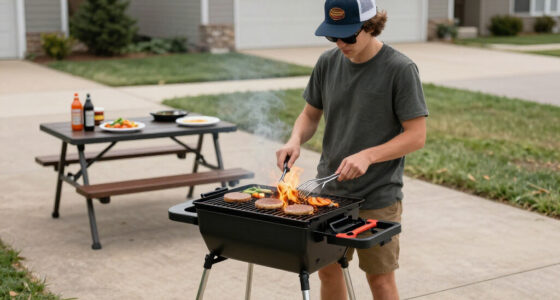
Portable tailgating grills have to pull off a tricky balancing act: enough cooking power and grate space to feed a parking-lot crowd, but small and light enough to toss in a trunk without a second thought. The Weber Traveler Compact takes my best overall spot for hitting that balance better than anything else in the lineup, with a wide grilling area and a design that folds down flat for transport. If raw feeding capacity matters more, the Coleman RoadTrip 285 brings three burners and 20,000 BTUs of output, while budget shoppers get real value from the Royal Gourmet GT1001. The main tradeoff you’ll face in this category is power versus portability — bigger burners mean bigger weight — along with assembly hassle and wind performance at open-air tailgates. Read on for the full breakdown of all 13 models.
Listen free for 30 days with Audible
Thousands of audiobooks and originals — cancel anytime.
Start your free trialAs an affiliate, we earn on qualifying purchases.
Complete the kit


Key Takeaways
- The Weber Traveler Compact won best overall because it was the only grill in the lineup that paired a large single-grate cooking area with a true fold-flat design — most competitors forced a choice between one or the other.
- The three Coleman RoadTrip 285 variants (red, blue, and stand-up) are functionally near-identical, so the real decision there is whether the stand-up model’s built-in cart justifies its extra bulk over the tabletop versions.
- Budget single-burner models like the Megamaster and Charbroil Convective all landed under $100, but the Royal Gourmet GT1001 pulled ahead of that group with its lockable lid and warming rack — features the cheaper options skip.
- The Blackstone 22-inch griddle is the odd one out in this roundup: it can’t grill at all, but for tailgaters who cook burgers, breakfast, and stir-fry, its flat-top surface out-feeds every grate-based grill here.
- Two-burner stainless models (Bestfire, Pit Boss, Cuisinart 20,000 BTU) offered the best BTU-per-dollar ratio, making them the sweet spot for groups of six or more.


| portable tailgating grill | Burners | BTU |
|---|---|---|
| Charbroil Grill2Go X200 Portab | 1 | — |
| Cuisinart Portable Gas Grill | 2 stainless steel | 20,000 total |
| Charbroil Portable Convective | 1 | — |
| Megamaster Tabletop 1 Burner G | 1 stainless steel | — |
| Royal Gourmet GT1001 Stainless | — | 10,000 |
| Bestfire 2-Burner Portable Gas | — | 20,000 total |
| Coleman RoadTrip 285 Portable | 3, independently adjustable | 20,000 total |
| Coleman RoadTrip 285 Portable | 3, adjustable | 20,000 total |
| Pit Boss Grills 75275 Stainles | 2, independent | 20,000 total |
| Weber Traveler Compact Portabl | — | — |
| Cuisinart Portable Gas Grill w | — | 8,000 |
| Blackstone 1666 22" Tabletop G | — | — |
| Coleman RoadTrip 285 Portable | — | — |
More Details on Our Top Picks
Charbroil Grill2Go X200 Portable Gas Grill, Dark Grey
The Grill2Go X200 earns the top spot because it solves the problem that kills most tailgating grills: rough handling. Its cast-aluminum body and suitcase-style design shrug off truck-bed abuse that would bend the thinner steel on the Royal Gourmet GT1001 or the Megamaster tabletop. The patented Amplifire cooking system is the real differentiator — it radiates heat back toward the food rather than letting flames dry it out, which matters when you’re cooking burgers for a hungry pre-game crowd. With 200 square inches of space, it fits about eight burgers at once, putting it in the same capacity class as the Charbroil Convective but with far better heat quality. The tradeoff is weight and fuel flexibility: at 24 pounds, it’s the heaviest single-burner option here, and unlike the Coleman RoadTrip 285, there’s no multi-burner setup for indirect cooking.
Pros:- Durable cast-aluminum construction built for transport abuse
- Amplifire system keeps food juicy instead of dried out
- 200 sq in of space fits roughly 8 burgers per batch
- Push-button ignition and a strong 5-year burner and lid warranty
Cons:- 24 pounds is heavy for a single-burner portable
- Single burner means no zone cooking for mixed menus
- Gas only — no fuel flexibility for campsite restrictions
Best for: Tailgaters who cook weekly and want a rugged, throw-it-in-the-truck grill that produces genuinely juicy results
Not ideal for: Buyers who want multi-zone cooking or frequently walk their grill long distances — it’s heavy and limited to a single burner
- Fuel Type:Gas
- Burners:1
- Cooking Area:200 sq in
- Weight:24 lbs
- Dimensions:24.8 x 26 x 15.7 inches
- Construction:Cast aluminum, non-stick finish
- Ignition:Push-button
- Warranty:5 years burner/lid, 1 year parts
Our verdict“Buy this if you tailgate often and want one grill that survives years of hauling while out-cooking cheaper single-burners.”
Cuisinart Portable Gas Grill, 20,000 BTU, 2-Burner
While most grills in this lineup offer a single burner, the Cuisinart 2-burner brings 20,000 BTUs and independent heat zones, which changes what you can actually cook at a tailgate — sear sausage on high while warming buns on low. That dual-zone capability puts it closer to the Coleman RoadTrip 285 than to tabletop models like the Royal Gourmet GT1001, though it lacks the Coleman’s stand-up cart. The stainless steel grates distribute heat evenly and the locking lid keeps everything contained for transport. Real tradeoffs exist: there are no side shelves for prep space, the two-burner footprint still caps capacity for very large groups, and the propane tank isn’t included, so budget for that on day one. Compared with the Charbroil Convective, you give up a little portability but gain serious heat output and control.
Pros:- Two independent burners allow zone cooking
- 20,000 BTUs deliver fast preheating and searing
- Tool-free setup gets you grilling in minutes
- Locking lid and thermometer improve transport and control
Cons:- No side shelves or prep surfaces
- Propane tank sold separately
- Capacity still trails full-size grills for big groups
Best for: Tailgaters cooking for 6-10 people who need two heat zones and fast recovery time between batches
Not ideal for: Solo grillers or couples — the extra burner and 22-pound frame are overkill for small meals
- BTU:20,000 total
- Burners:2 stainless steel
- Weight:22 lbs
- Grates:Stainless steel
- Controls:Adjustable knobs with thermometer
- Lid:Locking
Our verdict“This is the pick when one burner won’t cut it and you need real heat and zone control for a group.”
Charbroil Portable Convective 1-Burner Propane Gas Grill
For buyers who grill a few Saturdays a season and don’t want to spend real money, the Charbroil Convective is the honest entry point in this lineup. Its 190 square inches and porcelain-coated grates cover the basics — burgers, dogs, and kebabs for four or five people — at a price well below the Grill2Go X200, which offers similar capacity but far tougher construction and better heat performance. The porcelain grates resist rust and wipe clean easily, a genuine plus after a greasy tailgate. The compromises are obvious: a single burner means everything cooks at one temperature, and the 90-day warranty signals that longevity is not the priority here. If your tailgating is occasional and budget-driven, that tradeoff makes sense; if you’re out every fall weekend, stepping up to the X200 or the Cuisinart 2-burner will pay off.
Pros:- Lowest-cost entry into portable gas grilling
- Porcelain-coated grates resist rust and clean easily
- Compact, genuinely light footprint for trunk storage
- Straightforward assembly with included instructions
Cons:- 90-day warranty is the shortest in this lineup
- Single burner with no heat-zone flexibility
- Basic build quality compared with cast-aluminum rivals
Best for: Casual, occasional tailgaters or first-time grill owners who want functional cooking capacity for minimal spend
Not ideal for: Frequent grillers — the thin steel and 90-day warranty won’t hold up to weekly use and transport
- Cooking System:Liquid propane, convective
- Burners:1
- Cooking Area:190 sq in
- Grates:Porcelain-coated
- Dimensions:15″ H x 24.1″ W x 12.3″ D
- Warranty:90 days
Our verdict“A sensible cheap ticket into tailgating, as long as you accept it’s built for occasional use, not a full season schedule.”
Megamaster Tabletop 1 Burner Gas Grill with Foldable Legs and Warming Rack
The Megamaster takes a different bet than every other single-burner here: instead of premium materials, it maximizes surface. With 360 square inches including a warming rack, it out-cooks the Grill2Go X200 (200 sq in) and the Royal Gourmet GT1001 (285 sq in) in raw batch size, which matters when the queue at your tailgate is long. The foldable legs and locking lid make it genuinely easy to carry, and the built-in thermometer helps you hold steady temps. But one 11,000 BTU burner spread across that much grate means the edges run noticeably cooler than the center — you’re trading evenness for area. Compared with the Cuisinart 2-burner, you also lose any ability to run separate temperatures. For volume-focused cooks on a budget, though, it’s hard to beat the price-to-space ratio.
Pros:- 360 sq in of total cooking space leads this price class
- Foldable legs and locking lid simplify transport
- Warming rack keeps finished food hot during multi-batch cooking
- Built-in thermometer for temp monitoring
Cons:- Single burner creates uneven heat across the large grate
- No adjustable power levels for fine control
- Warming rack capacity isn’t specified and runs small
Best for: Budget-minded tailgaters who prioritize cooking as much food as possible per batch over precision
Not ideal for: Grillers who want even, controlled heat — a single burner across 360 sq in creates noticeable hot and cool spots
- Fuel Type:Gas
- Burner Power:11,000 BTUs
- Burners:1 stainless steel
- Total Cooking Space:360 sq in
- Warming Rack:Yes
- Foldable Legs:Yes
- Thermometer:Built-in
Our verdict“Choose this when feeding a line of people cheaply matters more than perfect heat control.”
Royal Gourmet GT1001 Stainless Steel Portable Grill, 10,000 BTU BBQ Tabletop Gas Grill with Folding Legs and Lockable Lid
The Royal Gourmet GT1001 sits in the sweet spot between the bare-bones Charbroil Convective and the capacity-first Megamaster. Its 285 square inches — split between a 214 sq in grate and a defined 71 sq in warming rack — give it a more usable layout than the Megamaster’s unspecified rack arrangement, while its stainless steel build feels a step above budget porcelain grates. Practical touches add up: a removable grease tray makes post-tailgate cleanup genuinely quick, and the lid-mounted temperature gauge plus lockable lid round out a complete travel package. At 10,000 BTUs, it heats evenly but won’t sear as hard as the Cuisinart 2-burner’s 20,000 BTU output, and tabletop-only use means you’ll need a tailgate or table to set it on. As a balanced do-everything portable, it’s the easiest recommendation for most buyers.
Pros:- Thoughtful layout with a defined 71 sq in warming rack
- Removable grease tray makes cleanup fast
- Folding legs and lockable lid for grab-and-go transport
- Temperature gauge supports more consistent cooking
Cons:- 10,000 BTUs limit searing performance versus 20,000 BTU rivals
- Tabletop-only design requires a stable surface
- May need extra accessories, like a stand, for standalone use
Best for: Tailgaters and campers who want a well-rounded, easy-cleaning tabletop grill with a proper warming rack
Not ideal for: Cookers who want serious searing power or grill without a table or tailgate surface to set the grill on
- BTU:10,000
- Total Cooking Area:285 sq in
- Cooking Grate:214 sq in
- Warming Rack:71 sq in
- Material:Stainless steel
- Features:Folding legs, lockable lid, temperature gauge, removable grease tray
Our verdict“The most sensible all-rounder for typical tailgaters who value cleanup and layout over raw power.”
Bestfire 2-Burner Portable Gas Grill, 20,000 BTU, Stainless Steel
Bestfire’s dual-burner tabletop makes the list because it delivers the same 20,000 BTU output as pricier rivals like the Coleman RoadTrip 285 at a noticeably lower price, and the stainless steel body cleans up faster than painted-steel alternatives. The removable legs are the standout trick here: it works as a standalone grill or a true tabletop unit, which the Pit Boss 75275 can’t match since its legs only fold. Where it falls short is footprint — the 16 x 15-inch cooking zone is the smallest in this batch, so feeding more than four people means cooking in shifts. Buyers also need to budget for a propane cylinder and regulator, since neither is included. Compared with the Weber Traveler, you give up refinement and capacity, but you keep most of the cooking power for far less money.
Pros:- Full 20,000 BTU output from two burners rivals pricier grills
- Removable legs allow true tabletop or freestanding setups
- Stainless steel construction resists corrosion and wipes clean quickly
- Lightweight enough to carry from car to tailgate spot in one trip
Cons:- Smallest cooking footprint in this batch at roughly 16 x 15 inches
- No propane cylinder or regulator included, adding hidden cost
- Two burners limit indirect-heat zones compared to three-burner rivals
Best for: Budget-minded tailgaters who want dual-burner power and stainless cleanup without paying premium prices
Not ideal for: Crews feeding six or more — the compact grate forces batch cooking that slows down game-day service
- BTU:20,000 total
- Burner Count:2
- Material:Stainless steel
- Dimensions:16″D x 15″W x 13″H
- Fuel Type:Propane (gas)
- Legs:Removable
- Thermometer:Built-in
- Cooking Method:Grilling
Our verdict“A smart value pick for small groups who prioritize power-per-dollar and easy cleanup over cooking real estate.”
Coleman RoadTrip 285 Portable Propane Grill, 3 Burners, Red
This is the grill I’d point most tailgaters toward, because it solves the two problems that ruin game day: slow setup and crowding. The 285 sq. in. cooking surface is the largest in this batch, and the three independently adjustable burners let you sear burgers on one side while warming buns on another — something neither the Bestfire nor the Pit Boss 75275 can do with their two-burner layouts. The foldable legs and wheels mean you roll it from the trunk rather than carry it, though that convenience makes it bulkier to stash than the Weber Traveler. Its real weakness is fuel flexibility: it runs only on 16.4 oz. disposable cylinders, so long tailgates mean packing spares, and those little tanks cost more per BTU than a full tank. Still, for capacity plus control, nothing here beats it.
Pros:- Largest cooking area in this lineup at 285 sq. in.
- Three adjustable burners enable true multi-zone cooking
- Foldable legs and wheels make parking-lot setup a one-person job
- Built-in thermometer and 3-year limited warranty add confidence
Cons:- Runs only on 16.4 oz. disposable cylinders — costly for long cook sessions
- Bulkier to store and transport than tabletop models like the Bestfire
- Propane sold separately, so first-use cost is higher than the sticker suggests
Best for: Tailgaters regularly cooking for 5-8 people who want three heat zones and wheeled transport
Not ideal for: Solo grillers or couples — the extra capacity and bulk are wasted if you only cook for two or three
- BTU:20,000 total
- Burners:3, independently adjustable
- Grilling Area:285 sq. in.
- Ignition:Instastart push-button
- Stand:Foldable legs with wheels
- Thermometer:Integrated
- Fuel:Propane, 16.4 oz. cylinder (sold separately)
- Warranty:3-year limited
Our verdict“The best all-around choice for groups, trading storage compactness for the most usable cooking space and heat control in the batch.”
Coleman RoadTrip 285 Portable Propane Grill, 3 Burners, Blue
Functionally, this blue RoadTrip 285 is the same grill as the red version — same 20,000 BTU output, same 285 sq. in. grate, same three-burner control — so the choice between them comes down to price and color preference on the day you buy. I’m including both because availability swings between them, and paying $30 more for an identical grill in a different shade is a bad deal. Where it stands apart from the rest of the lineup is quick-fold legs and push-button ignition: compared with the Pit Boss 75275, you get an extra burner and wheeled transport for similar money. The tradeoff mirrors the red model — you’re locked into small disposable propane canisters, and the stand-up frame takes more trunk space than the tabletop Bestfire. Buy whichever color is cheaper.
Pros:- Identical 20,000 BTU, 3-burner performance to the red RoadTrip 285
- Quick-fold legs and wheels simplify one-person setup
- Push-button ignition fires up reliably at cold morning tailgates
- Integrated thermometer supports accurate multi-zone cooking
Cons:- Locked to small 16.4 oz. canisters that run out mid-cook if you don’t pack spares
- Stand-up cart frame consumes more trunk space than tabletop rivals
- No propane cylinder included at checkout
Best for: Buyers who want RoadTrip 285 performance and will simply pick whichever color variant is in stock or discounted
Not ideal for: Anyone paying a premium over the red version — identical specs mean the pricier color is pure loss
- BTU:20,000 total
- Burners:3, adjustable
- Grilling Area:285 sq. in.
- Ignition:Push-button
- Legs:Quick-fold with wheels
- Thermometer:Integrated
- Fuel:Propane, 16.4 oz. cylinder (sold separately)
- Warranty:3 years
Our verdict“A color-swap duplicate of the top pick — grab it only when it undercuts the red model’s price.”
Pit Boss Grills 75275 Stainless Steel Two-Burner Portable Grill
The Pit Boss 75275 splits the difference between the tabletop Bestfire and the cart-style Coleman RoadTrip 285: you get nearly the same 274 sq. in. of cooking space as the Coleman but in a 22-pound package that folds flat and travels like a suitcase. The grease management tray is a genuinely useful touch the Bestfire lacks — post-tailgate cleanup takes minutes, not scrubbing. Where it trails the Coleman is control: two burners instead of three means less granular heat zoning, and there are no wheels, so you’re carrying all 22 pounds yourself. The push-and-turn ignition is a step down from instant push-button starts on cold mornings. Assembly can also frustrate first-time buyers. For cooks who prioritize cooking surface per pound hauled, this is the strongest argument in the batch.
Pros:- 274 sq. in. cooking area nearly matches the larger Coleman for grilling capacity
- 22 lb. folding design travels far easier than wheeled cart grills
- Grease management tray makes post-cook cleanup genuinely quick
- Dome thermometer and stainless build support low-and-slow cooking
Cons:- Two burners limit heat-zone control versus three-burner rivals
- Assembly out of the box can be time-consuming and frustrating
- No wheels — you carry the full weight across parking lots
Best for: Grillers who want near-cart-sized cooking area in a carry-anywhere folding format at mid-range pricing
Not ideal for: Buyers who want push-button ignition and wheeled transport — the RoadTrip 285 delivers both for similar money
- Cooking Surface Area:274 sq. in.
- Burners:2, independent
- BTU:20,000 total
- Material:Stainless steel
- Dimensions:22.9″L x 18.5″W x 14.7″H
- Weight:22 lb.
- Ignition:Push-and-turn
- Fuel Type:Propane
- Extras:Dome thermometer, grease tray, folding legs
Our verdict“The pick for tailgaters who cook seriously but want cart-level capacity in a grab-and-go folding grill.”
Weber Traveler Compact Portable Gas Grill for Outdoor Cooking, Propane
The Weber Traveler is the most refined grill in this lineup, and you feel it in details the others skip: one-handed operation from unfolding to ignition, an automatic lid lock, and porcelain-enameled cast iron grates that hold sear marks and resist rust far better than the bare stainless on the Bestfire or Pit Boss 75275. Weber’s reputation for durability is why this costs more — it’s the grill that still runs smoothly after five seasons of trunks and tailgates. The tradeoff is capacity: at roughly 12 burgers or 15 sausages, it feeds about four people comfortably, while the Coleman RoadTrip 285 handles bigger crowds across a larger grate. It’s also heavier than it looks once you’re carrying it any distance. This pick makes the most sense for buyers who cook often and want longevity, not for occasional crowd-feeding.
Pros:- One-handed setup and ignition make it the fastest grill here to deploy
- Porcelain-enameled cast iron grates deliver superior searing and rust resistance
- Automatic lid lock and low-profile design fit most car trunks easily
- Weber build quality and support reputation support long-term ownership
Cons:- Capacity tops out around four people, well short of the RoadTrip 285
- Premium price buys refinement, not extra BTUs or grate space
- Heavier than expected for a compact grill when carried any distance
Best for: Frequent tailgaters and campers willing to pay more for a durable, refined grill that lasts many seasons
Not ideal for: Budget buyers or large-group hosts — it costs more and cooks less per session than the RoadTrip 285
- Width:32 inches
- Cooking Capacity:Up to 4 people; 12 burgers or 15 sausages
- Grate Material:Porcelain-enameled cast iron
- Lid:Porcelain-enameled with automatic lock
- Ignition:One-handed burner ignition
- Mobility:Wheels for easy transport
- Fuel:Propane
Our verdict“Buy it if you grill on the road constantly and want a decade-grade tool; skip it if you feed big crowds on a budget.”
Cuisinart Portable Gas Grill with Locking Lid, 8,000 BTU, 10 lbs
At just 10 lbs, this Cuisinart is the lightest dedicated grill in the entire lineup — nearly half the weight of the Royal Gourmet GT1001 and a third of the Blackstone 22-inch griddle. That weight advantage changes how you use it: this is a grill you can toss into a car trunk, carry across a parking lot one-handed, and set up in under a minute with zero assembly. The tradeoff is raw capability. Its 8,000 BTU burner is the smallest output here, which means slower recovery when you load it with cold burgers, and the 146-square-inch grate realistically feeds two to three people, not a crowd. Compared with the Coleman RoadTrip 285, you give up wheels, three-burner zoning, and roughly half the cooking area. But for solo tailgaters who prioritize portability over volume, nothing else comes close on weight.
Pros:- Lightest grill in the lineup at just 10 lbs with a locking lid for one-handed carrying
- No assembly and no tools — ready to cook within minutes of arriving
- 146 sq. in. of cooking space is generous relative to its tiny footprint
- Enameled steel surface is easy to wipe down after a long game day
Cons:- 8,000 BTU output is the weakest here, so it struggles with searing and recovers slowly between batches
- No fine temperature control — single burner means one heat zone for everything
- Small build feels less rugged than sturdier picks like the Charbroil Grill2Go X200
Best for: Solo tailgaters and couples who walk or hike to their spot and want a grab-and-go grill under 10 pounds
Not ideal for: Groups of four or more — the 146 sq. in. surface and 8,000 BTU burner can’t keep up with volume cooking
- Cooking Surface:146 sq. inches
- BTU:8,000
- Weight:10 lbs
- Dimensions:19″ x 11.5″ x 10″
- Lid:Locking
- Assembly:None required
Our verdict“Buy this if you carry your grill on foot and cook for two; skip it if you’re feeding a full tailgate crew.”
Blackstone 1666 22″ Tabletop Griddle with Stainless Steel Faceplate
The Blackstone 22-inch isn’t technically a grill — it’s a flat-top griddle, and that distinction is exactly why it earns a spot. Every other product here, from the Weber Traveler to the Coleman RoadTrip 285, cooks over grates. This one handles the foods grates can’t: eggs, hash browns, smash burgers, cheesesteaks, and bacon for a morning tailgate. The 24,000 BTU output across two independently adjustable H-burners gives you real zoning — keep pancakes warm on one side while frying on the other — something single-burner picks like the Charbroil Portable Convective simply can’t do. The rear grease management system makes cleanup faster than scraping grates. The catch: at 32 lbs, it’s the heaviest tabletop option in this roundup, it needs a stable tailgate or table to sit on, and propane is sold separately. You also have to season and maintain the rolled steel surface or it will rust.
Pros:- 339 sq. inches of flat-top space with two independently controlled 24,000 BTU burners for true heat zoning
- Grease chute and rear drawer make post-cook cleanup faster than grate grills
- Rust-resistant rolled steel surface holds up to frequent tailgate seasons
- Runs on either 1 lb. or 20 lb. propane tanks for flexibility at home or on the road
Cons:- At 32 lbs, it’s the heaviest portable option here and demands a sturdy surface to sit on
- Requires seasoning and ongoing maintenance, unlike porcelain-coated grate grills
- No char or flame-grilled flavor — it’s a different cooking style entirely
Best for: Early-arriving tailgaters who cook breakfast and want one surface for eggs, smash burgers, and stir-fry-style crowd food
Not ideal for: Grill purists who want char marks and smoke flavor, or anyone without a table — this has no legs or stand of its own
- Cooking Surface:22 inches / 339 sq. inches
- Heat Output:24,000 BTUs
- Number of Burners:2 adjustable H-shaped burners
- Fuel Type:Propane (1 lb. or 20 lb. tank, not included)
- Dimensions:22.5″ L x 9″ H x 19″ W
- Weight:32 lbs
- Surface:Rust-resistant rolled steel flat top
Our verdict“Choose this if your tailgate menu starts with eggs and ends with smash burgers; choose a grate grill if char matters more than versatility.”
Coleman RoadTrip 285 Portable Stand-Up Propane Grill with 3 Adjustable Burners & Instastart Ignition
This is the grill for the tailgater who treats the parking lot like a backyard. Unlike tabletop models such as the Blackstone 22-inch or the Megamaster 1-burner, the RoadTrip 285 brings its own quick-fold legs and wheels, so you roll it from the car like luggage rather than hauling a tabletop around. The three adjustable burners totaling 20,000 BTUs across 285 sq. in. let you run three heat zones — sear sausage on high, warm buns on low — a level of control none of the single-burner budget picks here can match. The push-button Instastart ignition means no matches in the wind, and the integrated thermometer removes guesswork. The compromises are real, though: it’s bulkier folded than any tabletop in this roundup, propane sells separately, and at this price you’re getting close to Weber Traveler territory, where build quality is a step up. You’re paying for the stand-up convenience, not premium materials.
Pros:- Freestanding design with quick-fold legs and wheels eliminates the need for a table
- Three independently adjustable burners enable true multi-zone cooking across 285 sq. in.
- Push-button Instastart ignition fires reliably in windy lots
- Integrated lid thermometer takes guesswork out of doneness
Cons:- Bulkier to store and transport than every tabletop pick in this roundup
- Propane cylinder sold separately, adding to the real cost
- Build quality trails the Weber Traveler at a similar price point
Best for: Tailgaters with a regular spot who want a freestanding, multi-zone grill they can roll in on wheels and cook a full spread on
Not ideal for: Anyone with a small trunk or who walks to the game — folded, it takes up more space than every tabletop option here
- Grilling Area:285 sq. in.
- BTUs:20,000
- Number of Burners:3 adjustable
- Ignition:Push-button Instastart
- Fuel:Propane (sold separately)
- Stand:Quick-fold legs with wheels
- Thermometer:Integrated in lid
- Warranty:3 years
Our verdict“If you drive to a fixed tailgate spot and want the closest thing to a backyard grill on wheels, this is the pick; walkers and minimalists should stick with a tabletop.”
How We Picked
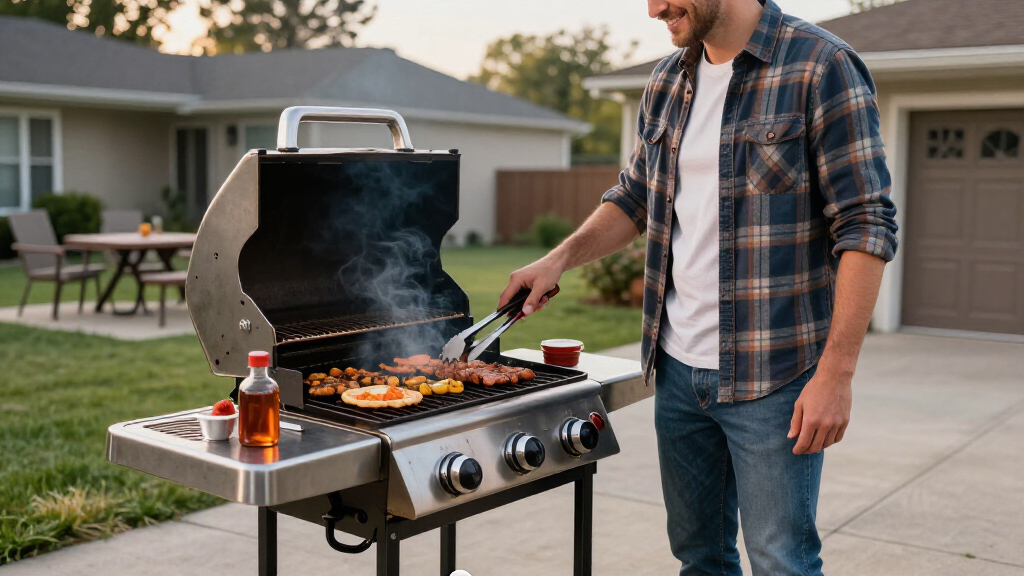
My ranking process started with the realities of tailgating: you’re cooking outdoors, often in wind, on a table or tailgate, for a hungry group, and you have maybe an hour to get food out. That pushed heat output and wind resistance, setup and teardown speed, transported size and weight, and cooking capacity per square inch to the top of the criteria list. A grill that wins on BTUs but takes twenty minutes to assemble before the first burger loses to a slower model that’s ready in two.
From there, I weighed build quality and durability — latches, legs, and igniters are the first things to break on cheap portables — along with value and warranty backing. Grills that earned higher slots either did one thing exceptionally well (like the Weber’s fold-flat design) or offered a genuinely different capability (like the Blackstone’s griddle surface). Models ranked lower weren’t bad grills; they simply overlapped with a better-priced or better-built competitor, which is exactly why the three RoadTrip 285 variants don’t all sit in the top five.
Factors to Consider When Choosing Portable Tailgating Grills
Before you commit to a specific model, it helps to understand what actually separates a grill that thrives in a parking lot from one that frustrates you by the second tailgate. These are the factors that shaped my rankings — and the ones most buyers underestimate.Total Packed Size Matters More Than Cooking Size
The spec sheets advertise cooking area, but what determines whether a grill is genuinely tailgate-friendly is its folded footprint. A grill with foldable legs may still have a tall, awkward profile that dominates your trunk, while a scissor-legged or fold-flat design slides behind a seat. My advice: measure your actual cargo space before buying, and think in three dimensions, not two. Also check whether the grill stores standing or lying flat, since a lid that pops open in transit will coat your car in grease. Buyers who skip this step often end up leaving their ‘portable’ grill at home — the most expensive mistake in this category. If you drive a sedan rather than an SUV or truck, packed height under 20 inches should be a hard requirement.
BTUs Are Meaningless Without Context
Manufacturers love big BTU numbers, but output per square inch and burner count tell you far more about real performance. A single 10,000 BTU burner on a small grate can outperform a 20,000 BTU grill spread across a massive cooking surface, because heat density is what sears burgers and chicken. Multiple burners also give you zoning — essential if you’re keeping dogs warm while searing fresh patties. The common mistake here is chasing the highest BTU figure on the page and ending up with a grill that’s actually slower to recover heat every time the lid opens. Aim for roughly 80–100 BTUs per square inch of grate, and remember that wind at an outdoor tailgate can cut effective output dramatically, which is why lidded models hold an advantage in exposed lots.
Build Quality Shows Up in the Small Parts
The burners on almost any grill in this price range will last for years — it’s the latches, leg hinges, and igniters that fail first, usually within a season or two of trunk rattling. That’s why I weighted these details heavily. Stainless steel construction isn’t just about rust resistance; it’s about whether the frame flexes when you carry a loaded grill by its handle. Look for lockable lids and legs that positively click into place rather than flopping loose. Cheap plastic latch mechanisms are the number one complaint on budget portables, and replacing them usually isn’t practical. If you tailgate more than four or five times a season, spending an extra $50–100 on better hardware pays for itself in avoided replacements.
Griddle or Grill — Know What You Actually Cook
The rise of flat-top griddles has split this category, and the right choice depends entirely on your menu. Grates give you flame-kissed flavor and char marks on burgers, chicken, and steaks, but the fat drips away and you lose it. A griddle like the Blackstone keeps all that fat in play, which makes it dramatically better for smash burgers, bacon, eggs, hash browns, and fajitas — arguably a better fit for all-day tailgating that starts at 8 a.m. Some buyers end up wanting both, and a few two-burner models can accept griddle plates as accessories. The mistake to avoid is assuming a griddle is just a different-shaped grill; the cooking techniques, cleanup, and even the spatulas are different. Pick based on your three most-cooked tailgate foods, not on novelty.
Fuel Type and Run Time Planning
Every grill in this roundup runs on propane, but they differ in whether they take 1-pound canisters or 20-pound tanks, and that shapes your whole game-day logistics. Tabletop models almost universally use 1-pound bottles, which are convenient but burn fast — a three-burner grill at full tilt can empty one in under two hours. That means serious tailgaters should budget for two or three canisters per event, or invest in an adapter hose to run off a full-size tank kept in the truck. Also check regulator type and whether the grill includes a hose at all, since some budget models expect you to supply your own. Running out of fuel mid-cook is the most common tailgate grailing failure I hear about, and it’s entirely preventable with a five-dollar spare canister.
When to Pay More — and When Not To
The price ladder in this category runs from about $60 to $400, and the differences aren’t linear. Under $100, you get functional single-burner grills with cut-rate hardware — perfectly fine for occasional use, two-to-four people, and tight budgets. The $150–300 midrange is where the real value lives, adding second burners, stainless construction, and fold-flat designs that survive weekly use. Above $300, you’re paying for brand engineering, warranty support, and refined details like the Weber’s one-handed setup. My honest take: if you tailgate fewer than three times a year, don’t buy premium — a $70 tabletop will cook your hot dogs just as dead. If you’re out every fall Saturday, the premium tier’s durability and speed of setup genuinely change the experience.
Frequently Asked Questions
Is a tabletop grill or a stand-up grill better for tailgating?
Tabletop grills win on portability and flexibility — you can set them on a tailgate, picnic table, or folding camp table, and they pack smaller and lighter. Stand-up models like the Coleman RoadTrip 285 stand-up version save you from hunting for a surface and keep the cooking height ergonomic, but they add weight and bulk that matters if trunk space is tight. The deciding factor is usually your tailgate setup: if you arrive early with a full spread and a canopy, a stand-up grill feels professional. If you’re walking blocks from a parking garage or squeezing gear into a car, tabletop wins every time. Also note that foldable legs on tabletop models sometimes wobble on uneven asphalt, so bring a sturdy surface rather than relying on a cooler lid.
How many BTUs do I actually need for a tailgate grill?
For a group of four to six people, around 10,000 to 12,000 total BTUs on a compact grate is plenty — the Cuisinart 8,000 BTU model can even handle small groups despite its modest number, because its cooking area is small enough that heat stays concentrated. Where BTU counts really matter is recovery time: high-output grills bounce back to searing temperature quickly after you load cold burgers, while weak grills stall and steam the food instead. For crowds over eight, look at the 20,000 BTU two-burner class or the RoadTrip 285’s three-burner setup. One caution — output ratings are measured in ideal, windless conditions, and a breezy parking lot can cut effective performance by a third. A lid, windscreen positioning, and parking your vehicle as a windbreak all help more than chasing extra BTUs.
Can I use a portable tailgating grill somewhere with open-flame restrictions?
Increasingly, stadiums and campus lots are restricting open-flame cooking, and this is where grill type matters. Propane grills with lids that fully contain the flame are usually allowed where charcoal is banned, since charcoal cannot be extinguished on command and creates disposal hazards. Check your specific lot’s rules before game day — many allow propane but cap tank size, which favors 1-pound canister models over 20-pound tank setups. Flameless electric options exist but typically require generator or inverter power that most tailgaters don’t carry. If your lot bans everything, the workaround is pre-cooking and using a grill only at home gatherings. When in doubt, call the stadium’s guest services line; getting shut down mid-cook is a bad way to start a game day.
How long will a 1-pound propane bottle last on a portable grill?
At full output, a 1-pound canister delivers roughly 20,000 to 22,000 BTUs total, which means a single-burner 10,000 BTU grill runs about two hours flat-out, and a 20,000 BTU two-burner model can drain one in barely an hour at max heat. In practice, you’ll cook at medium most of the time, which stretches a canister considerably — most tailgaters get through a normal cook with one to spare. The math changes for the Coleman RoadTrip 285 at full three-burner blast, where a single bottle is genuinely marginal for an all-day session. My rule of thumb: carry one canister per hour of expected cooking, plus one backup. An adapter hose that lets you tap a 20-pound tank from the truck is the cheapest upgrade for heavy users, and it cuts your per-tailgate fuel cost dramatically.
Are the Coleman RoadTrip 285 color variants actually different grills?
No — the red and blue RoadTrip 285 models are functionally identical, with the same three burners, 20,000 BTU output, 285 square inches of grates, and Instastart ignition. The color choice is purely cosmetic, so buy whichever is cheaper or matches your tailgate aesthetic. The stand-up version is a genuinely different product, adding a wheeled cart with legs that swing out, which changes the weight, folded size, and price point. That cart version makes sense if you cook standing height matters to you and you have the cargo room; the tabletop versions make more sense for compact vehicles. Don’t pay a premium for a color, though — I’ve seen price gaps of $20 or more between the red and blue for zero functional difference.
Conclusion
After comparing all 13 models, the right pick comes down to how you actually tailgate. For best overall, the Weber Traveler Compact earns the top spot with its fold-flat design and generous cooking surface — it’s the grill that disappears into your trunk and still feeds a crowd. The Royal Gourmet GT1001 takes best value, delivering a lockable lid and warming rack at a price that leaves budget for fuel and food. If money is no object and you tailgate every weekend, the Coleman RoadTrip 285 stand-up is the best premium choice, pairing three-burner power with a built-in cart.
For beginners, the Cuisinart 8,000 BTU locking-lid model is the gentlest entry point — light, simple, and cheap enough that a tailgating habit can grow into it. The Blackstone 22-inch griddle is my pick for specific needs: tailgaters who live on smash burgers, breakfast, and stir-fry will get more real cooking out of that flat top than any grate in this lineup. And if you’re feeding eight or more on a midrange budget, the Bestfire or Pit Boss two-burner stainless models offer the best capacity-per-dollar in the group. Whatever you choose, buy for the group size and vehicle you actually have — not the one you’re dreaming about — and the grill will still be earning its trunk space next season.
NFL season / tailgating Picks
team gear
As an affiliate, we earn on qualifying purchases.