
Among the best energy-efficient air conditioners in this roundup, I’d put the Midea 7,800 BTU Inverter Window Air Conditioner first for buyers who want inverter efficiency in a familiar window unit. The Midea 8,000 BTU Smart Inverter Window Air Conditioner with Heat adds heating and smart controls, while the Rellytech 12,000 BTU Mini Split offers a higher-capacity, 19 SEER2 option for buyers open to installation work. The central tradeoff is between simpler window installation, the flexibility of portable units, and the potential efficiency and whole-room comfort of a correctly sized mini split. Capacity, room layout, climate, and installation constraints can matter as much as the unit’s headline efficiency figure. Read on for how the 15 options compare and which type fits your needs.

Get home appliances delivered free with Prime
- Fast, free delivery on millions of items
- Prime Video, Amazon Music and more included
- Member-only deals all year
Complete the kit


Key Takeaways
- Inverter window units lead the roundup for accessible efficiency: the Midea 7,800 BTU and 8,000 BTU models pair inverter operation with a window-unit format, with the latter adding heat and smart controls.
- Mini splits suit buyers ready for a more involved installation: the Rellytech and DELLA 12,000 BTU models list 19 SEER2, while the 35,000 BTU DELLA serves a distinct multi-zone need.
- Small rooms do not call for oversized capacity: several 5,000 BTU window units offer a simpler fit for compact spaces, but the listed models do not provide the inverter features of the Midea picks.
- Portable convenience brings a different efficiency tradeoff: the Garvee and AC Infinity options avoid a fixed window installation, but buyers should account for exhaust setup and the room conditions that can affect portable cooling.
- Heating features change the comparison: select Midea, mini-split, and AC Infinity models combine cooling with heat, which may suit longer seasonal use but calls for checking heating capacity and climate suitability.
| Midea EasyCool 5,000 BTU Window Air Conditioner with Remote |  | Best Small-Room Pick for Scheduled Cooling | Cooling capacity: 5,000 BTU | Coverage: Up to 150 sq. ft. | Operating modes: Cooling, fan, dehumidifier | VIEW LATEST PRICE | See Our Full Breakdown |
| Rellytech 12,000 BTU Mini Split Air Conditioner and Heat Pump, 19 SEER2, 115V |  | Best Efficiency-Labeled Ductless Pick | Cooling capacity: 12,000 BTU | Heating capacity: 12,500 BTU | Coverage: Up to 750 sq. ft. | VIEW LATEST PRICE | See Our Full Breakdown |
| Comfort Temps Elite Series 9000 BTU Mini Split Air Conditioner and Heat Pump | 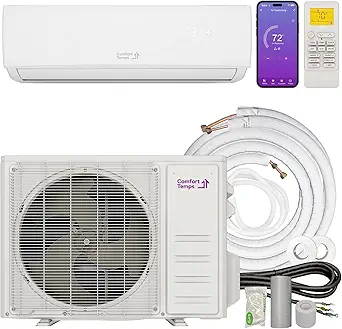 | Best Smart Scheduling Mini Split | Cooling capacity: 9,000 BTU | Voltage: 115V (fits 110–120V) | Coverage: Up to 400 sq. ft. | VIEW LATEST PRICE | See Our Full Breakdown |
| Garvee 3-in-1 Portable Air Conditioner, 14,000 BTU |  | Best Portable Pick with Consumption Data | Cooling power: 14,000 BTU; 9,300 BTU SACC | Coverage: Up to 750 sq. ft. | Functions: Air conditioner, fan, dehumidifier | VIEW LATEST PRICE | See Our Full Breakdown |
| Midea EasyCool 5,000 BTU Window Air Conditioner |  | Best Basic Pick with a Stated CEER | Cooling capacity: 5,000 BTU | Coverage: Up to 150 sq. ft. | Energy efficiency: CEER 11.0 | VIEW LATEST PRICE | See Our Full Breakdown |
| Midea 8,000 BTU Smart Inverter Window Air Conditioner with Heat |  | Best for Efficient Cooling with Supplemental Heat | Cooling capacity: 8,000 BTU | Coverage: Up to 350 sq. ft. | Modes: Heat, Auto, Cool, Dry, Fan | VIEW LATEST PRICE | See Our Full Breakdown |
| GE 6,000 BTU Electronic Window Air Conditioner with Remote |  | Best Value for Medium Small Rooms | Cooling capacity: 6,000 BTU | Coverage area: Up to 250 sq. ft. | Temperature range: 64°F to 86°F | VIEW LATEST PRICE | See Our Full Breakdown |
| GE 5,000 BTU Window Air Conditioner for Small Rooms |  | Best Simple Pick for Tiny Rooms | Cooling capacity: 5,000 BTU | Room coverage: Up to 150 sq. ft. | Power draw: 440 W | VIEW LATEST PRICE | See Our Full Breakdown |
| Midea 7,800 BTU Inverter Window Air Conditioner |  | Best Overall for Efficient, Quiet Cooling | Cooling capacity: 7,800 BTU | Room coverage: Up to 340 sq. ft. | Technology: Variable-speed inverter | VIEW LATEST PRICE | See Our Full Breakdown |
| Frigidaire 5,000 BTU Window Air Conditioner, White |  | Best Compact Pick for Basic Cooling | Cooling capacity: 5,000 BTU | Coverage area: Up to 150 sq. ft. | Noise level: 52 dBA | VIEW LATEST PRICE | See Our Full Breakdown |
| DELLA Motto Series 12000 BTU Ductless Mini Split Air Conditioner with Heat Pump |  | Best Quiet Mini Split | Cooling capacity: 12,000 BTU | Heating capacity: 12,300 BTU/h | Coverage area: Up to 550 sq. ft. | VIEW LATEST PRICE | See Our Full Breakdown |
| AC Infinity Smart Portable Air Conditioner 5-in-1, All-Season Cool & Heat |  | Best Smart Portable for Year-Round Use | Cooling capacity: 12,000 BTU | Coverage area: Up to 600 sq. ft. | Modes: Cool, Heat, Dry, Fan, Auto, Combo | VIEW LATEST PRICE | See Our Full Breakdown |
| Midea 12,000 BTU Window Air Conditioner with Supplemental Heat, for Rooms up to 550 Sq. Ft. | | Best Efficient Window Unit with Heat | Cooling capacity: 12,000 BTU | Room coverage: Up to 550 sq. ft. | Efficiency: CEER 13.3; Energy Star certified | VIEW LATEST PRICE | See Our Full Breakdown |
| Frigidaire 8,000 BTU Window Air Conditioner with Remote |  | Best for Smaller Rooms | Cooling capacity: 8,000 BTU | Coverage area: Up to 350 sq. ft. | Noise level: 54 dBA | VIEW LATEST PRICE | See Our Full Breakdown |
| DELLA 35,000 BTU 3-Zone Mini-Split Heat Pump, 19 SEER2 |  | Best Multi-Room System | Cooling capacity: 35,000 BTU/h | Indoor unit capacities: 9,000 + 12,000 + 12,000 BTU | Coverage area: Up to 1,500 sq. ft. | VIEW LATEST PRICE | See Our Full Breakdown |
| energy efficient air conditioner | Cooling capacity | Noise level |
|---|---|---|
| Midea EasyCool 5,000 BTU Windo | 5,000 BTU | As low as 52 dB |
| Rellytech 12,000 BTU Mini Spli | 12,000 BTU | 42 dB |
| Comfort Temps Elite Series 900 | 9,000 BTU | — |
| Garvee 3-in-1 Portable Air Con | — | 50 dB |
| Midea EasyCool 5,000 BTU Windo | 5,000 BTU | — |
| Midea 8,000 BTU Smart Inverter | 8,000 BTU | As low as 45 dBA |
| GE 6,000 BTU Electronic Window | 6,000 BTU | — |
| GE 5,000 BTU Window Air Condit | 5,000 BTU | 52 dBA on low; 56 dBA on high |
| Midea 7,800 BTU Inverter Windo | 7,800 BTU | — |
| Frigidaire 5,000 BTU Window Ai | 5,000 BTU | 52 dBA |
| DELLA Motto Series 12000 BTU D | 12,000 BTU | 27 dB |
| AC Infinity Smart Portable Air | 12,000 BTU | 48 dB |
| Midea 12,000 BTU Window Air Co | 12,000 BTU | As low as 45 dBA |
| Frigidaire 8,000 BTU Window Ai | 8,000 BTU | 54 dBA |
| DELLA 35,000 BTU 3-Zone Mini-S | 35,000 BTU/h | 28 dBA |
More Details on Our Top Picks
Midea EasyCool 5,000 BTU Window Air Conditioner with Remote
For a bedroom or home office up to 150 sq. ft., this EasyCool pairs modest capacity with controls that make it easier to avoid running the unit longer than needed. Its Eco mode and programmable timer support more deliberate use, while cooling, fan, and dehumidifier modes cover different comfort needs. Compared with the mechanical-control Midea EasyCool 5,000 BTU Window Air Conditioner, this version adds a remote and LED display, so adjusting settings is simpler from across the room. That convenience does not change its small-room reach, and the supplied details do not include an efficiency rating to compare directly with that model’s CEER 11.0. It is a practical feature-rich choice for a compact space, though installation still calls for a screwdriver that is not included.
Pros:- Eco mode and programmable timer support more controlled operation.
- Remote and LED display make adjustments convenient.
- Cooling, fan, and dehumidifier modes add flexibility.
- Reusable filter and included mounting accessories simplify routine upkeep and setup.
Cons:- Rated for spaces up to 150 sq. ft. only.
- No efficiency rating is provided in the supplied specifications.
- A screwdriver is required for installation but is not included.
Best for: People cooling a small bedroom or office who want a remote, timer, and multiple operating modes.
Not ideal for: Buyers cooling a larger open room or prioritizing a documented efficiency rating for direct comparison.
- Cooling capacity:5,000 BTU
- Coverage:Up to 150 sq. ft.
- Operating modes:Cooling, fan, dehumidifier
- Fan speeds:3
- Noise level:As low as 52 dB
- Controls:Remote control and LED display
- Energy-saving features:Eco mode and EasyTimer
- Warranty:1 year parts and labor
Our verdict“Choose this EasyCool for a small room where remote control and scheduled operation matter more than a published efficiency rating.”
Rellytech 12,000 BTU Mini Split Air Conditioner and Heat Pump, 19 SEER2, 115V
The Rellytech is the clearest fit here for buyers seeking a larger ductless system with a stated efficiency measure: its 19 SEER2 rating gives a concrete comparison point missing from several other products in this batch. It is rated to cool up to 750 sq. ft. and also supplies 12,500 BTU of heating, making it more versatile across seasons than the cooling-only Garvee 3-in-1 Portable Air Conditioner. ECO and Sleep modes, plus a 24-hour timer, offer ways to tailor operation around occupancy. Its tradeoff is the commitment of a mini split: professional HVAC installation is required, so it is not a quick window-unit replacement. The provided data also does not state annual energy consumption, so the SEER2 rating alone does not predict a particular household’s bill.
Pros:- 19 SEER2 rating provides a useful efficiency comparison metric.
- Heating and cooling support year-round use.
- ECO mode, Sleep mode, and a 24-hour timer allow scheduled operation.
- 8-year warranty and ETL and AHRI certifications are specified.
Cons:- Professional HVAC installation is required.
- No annual energy consumption figure is supplied.
- A fixed ductless installation is less flexible to relocate than the Garvee portable unit.
Best for: Homeowners with a suitable 750 sq. ft. zone who want ductless cooling and heating with a published SEER2 rating.
Not ideal for: Renters or buyers who need a portable, self-installed unit, or anyone unwilling to arrange professional HVAC installation.
- Cooling capacity:12,000 BTU
- Heating capacity:12,500 BTU
- Coverage:Up to 750 sq. ft.
- Efficiency:19 SEER2
- Heating efficiency:8.5 HSPF2
- Voltage:115V/110V
- Noise level:42 dB
- Warranty:8 years
- Certifications:ETL and AHRI
Our verdict“Pick the Rellytech when you want a ductless heating and cooling system with a stated 19 SEER2 rating and can support professional installation.”
Comfort Temps Elite Series 9000 BTU Mini Split Air Conditioner and Heat Pump
Smart scheduling is the Elite Series’ clearest distinction: Wi-Fi, app, voice, and geolocation controls give buyers several ways to coordinate operation with their routines. Its 9,000 BTU capacity is specified for spaces up to 400 sq. ft., a more focused fit than the 750 sq. ft. Rellytech mini split. The stated 19 SEER2 rating and inverter technology make it relevant to an efficiency-minded shortlist, while heating as well as cooling adds seasonal flexibility. The 16.4 ft. copper line set is included, but refrigerant balancing must be handled by a certified HVAC technician; buyers should factor that into installation planning. Its five-year parts and compressor warranty is shorter than Rellytech’s stated eight years, and the supplied details give no annual consumption figure.
Pros:- 19 SEER2 rating and inverter technology suit an efficiency-focused comparison.
- App, voice, and geolocation controls enable flexible scheduling.
- Provides heating and cooling for spaces up to 400 sq. ft.
- Includes a 16.4 ft. copper line set and a 5-year parts and compressor warranty.
Cons:- Refrigerant balancing requires a certified HVAC technician.
- Coverage is smaller than the Rellytech mini split’s stated 750 sq. ft.
- Warranty term is shorter than Rellytech’s stated 8 years.
Best for: Owners of a 400 sq. ft. room who value app, voice, and geolocation scheduling alongside ductless heating and cooling.
Not ideal for: Buyers who want a straightforward self-installed appliance, need to condition a larger area, or prioritize a longer stated warranty.
- Cooling capacity:9,000 BTU
- Voltage:115V (fits 110–120V)
- Coverage:Up to 400 sq. ft.
- Efficiency:19 SEER2
- Fan speeds:7
- Refrigerant:Pre-charged R454B
- Line set:16.4 ft. copper
- Controls:Wi-Fi, app, Alexa, Google Assistant, and geolocation
- Warranty:5 years on parts and compressor
Our verdict“Choose the Elite Series for a moderately sized room when connected scheduling and a stated 19 SEER2 rating outweigh installation complexity.”
Garvee 3-in-1 Portable Air Conditioner, 14,000 BTU
The Garvee stands out among these five for buyers who need a movable, no-drill setup and a disclosed energy-use figure: the listing gives 869 kWh annual consumption and 1,155 W of power. Those numbers help frame operation, though actual use depends on conditions and the supplied data does not identify a test schedule. Its 14,000 BTU headline rating becomes 9,300 BTU SACC, a more relevant capacity figure for comparing portable units. Rolling casters, handles, and a window kit make it easier to reposition than either Midea window unit, while the Rellytech offers a 19 SEER2 rating and heating in a fixed ductless format. The Garvee’s 85.3 lb. weight limits easy stair-to-stair moves, and its stated window kit fits most double-hung or sliding windows.
Pros:- Annual energy consumption and wattage are disclosed.
- Three functions provide air conditioning, fan, and dehumidifier operation.
- Casters and handles allow repositioning without a fixed window installation.
- Includes sleep mode, remote, timer, and a no-drill window kit.
Cons:- Weighs 85.3 lb., making frequent movement difficult.
- Window kit compatibility is limited to most double-hung or sliding windows.
- SACC capacity is 9,300 BTU, below the 14,000 BTU headline figure.
Best for: Renters or households that need a portable unit, want dehumidification, and can use a compatible window kit.
Not ideal for: Buyers seeking a light unit, heating capability, or an efficiency rating directly comparable to the mini splits’ SEER2 figures.
- Cooling power:14,000 BTU; 9,300 BTU SACC
- Coverage:Up to 750 sq. ft.
- Functions:Air conditioner, fan, dehumidifier
- Power:1,155 W
- Annual energy consumption:869 kWh
- Noise level:50 dB
- Weight:85.3 lb.
- Dehumidifying capacity:90 pints
Our verdict“Choose the Garvee if portability and disclosed annual consumption matter more than low weight or ductless heating.”
Midea EasyCool 5,000 BTU Window Air Conditioner
For a small room, the basic EasyCool has the strongest efficiency evidence among the two 5,000 BTU Midea window models here: it lists CEER 11.0, while the remote-equipped EasyCool does not provide an efficiency rating in the supplied specs. That gives buyers a concrete metric, though it does not establish how much energy a specific room will use. Its mechanical controls, seven temperature settings, and two-way air direction keep operation straightforward. Compared with the remote model, it gives up a display, remote, and stated dehumidifier mode, so it suits buyers who prefer simpler controls over convenience features. Capacity remains limited to rooms up to 150 sq. ft.; window-fit requirements and possible pilot holes also make installation worth checking before purchase.
Pros:- CEER 11.0 is specified for efficiency comparisons.
- Seven temperature settings and two cooling speeds offer basic adjustment.
- Reusable filter supports repeat use and cleaning.
- Window dimensions and included mounting accessories are specified.
Cons:- Mechanical controls lack the remote and LED display of the other Midea EasyCool.
- Rated for spaces up to 150 sq. ft. only.
- Some window frames may require pilot holes, and a screwdriver is not included.
Best for: Buyers cooling a small room who prefer mechanical controls and want a stated CEER figure for comparison.
Not ideal for: People who want remote operation, a programmable timer, or cooling for spaces larger than 150 sq. ft.
- Cooling capacity:5,000 BTU
- Coverage:Up to 150 sq. ft.
- Energy efficiency:CEER 11.0
- Temperature settings:7
- Cooling speeds:2
- Fan-only speeds:2
- Window width:23–36 in.
- Minimum window height:13 in.
- Warranty:1 year parts and labor
Our verdict“Pick this model for a small room if a stated CEER and simple mechanical controls matter more than remote features.”
Midea 8,000 BTU Smart Inverter Window Air Conditioner with Heat
The Midea 8,000 BTU Smart Inverter stands out for buyers who want efficient cooling plus some shoulder-season warmth from one window unit. Its Energy Star certification and variable-speed inverter suit rooms up to 350 square feet, while app and voice controls make temperature changes easier without reaching for the remote. Compared with the Midea 7,800 BTU Inverter Window Air Conditioner, this model trades a little less quiet operation—the other Midea reaches 39 dBA—for a supplemental heat mode. That heat has a clear limit: it works only when outdoor temperatures are above 41°F, so it cannot replace a dedicated heating system in colder weather. The unit also needs a compatible double-hung window. Choose it for flexible seasonal use; skip it if quiet is your main priority or your window does not fit.
Pros:- Energy Star certified variable-speed inverter technology
- Cooling, dehumidifying, and supplemental heat in one unit
- App and Alexa or Google Assistant controls
- Washable filter and noise as low as 45 dBA
Cons:- Supplemental heat works only above 41°F outdoors
- Requires a compatible double-hung window
- Not as quiet as the Midea 7,800 BTU Inverter Window Air Conditioner, rated as low as 39 dBA
Best for: People with a double-hung window and a room up to 350 square feet who want efficient cooling, app control, and supplemental warmth in mild weather
Not ideal for: Buyers who need dependable heat below 41°F, have a casement window, or prioritize the quietest operation
- Cooling capacity:8,000 BTU
- Coverage:Up to 350 sq. ft.
- Modes:Heat, Auto, Cool, Dry, Fan
- Noise level:As low as 45 dBA
- Window width:24–38.5 in.
- Minimum vertical opening:14.5 in.
- Controls:Control panel, remote, SmartHome app, Alexa, Google Assistant
Our verdict“Pick this Midea if you want inverter cooling and mild-weather supplemental heat in a smart, single-window unit.”
GE 6,000 BTU Electronic Window Air Conditioner with Remote
The GE 6,000 BTU Electronic offers a straightforward step up from small-room units, with coverage up to 250 square feet and controls that help manage run time. Its Eco mode and 24-hour timer give buyers practical ways to limit unnecessary operation, while auto-restart restores the prior settings after an outage. The Frigidaire 5,000 BTU Window Air Conditioner is a better fit for rooms up to 150 square feet, but it lacks the GE’s listed programmable timer and digital thermostat. This GE does not provide inverter technology or Wi-Fi control, so buyers seeking more advanced efficiency features should compare it with the Energy Star certified Midea 7,800 BTU Inverter. At 52 to 56 dBA, it also may be noticeable in quiet rooms. Its appeal is simple electronic control for a properly sized space.
Pros:- Eco mode and programmable 24-hour timer
- Digital thermostat with remote control
- Auto-restart restores settings after a power interruption
- Washable reusable filter
Cons:- No Wi-Fi or smart-home compatibility
- Operating noise is 52 dBA on low and 56 dBA on high
- Limited to compatible double-hung windows
Best for: Renters or homeowners cooling a bedroom or office up to 250 square feet who want a remote, timer, and Eco mode without smart-home setup
Not ideal for: Buyers seeking inverter technology, Wi-Fi control, or cooling for a room larger than 250 square feet
- Cooling capacity:6,000 BTU
- Coverage area:Up to 250 sq. ft.
- Temperature range:64°F to 86°F
- Operating noise:52 dBA on low; 56 dBA on high
- Timer:24-hour programmable
- Window compatibility:27.125–36 in. wide; 13.375 in. minimum height
- Smart-home compatibility:Not Wi-Fi compatible
Our verdict“Choose this GE for practical scheduled cooling in a medium small room when app control and inverter operation are not priorities.”
GE 5,000 BTU Window Air Conditioner for Small Rooms
For a room up to 150 square feet, the GE 5,000 BTU keeps operation simple with mechanical controls and no digital beeps. Its 440-watt power draw is useful context for a small-room appliance, but it does not establish how its efficiency compares with inverter models such as the Midea 7,800 BTU Inverter, which lists an efficiency ratio and Energy Star certification. The Midea also covers more than twice the area and adds app controls, while this GE prioritizes basic cooling with two modes, two fan speeds, and 10 temperature settings. That smaller capacity can help avoid choosing an oversized unit for a compact room, but it leaves little room for larger spaces or unusually high heat loads. The double-hung window requirement narrows fit, too.
Pros:- Sized for rooms up to 150 sq. ft.
- Mechanical controls avoid digital beeps
- Washable filter and auto-restart
- Installation kit and foam insulation included
Cons:- Two cooling modes and two fan speeds offer limited adjustment
- No listed inverter technology or smart controls
- Requires a compatible double-hung window
Best for: Buyers cooling a compact bedroom, home office, or similar room up to 150 square feet who prefer basic mechanical controls
Not ideal for: People cooling larger rooms, seeking smart controls or documented inverter efficiency, or using a window outside the listed fit range
- Cooling capacity:5,000 BTU
- Room coverage:Up to 150 sq. ft.
- Power draw:440 W
- Dimensions:16.4 × 13.4 × 12.6 in. (W × D × H)
- Cooling modes:2
- Fan speeds:2
- Noise level:52 dBA on low; 56 dBA on high
- Window compatibility:27.125–36 in. wide; 13.375 in. minimum height
Our verdict“Choose this GE for uncomplicated cooling in a small room; select the Midea 7,800 BTU Inverter for wider coverage and smart efficiency features.”
Midea 7,800 BTU Inverter Window Air Conditioner
The Midea 7,800 BTU Inverter earns the lead for buyers focused on efficient cooling: it pairs Energy Star certification, a 15.1 efficiency ratio, and variable-speed operation with coverage up to 340 square feet. Its sound level reaches as low as 39 dBA, quieter than the Midea 8,000 BTU Smart Inverter with Heat, which adds supplemental warmth but is rated as low as 45 dBA. This model also offers app and voice controls, Dry mode, and a 24-hour timer, giving buyers more control over comfort and run time than the basic GE 5,000 BTU. The tradeoff is that there is no heat mode, and installation depends on a window at least 19.6 inches high. The listed savings comparison is tied to an energy standard, not a guarantee for every home.
Pros:- Energy Star certified variable-speed inverter
- 15.1 energy efficiency ratio
- Noise as low as 39 dBA
- App and voice controls with a 24-hour timer
Cons:- No heat mode
- Requires a window at least 19.6 inches high
- Not compatible with casement windows
Best for: People cooling a room up to 340 square feet who value quiet inverter operation, documented efficiency, and app or voice control
Not ideal for: Buyers who need supplemental heat, have a casement window, or cannot meet the minimum window height
- Cooling capacity:7,800 BTU
- Room coverage:Up to 340 sq. ft.
- Technology:Variable-speed inverter
- Energy efficiency ratio:15.1
- Operating noise:As low as 39 dBA
- Modes:Auto, Cool, Dry, Fan
- Timer:24 hours
- Window compatibility:Single-hung or double-hung; 23–36 in. wide and at least 19.6 in. high; not for casement windows
Our verdict“Choose this Midea for quiet, efficient cooling and smart controls when your window fits and heating is not required.”
Frigidaire 5,000 BTU Window Air Conditioner, White
The Frigidaire 5,000 BTU is a compact choice for spaces up to 150 square feet, with a washable filter and auto-restart that keep routine upkeep and power interruptions manageable. Its 52 dBA noise rating matches the GE 5,000 BTU Window Air Conditioner’s low setting, while the GE supplies more detail on modes, fan speeds, power draw, and window fit. Frigidaire’s extra-long three-prong cord and adjustable side panels can make placement and installation more flexible, though the supplied data does not specify a window range or an efficiency certification. That makes it harder to compare its energy performance directly with the Energy Star certified Midea inverter models. For buyers choosing strictly on efficiency, those missing details matter; for a small room and straightforward controls, the basic feature set may be enough.
Pros:- Sized for spaces up to 150 sq. ft.
- Washable dust filter
- Auto-restart restores previous settings after an outage
- Extra-long three-prong power cord and adjustable side panels
Cons:- Designed only for small spaces
- No efficiency certification or ratio is listed in the provided product data
- Only two fan speeds
Best for: Buyers cooling a room up to 150 square feet who want a compact unit with a washable filter and auto-restart
Not ideal for: People who need cooling beyond 150 square feet or want documented inverter technology, efficiency certification, or smart controls
- Cooling capacity:5,000 BTU
- Coverage area:Up to 150 sq. ft.
- Noise level:52 dBA
- Fan speeds:2
- Filter:Washable
- Auto-restart:Yes
- Power cord:Extra-long three-prong cord
Our verdict“Pick the Frigidaire for basic cooling in a small room if its cord and side panels suit your setup and you do not need documented efficiency features.”
DELLA Motto Series 12000 BTU Ductless Mini Split Air Conditioner with Heat Pump
For buyers focused on efficiency in a permanently installed system, the DELLA Motto’s 19 SEER2 rating and DC inverter make it a stronger fit for regular use than the Frigidaire 8,000 BTU window unit, which is aimed at smaller rooms and lists no comparable efficiency rating. Its 12,000 BTU cooling and heat pump cover spaces up to 550 square feet, with heating specified down to 5°F. At 27 dB, it is also the quietest clearly rated option in this group. WiFi, Alexa, and 4D airflow add control over schedules and air direction. The tradeoff is a demanding installation: this is not a plug-in replacement, and line-set work requires care. Choose it for a room where long-term, quiet heating and cooling justify professional installation; skip it if you need a simple window fit.
Pros:- 19 SEER2 rating and DC inverter technology are designed to reduce power use
- 27 dB operation suits bedrooms and other noise-sensitive rooms
- Provides heating and cooling, with heating operation specified down to 5°F
- WiFi and Alexa control, plus a 16.4-foot installation kit
Cons:- Professional installation is required
- Changing line-set length requires refrigerant adjustment
- Requires a compatible outdoor unit
Best for: Owners of a 550-square-foot space who want quiet, efficient heating and cooling and can arrange professional mini-split installation
Not ideal for: Renters or buyers seeking a quick, DIY window or portable unit
- Cooling capacity:12,000 BTU
- Heating capacity:12,300 BTU/h
- Coverage area:Up to 550 sq. ft.
- Efficiency:19 SEER2
- Noise level:27 dB
- Refrigerant:R-32
- Heating operation:Down to 5°F
- Voltage:208–230 V
Our verdict“Choose the DELLA Motto for quiet, efficient year-round comfort in one space if professional installation is practical.”
AC Infinity Smart Portable Air Conditioner 5-in-1, All-Season Cool & Heat
The AC Infinity is the most flexible pick here for someone who cannot install a window unit or ductless system: it combines cooling, heating, drying, fan, and auto modes in a portable format. That makes it more adaptable across seasons than the Frigidaire 8,000 BTU window AC, though the Frigidaire’s simpler controls may suit buyers who only need summer cooling. AC Infinity lists coverage up to 600 square feet and smart control through its app, Alexa, and Google Home. Its 48 dB rating is quiet for a portable unit, but it is still much louder than the DELLA Motto mini split’s 27 dB. The drainage-free design reduces routine upkeep, while app setup may be needed to use its smarter scheduling and comfort features. Pick it for flexible room-by-room use; skip it if low noise or a permanently installed efficiency-focused system is the priority.
Pros:- Five climate modes cover cooling, heating, drying, fan, and automatic operation
- Portable setup avoids permanent mini-split installation
- Drainage-free design reduces routine water handling
- Works with Alexa and Google Home, with app and IR remote control
Cons:- At 48 dB, it is louder than the DELLA Motto mini split
- Advanced scheduling and comfort features may require app setup
- No efficiency rating is provided in the supplied product data
Best for: Renters or homeowners who need portable heating and cooling with voice control across changing seasons
Not ideal for: Light sleepers seeking near-silent operation or buyers prioritizing a permanently installed system with a stated SEER2 rating
- Cooling capacity:12,000 BTU
- Coverage area:Up to 600 sq. ft.
- Modes:Cool, Heat, Dry, Fan, Auto, Combo
- Noise level:48 dB
- Output levels:3
- Controls:IR remote, app, Alexa, Google Home
Our verdict“Choose AC Infinity if you need a portable, connected unit for both heating and cooling and can accept more noise than a mini split.”
Midea 12,000 BTU Window Air Conditioner with Supplemental Heat, for Rooms up to 550 Sq. Ft.
Among the window choices in this group, the Midea gives efficiency-minded buyers a specific benchmark: CEER 13.3, inverter technology, and Energy Star certification. That makes its energy case easier to compare than the Frigidaire 8,000 BTU window unit, whose supplied specifications do not include an efficiency rating. It cools up to 550 square feet and adds supplemental heat, app control, and voice assistant support, so one installation can serve beyond the hottest months. The heating function has a clear limit: the heat pump does not operate below 41°F, making it unsuitable as a cold-weather heating replacement. Its 45 dBA low noise figure is also louder than the DELLA Motto mini split’s 27 dB. Choose this Midea for an eligible double-hung window and moderate-season versatility; skip it if winter heat or nonstandard window compatibility matters.
Pros:- CEER 13.3 and inverter technology support energy-conscious cooling
- Energy Star certified
- Adds supplemental heat, drying, and fan modes to cooling
- App, Alexa, and Google Assistant controls are included
Cons:- Heat pump does not operate below 41°F
- Fits double-hung windows only
- At 45 dBA, it is not as quiet as the DELLA Motto mini split
Best for: Buyers with a compatible double-hung window who want an efficient room AC with supplemental heat and app control
Not ideal for: People relying on the unit for heat below 41°F or with casement and other non-double-hung windows
- Cooling capacity:12,000 BTU
- Room coverage:Up to 550 sq. ft.
- Efficiency:CEER 13.3; Energy Star certified
- Noise level:As low as 45 dBA
- Heating limit:Heat pump does not operate below 41°F
- Voltage:115 V
- Window fit:Double-hung; 24–38.5 in. wide, 14.5 in. minimum vertical opening
- Controls:Panel, remote, app, Alexa, Google Assistant
Our verdict“Choose this Midea for efficient window-mounted cooling and mild-weather supplemental heat in a compatible double-hung window.”
Frigidaire 8,000 BTU Window Air Conditioner with Remote
For a room up to 350 square feet, the Frigidaire’s 8,000 BTU capacity is a more appropriately sized option than the 12,000 BTU Midea window AC, which is specified for rooms up to 550 square feet. Matching capacity to the room can help buyers avoid choosing a larger unit than they need, though the supplied data does not include an efficiency rating to compare directly. Eco and Sleep modes offer basic ways to manage operation, while the 24-hour timer and remote make everyday control straightforward. Dry Mode and six-way airflow add useful flexibility, but this model lacks the app and voice controls found on the Midea. Its washable filter also needs regular cleaning. This is a practical cooling choice for a modest room; skip it if you need heating, connected controls, or published efficiency figures.
Pros:- 8,000 BTU capacity is suited to rooms up to 350 square feet
- Eco and Sleep modes give simple operating options
- Six-way airflow lets users direct air around the room
- Remote control and 24-hour timer simplify routine use
Cons:- No heating mode
- No efficiency rating is provided in the supplied product data
- Washable filter requires regular cleaning
Best for: Buyers cooling a bedroom or other room up to 350 square feet who want simple remote operation
Not ideal for: People who need supplemental heat, smart home controls, or a listed efficiency rating for comparison
- Cooling capacity:8,000 BTU
- Coverage area:Up to 350 sq. ft.
- Noise level:54 dBA
- Fan speeds:3
- Airflow direction:6-way
- Modes:Eco, Sleep, Dry
- Timer:24-hour on/off
- Filter:Washable dust filter with Clean Filter alerts
Our verdict“Choose the Frigidaire for straightforward cooling in a smaller room when heating and smart controls are unnecessary.”
DELLA 35,000 BTU 3-Zone Mini-Split Heat Pump, 19 SEER2
For a home with several rooms to condition, the DELLA 3-zone system solves a different problem from the single-room DELLA Motto: three indoor units and 35,000 BTU/h provide separate room controls across up to 1,500 square feet. Its 19 SEER2 inverter system gives it a clear efficiency specification, while the Frigidaire 8,000 BTU window unit is a simpler fit for one smaller room and lists no comparable rating. This system also heats and cools, with heating operation specified down to -13°F, and includes Alexa compatibility and 16-foot line sets for each indoor unit. The scale brings real commitments: professional installation, a 208–230 V supply, and multiple indoor units to plan around. It also lacks a self-cleaning function. Choose it when separate room control is worth a full mini-split installation.
Pros:- Three indoor units allow room-by-room temperature control
- 19 SEER2 inverter system provides a stated efficiency benchmark
- Heating and cooling operation, with heating specified down to -13°F
- Alexa compatibility and 16-foot line sets for each indoor unit
Cons:- Professional installation is required
- Requires 208–230 V power and planning for three indoor units
- Self-cleaning function is not supported
Best for: Homeowners conditioning several rooms across a space up to 1,500 square feet who want separate zone controls
Not ideal for: Renters, small-space buyers, or anyone seeking a single-unit DIY installation
- Cooling capacity:35,000 BTU/h
- Indoor unit capacities:9,000 + 12,000 + 12,000 BTU
- Coverage area:Up to 1,500 sq. ft.
- Efficiency:19 SEER2
- Voltage:208–230 V
- Noise level:28 dBA
- Refrigerant:R-454B
- Heating operation:Down to -13°F
- Line set length:16 ft. per indoor unit
Our verdict“Choose this DELLA system when you need efficient heating and cooling across several rooms and can support a professional three-zone installation.”

How We Picked
I compared the 15 listed models through the lens of energy-conscious buying: operating approach, stated efficiency information, capacity, installation demands, controls, and whether a unit adds heating or multi-room coverage. Models with inverter technology or a stated 19 SEER2 figure rank ahead when those details offer a clearer efficiency case, provided their format and capacity fit the intended space. I gave separate consideration to smaller window units, since a modestly sized model can be a more sensible choice for a compact room than a larger unit running in the wrong conditions.
The order also reflects usability and tradeoffs. Window units generally call for less installation work than mini splits, while portable models offer placement flexibility at the cost of exhaust setup. Heat pumps and supplemental-heat models earn attention for year-round use, but their usefulness depends on local temperatures and the home’s existing heating. Product descriptions do not provide comparable efficiency figures for every model, so I avoid treating BTU capacity alone as proof of efficiency; buyers should confirm the energy label, sizing guidance, and installation requirements for the exact model before choosing.
Factors to Consider When Choosing Best Energy Efficient Air Conditioners
Energy use depends on how well an air conditioner matches the room and how it will be installed and operated. I’d start with the space and constraints you can measure, then compare efficiency information among models that meet those needs.
Size the Room Before Comparing Features
Cooling capacity should match the space, rather than simply exceed it. An oversized unit may cool the air quickly while leaving humidity less controlled, and short cycling can make operation less comfortable. A unit that is too small may run for long stretches without reaching the set temperature. Room area is only a starting point: ceiling height, sun exposure, insulation, occupants, and kitchen heat can change the load. Open layouts can also make a nominal room-size claim misleading. Use the manufacturer’s sizing guidance or a qualified installer’s assessment before choosing between compact window models and higher-capacity options.
Compare Efficiency Figures Like for Like
Efficiency labels help compare models, but only when you are looking at the same kind of equipment and the same rating method. SEER2 appears on some mini-split listings here, while the window and portable models may use other measures on their labels. BTUs describe cooling capacity, not how much electricity a unit uses to deliver that cooling. Check the EnergyGuide label and the exact model documentation for the applicable rating and estimated consumption. Treat an inverter feature as a useful design detail, not a substitute for a published efficiency figure. If comparable figures are missing, verify them before using efficiency as the deciding factor.
Account for Installation and Air Leakage
Installation can affect real-world performance as well as convenience. A window unit needs a compatible opening, secure support, and a well-sealed perimeter; gaps let outdoor heat and humidity back in. Portable units need a window exhaust connection, and a poorly sealed hose or panel can undermine cooling. Mini splits call for indoor and outdoor equipment placement, line routing, and professional installation in many cases. Check electrical requirements, including voltage and circuit capacity, before ordering. If your home is rented, has unusual windows, or limits exterior changes, those constraints may narrow the shortlist before efficiency differences do.
Decide Whether You Need Heating or Multiple Zones
A cooling-only unit may be the more direct fit if you only need relief during hot weather. Heat-pump models can serve more of the year, but their heating output and low-temperature performance vary by model and climate. Supplemental heat is not automatically a replacement for a home’s main heating system. Multi-zone equipment can address several rooms with one outdoor system, but each indoor zone needs suitable placement and capacity. Buyers should check whether the listed configuration matches the number and size of spaces they plan to serve. Compare seasonal use and local conditions before paying for heating features you may rarely use.
Choose the Format That Fits Your Room and Routine
Window units often suit one room when a suitable window is available, while mini splits make more sense for planned, longer-term installations or spaces that need zoned comfort. Portable units can be moved and avoid mounting a heavy appliance in a window, though the exhaust connection still ties them to a suitable opening. Think about noise placement, airflow, floor space, storage, and whether controls need to be easy to reach. Smart features can support schedules and remote adjustments, but they add little if you prefer a basic control panel. Match convenience to your daily routine rather than assuming the most feature-rich format will use the least energy.
Frequently Asked Questions
Is an inverter window air conditioner a better efficiency choice than a mini split?
Either format can be a strong fit, but the comparison depends on the exact models and installation. The Midea inverter window units offer an accessible option when you need to cool one room and can use a window opening. The mini splits in this roundup list 19 SEER2, but they require more planning and installation. Compare the ratings on the exact units, then account for room size, climate, and installation quality. A poorly sized or poorly installed system can undercut the benefit of a higher headline rating.
Should I choose a 5,000 BTU unit or a larger model for a small bedroom?
Start with the room’s measured area and the manufacturer’s coverage guidance rather than choosing by bedroom label alone. Sun exposure, ceiling height, insulation, and heat from adjoining spaces can change how much capacity the room needs. A smaller unit may be the better match in a compact, shaded room, while a larger or more capable model could make sense for a sunny space. Excess capacity can lead to uneven comfort, and insufficient capacity can mean long run times. Check the installation opening and noise placement alongside capacity.
Are portable air conditioners a good choice when I cannot install a window unit?
They can work when a conventional window unit is not practical, but a portable model still needs a path to exhaust hot air outdoors. Confirm that the supplied window kit fits your opening and that the hose can be routed without kinks or large gaps. Portable units also occupy floor space and may be less efficient in practice than a well-fitted alternative. If your restriction is a building rule or a window shape, check the specific setup before buying. For a permanent room solution, compare a mini split if installation is allowed.
Does a heat-pump air conditioner replace my existing heating system?
Not automatically. The models with heat in this roundup vary in heating capacity and may have limits in colder weather, so the exact specifications and local climate matter. Supplemental heat in a window unit may help during milder conditions without meeting the needs of a whole home. A mini-split heat pump can serve as primary or supplemental heat when sized and installed for that job. Check the manufacturer’s operating-temperature range and have the heating load assessed before relying on it as your only heat source.
When is a multi-zone mini split worth the extra planning?
A multi-zone system may suit a home where several rooms need separate temperature control and window units would be inconvenient. Its value depends on whether the indoor units can be placed to cover the intended rooms and whether the combined capacity matches the load. A large system is not automatically more efficient when only one small area needs cooling. Installation scope, line routing, electrical work, and service access all affect the decision. Compare the full system design with room-by-room alternatives before selecting a multi-zone configuration.
Conclusion
For the strongest balance of efficiency cues and straightforward installation, I’d choose the Midea 7,800 BTU Inverter Window Air Conditioner as the best overall pick, assuming its capacity matches the room. The Midea EasyCool 5,000 BTU models make the most sense as best value for compact spaces where a basic window unit is enough. Beginners who want a familiar setup can start with a small window model such as the GE 5,000 BTU, after checking room sizing and window fit. For a premium, longer-term installation, I’d compare the Rellytech and DELLA 12,000 BTU mini splits by their exact efficiency and installation specifications. Choose the Midea 8,000 BTU Smart Inverter with Heat for one-room cooling plus heating features, the AC Infinity or Garvee when portable placement is the priority, and the 35,000 BTU DELLA multi-zone only when you need a properly designed multi-room system.