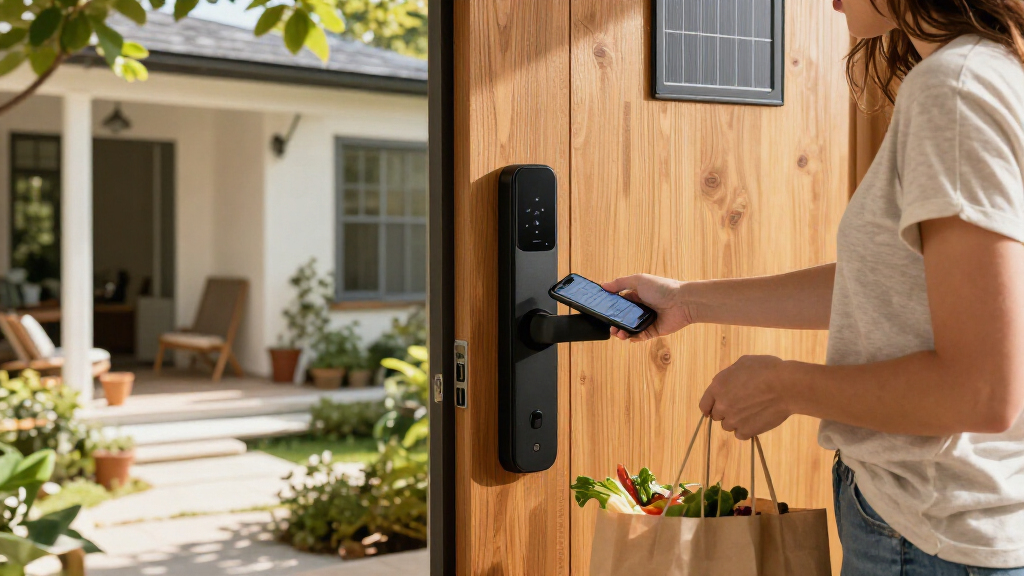

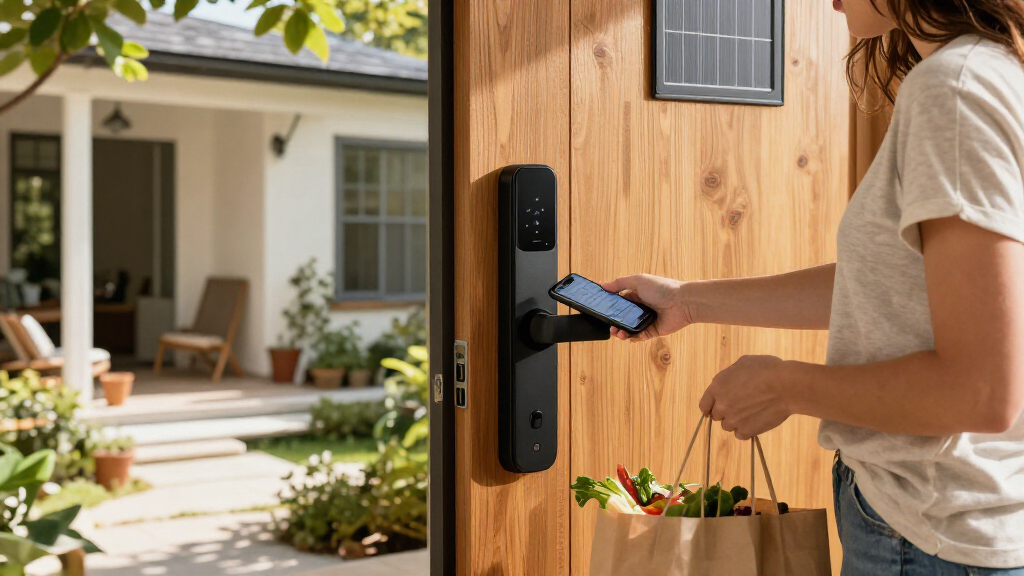
For buyers comparing the best solar smart locks, the right choice depends on whether you need a full front-door deadbolt or a portable lock for a gate, shed, or locker. I’d start with the DESLOC V150 Plus for its combination of solar-assisted power, built-in Wi-Fi, and face and fingerprint entry; choose the Lockin Veno if Matter support and an integrated solar-charging system matter more; and look at the Volcora if what you need is a solar-assisted padlock rather than a deadbolt.

Get home appliances delivered free with Prime
- Fast, free delivery on millions of items
- Prime Video, Amazon Music and more included
- Member-only deals all year
Those picks are not interchangeable. The DESLOC and Lockin are designed to replace a compatible residential deadbolt, while the Volcora secures a hasp or other padlock-compatible fixture. Their power systems also differ: the DESLOC pairs solar assistance with a 10,000 mAh battery, the Lockin uses a 37 Wh battery and a perovskite panel, and the Volcora supplements a smaller rechargeable battery with solar or USB-C charging. I weigh lock type, access, charging resilience, weather limits, and installation fit so you can match the lock to the actual door or enclosure.
Complete the kit


Key Takeaways
- The DESLOC V150 Plus is the most versatile door-lock pick here: it combines solar-assisted charging and a 10,000 mAh battery with Wi-Fi, face recognition, fingerprint access, and a mechanical key.
- The Lockin Veno is the strongest fit for buyers who want a solar deadbolt with Matter and Wi-Fi support without a hub, but its IP53 rating is lower than the IP65 ratings on the other two products.
- The Volcora is the only padlock in this comparison, so it suits a gate, storage box, or similar fixture—not a standard residential deadbolt opening.
- Solar charging reduces dependence on manual charging, but it does not remove the need to check light exposure or keep the listed USB-C, battery, or mechanical-key backup available.
- Measure before buying a deadbolt: the DESLOC requires a 2-1/8-inch bore hole and fits specified door thicknesses and backsets; the Volcora instead depends on a compatible hasp and shackle clearance.
| DESLOC V150 Plus Solar-Powered Smart Lock with 3D Face Recognition |  | Best Overall Solar Smart Deadbolt | Lock type: Smart deadbolt | Power: Solar-assisted; 10,000 mAh lithium battery | Entry methods: 3D face recognition, fingerprint, app, Alexa or Google Assistant voice control, mechanical key | VIEW LATEST PRICE | See Our Full Breakdown |
| Lockin Veno Solar Fingerprint Smart Deadbolt |  | Best for Matter-Ready Smart Homes | Lock type: Smart deadbolt | Power: Perovskite solar panel; integrated 37 Wh battery; USB-C backup charging | Unlocking methods: Five methods; fingerprint access | VIEW LATEST PRICE | See Our Full Breakdown |
| Volcora Smart Fingerprint Padlock with Solar Panel, Keypad, Bluetooth App, and Long Shackle |  | Best Solar-Assisted Padlock for Gates and Storage | Lock type: Smart padlock with long shackle | Access methods: Fingerprint, app, passcode, RFID, physical key | Connectivity: Bluetooth | VIEW LATEST PRICE | See Our Full Breakdown |
| solar smart lock | Lock type | Connectivity | Power | Weather and temperature |
|---|---|---|---|---|
| DESLOC V150 Plus Solar-Powered | Smart deadbolt | Built-in Wi-Fi; no hub required | Solar-assisted; 10,000 mAh lithium battery | IP65; -22°F to 158°F (-30°C to 70°C) |
| Lockin Veno Solar Fingerprint | Smart deadbolt | Wi-Fi and Matter; no hub required | Perovskite solar panel; integrated 37 Wh battery; USB-C backup charging | — |
| Volcora Smart Fingerprint Padl | Smart padlock with long shackle | Bluetooth | — | IP65; 32°F to 158°F (0°C to 70°C) |
More Details on Our Top Picks
DESLOC V150 Plus Solar-Powered Smart Lock with 3D Face Recognition
The DESLOC V150 Plus takes the top spot because it brings the most complete mix of residential access and power backup in this group. Its solar-assisted charging and 10,000 mAh battery give it a substantial stated reserve, while built-in Wi-Fi lets you manage access remotely without adding a hub. For a main entrance, that combination is more useful than solar charging alone: household members can use biometrics, an app, voice control, or the included mechanical key if electronic access is unavailable.
Its access menu is the broadest here. The lock supports 3D face recognition, fingerprint entry, app control, Alexa or Google Assistant voice control, and a mechanical key. Face recognition may make entry convenient when hands are occupied, while fingerprints give residents another quick option. Local biometric storage and liveness detection are useful privacy and spoof-resistance features, though buyers should still assess whether they want facial recognition on a home lock. The stated capacity of up to 50 facial profiles and 50 fingerprints is more than many small households need, but gives the lock room for a larger family or regular users.
Compared with the Lockin Veno, the DESLOC offers face recognition and a larger stated battery capacity in mAh, while the Lockin brings Matter support and specifies a 37 Wh integrated battery. Those battery figures use different units and should not be read as a direct capacity comparison without more details. Compared with the Volcora, the DESLOC is a full deadbolt with Wi-Fi rather than a Bluetooth padlock, making it a much better match for an entry door and remote access needs. The tradeoff is a more demanding fit check: it needs a 2-1/8-inch bore hole, a compatible backset, and a door between 1-3/8 and 2 inches thick.
Weather protection is another strength: IP65 resistance and a listed operating range of -22°F to 158°F suit a wider range of outdoor conditions than the Volcora’s stated range, which begins at 32°F, or the Lockin’s lower IP53 rating. Still, solar assistance depends on the lock receiving usable light, and the face-recognition feature has a stated user-height range of 1.1 to 2.3 meters. I’d pick this for a buyer who wants one feature-rich residential deadbolt with several ways to enter; I’d skip it if the door measurements do not match or a simpler fingerprint-only lock would do.
Pros:- Solar-assisted charging is paired with a stated 10,000 mAh battery.
- Offers face recognition, fingerprint, app, voice, and mechanical-key access.
- Built-in Wi-Fi supports remote access management without a hub.
- IP65 weather resistance and a broad listed operating-temperature range.
Cons:- Requires a compatible 2-1/8-inch bore hole, door thickness, and backset.
- Face recognition is designed for users between 1.1 and 2.3 meters tall.
- Solar assistance still depends on light exposure and should not replace a backup plan.
Best for: Homeowners who want a solar-assisted deadbolt with remote Wi-Fi management, several biometric and key-based entry methods, and a mechanical backup.
Not ideal for: Buyers with incompatible door dimensions, those who do not want face recognition, or anyone seeking a portable lock for a gate or storage fixture.
- Lock type:Smart deadbolt
- Power:Solar-assisted; 10,000 mAh lithium battery
- Entry methods:3D face recognition, fingerprint, app, Alexa or Google Assistant voice control, mechanical key
- Connectivity:Built-in Wi-Fi; no hub required
- Biometric storage:Stored locally on the lock
- Capacity:Up to 50 facial profiles and 50 fingerprints
- Door fit:1-3/8 to 2 inches thick; 2-1/8-inch bore; 2-3/8 or 2-3/4-inch backset
- Weather and temperature:IP65; -22°F to 158°F (-30°C to 70°C)
Our verdict“I rank the DESLOC first for buyers who want the broadest residential entry options and a substantial battery paired with solar assistance.”
Lockin Veno Solar Fingerprint Smart Deadbolt
The Lockin Veno is the pick I’d move to the top when Matter compatibility and a hub-free connected deadbolt matter more than having the longest list of named entry methods. It combines Wi-Fi, Matter, app control, and Alexa support with a built-in perovskite solar panel and an integrated 37 Wh battery. The listed charging condition of 1,000-plus lux, including cloudy or rainy conditions, gives buyers a useful reference point, though actual charging will still depend on the light reaching the installed panel.
For daily entry, the product description highlights fingerprint access and five unlocking methods, with fingerprint unlocking listed at 1.5 seconds. That is a focused approach compared with the DESLOC V150 Plus, which specifically lists face recognition, fingerprint, app, voice, and mechanical-key entry. The Lockin may appeal to a smart-home buyer who wants Matter in the mix and a solar-powered deadbolt, but the supplied details do not name all five unlocking methods. I would check the manufacturer’s current instructions before choosing it based on a particular access method.
Power backup is a strength, but not a reason to forget maintenance. The integrated battery and solar panel are complemented by USB-C backup charging, giving you another way to restore power if light has been inadequate. By comparison, the DESLOC lists a mechanical key as an explicit fallback alongside its battery, while the Lockin’s supplied specifications call out USB-C rather than a mechanical key. If a physical key is a must-have for your household, that difference deserves attention before purchase.
The main compromise is environmental protection. The Veno is rated IP53, below the IP65 ratings listed for both the DESLOC and Volcora. That does not by itself determine whether the lock will suit a sheltered entrance, but it makes the DESLOC the clearer choice where stronger stated dust and water resistance matters. Lockin lists a BHMA Grade 3 security grade and an aluminum body; the DESLOC listing instead emphasizes biometrics, local storage, and its broader temperature range. The Veno makes the most sense for a compatible door in a connected home where Matter support and solar charging are priorities. I’d skip it if you need a stated IP65 rating, a clearly specified mechanical-key fallback, or a larger set of explicitly named access options.
Pros:- Perovskite solar panel works with an integrated 37 Wh battery.
- Supports Wi-Fi, Matter, app control, and Alexa without a hub.
- Fingerprint unlocking is listed at 1.5 seconds, with five unlocking methods overall.
- USB-C backup charging provides an alternative when solar input is insufficient.
Cons:- IP53 rating is lower than the IP65 ratings listed for DESLOC and Volcora.
- Solar charging depends on sufficient light at the installed panel.
- The supplied details do not identify all five unlocking methods or list a mechanical key.
Best for: Smart-home buyers who want a solar-assisted deadbolt with Wi-Fi, Matter support, fingerprint entry, and no hub requirement.
Not ideal for: Buyers who prioritize IP65 protection, need a clearly listed mechanical-key fallback, or want named details for every unlocking method before choosing.
- Lock type:Smart deadbolt
- Power:Perovskite solar panel; integrated 37 Wh battery; USB-C backup charging
- Unlocking methods:Five methods; fingerprint access
- Fingerprint speed:1.5 seconds
- Connectivity:Wi-Fi and Matter; no hub required
- Smart-home control:Amazon Alexa
- Protection and security:BHMA Grade 3; IP53
- Material and dimensions:Aluminum; 10.42 × 3 × 4 inches
Our verdict“I’d choose the Lockin Veno when Matter-ready connectivity and an integrated solar-and-battery setup outweigh the lower ingress rating and less fully specified access list.”
Volcora Smart Fingerprint Padlock with Solar Panel, Keypad, Bluetooth App, and Long Shackle
The Volcora earns its place by solving a different problem from the two deadbolts: it is a solar-assisted smart padlock for a hasp, gate, storage box, or other fixture designed for a padlock. That makes it the right choice when you cannot or do not want to replace a door deadbolt. Its long shackle and alloy-steel body give it a portable format, while fingerprint, app, passcode, RFID, and physical-key access offer several ways to share access without handing out a single permanent key.
Its power approach is deliberately flexible. The 350 mAh battery is listed for up to 8,000 unlocks or 12 months of standby, and the detachable solar panel can supplement charging; USB-C is another charging option. This is a much smaller stated battery than the figures provided for the DESLOC and Lockin, though the units and lock designs differ, so the capacities are not directly comparable. The useful buyer takeaway is that Volcora offers two charging routes, but the solar panel is detachable and the lock may need USB-C charging if its light exposure or use pattern does not support the battery.
Bluetooth is a meaningful difference from the built-in Wi-Fi on the DESLOC and the Wi-Fi and Matter support on the Lockin. Volcora’s app can manage users and temporary passwords, including scheduled access, but its listed connectivity is Bluetooth. I would treat app-based management as a nearby-phone feature unless the manufacturer confirms a remote-access bridge or service; the product details supplied here do not list one. That setup can suit a gate or shared storage point where an authorized person can be nearby, but it is less suitable for a buyer who wants to manage a front door from anywhere.
With an IP65 rating, the Volcora shares the stronger stated ingress protection of the DESLOC, but its operating range is 32°F to 158°F—narrower than the DESLOC’s range and not specified for freezing conditions. Its weather rating and temperature range describe different limits, so an IP65 label should not be read as proof that it will operate in any climate. Compared with both deadbolts, it also lacks their purpose-built door installation and built-in home-lock functionality. I’d choose it for portable access control where a padlock is the correct hardware; I’d skip it for a standard front door, for remote Wi-Fi control, or for use in cold conditions outside its listed range.
Pros:- Supports fingerprint, app, passcode, RFID, and physical-key access.
- Detachable solar panel and USB-C provide two charging options.
- App features include user management and temporary or scheduled passcodes.
- IP65-rated alloy-steel body with a hardened-steel shackle.
Cons:- Bluetooth connectivity is not the same as the built-in Wi-Fi on the deadbolts.
- Listed operating range starts at 32°F, limiting cold-weather suitability.
- A padlock cannot replace a compatible residential deadbolt.
Best for: People securing a padlock-compatible gate, shed, locker, or storage fixture who want fingerprint and temporary-code access with solar and USB-C charging.
Not ideal for: Anyone replacing a residential deadbolt, needing built-in Wi-Fi or confirmed remote app access, or expecting operation below 32°F.
- Lock type:Smart padlock with long shackle
- Access methods:Fingerprint, app, passcode, RFID, physical key
- Connectivity:Bluetooth
- Battery:350 mAh; listed for up to 8,000 unlocks or 12-month standby
- Charging:Detachable solar panel or USB-C
- Materials:Alloy-steel body; hardened-steel shackle
- Weather and temperature:IP65; 32°F to 158°F (0°C to 70°C)
- Dimensions:5.3 × 2.5 × 1 inches
Our verdict“I recommend the Volcora only when you need a portable padlock with flexible electronic access, not a solar smart lock for a standard front door.”
How We Picked
I ranked these products by how well their solar-powered design serves a specific locking job, rather than treating every solar lock as a substitute for a front-door deadbolt. That distinction shapes the order: DESLOC ranks first because it pairs a large stated battery with solar assistance, several entry methods, built-in Wi-Fi, and an included mechanical key. Lockin ranks second for a more connected solar deadbolt with Matter support and a notable integrated battery, though its IP53 rating and reliance on adequate light make its outdoor-use case less robust on paper than the IP65-rated alternatives. Volcora ranks third overall because it is a capable solar-assisted padlock, but a padlock is not a replacement for a door deadbolt.
I also compared access choices against the likely setting. A home’s main entry may benefit from remote management and multiple ways to get in; a shed or gate may benefit more from a padlock’s portability and temporary access codes. I considered backup power and mechanical access because solar conditions vary, as well as weather ratings and operating temperatures because locks are exposed to the elements. A rating is useful for comparison, but it does not tell me whether a particular installation will receive enough light or whether a lock will suit a given door.
Finally, I gave weight to installation and ecosystem fit. Deadbolt measurements can rule out an otherwise appealing product, while Matter or Wi-Fi compatibility matters only if it matches your smart-home plans. Product details supplied for this roundup do not establish solar output under every mounting condition, installation time, or long-term battery performance, so I avoid claims that go beyond the listed specifications. The result is a shortlist with three distinct jobs: an all-around residential option, a connected solar deadbolt, and a solar-assisted padlock.
| solar smart lock | Lock type | Power | Connectivity | Weather and temperature |
|---|---|---|---|---|
| DESLOC V150 Plus Solar-Powered | Smart deadbolt | Solar-assisted; 10,000 mAh lithium battery | Built-in Wi-Fi; no hub required | IP65; -22°F to 158°F (-30°C to 70°C) |
| Lockin Veno Solar Fingerprint | Smart deadbolt | Perovskite solar panel; integrated 37 Wh battery; USB-C backup charging | Wi-Fi and Matter; no hub required | — |
| Volcora Smart Fingerprint Padl | Smart padlock with long shackle | — | Bluetooth | IP65; 32°F to 158°F (0°C to 70°C) |
Factors to Consider When Choosing Best Solar Smart Locks
I’d choose a solar smart lock by matching its hardware to the opening first, then comparing how the lock handles entry, charging, and connectivity. Solar is a power feature, not a substitute for a suitable lock body or backup access. These three options range from a feature-rich Wi-Fi deadbolt to a Matter-ready deadbolt and a Bluetooth padlock, so the most appealing specification is only useful if it fits your door and routine.
Start with deadbolt versus padlock
The first decision is physical: do you need to replace a residential deadbolt, or secure a fixture with a padlock? The DESLOC V150 Plus and Lockin Veno are deadbolts; the Volcora is a padlock. A padlock can suit a gate, shed, locker, or storage enclosure with compatible hardware, but it will not install in a standard deadbolt opening. If the lock is for your front door, compare the two deadbolts first. If the opening has a hasp or padlock loop, the Volcora may be the more practical form factor.
For the DESLOC, check the listed door thickness of 1-3/8 to 2 inches, the 2-1/8-inch bore hole, and the 2-3/8- or 2-3/4-inch backset before ordering. The supplied product information does not give equivalent door-fit measurements for the Lockin, so I would confirm its fit requirements with the manufacturer or installation guide. For Volcora, check the fixture’s shackle clearance and opening size rather than deadbolt measurements. Fit comes before features: a lock that cannot mount correctly is not a useful upgrade, however appealing its solar setup may be.
Treat solar as assistance, not a guarantee
Solar charging can reduce how often a battery needs attention, but performance depends on the panel’s exposure and the conditions where the lock is mounted. The Lockin lists a 1,000-plus-lux charging condition and describes operation in cloudy or rainy light; that is a reference point, not a guarantee that every shaded doorway will keep the battery charged. The DESLOC lists solar-assisted charging with a 10,000 mAh battery, while the Volcora uses a detachable panel alongside a 350 mAh battery and USB-C charging.
Do not compare the DESLOC’s mAh figure directly with the Lockin’s 37 Wh figure as if they were the same measurement. The supplied information does not include all details needed to translate those values into an exact runtime comparison. Instead, ask whether the product has a backup charging route or mechanical access that suits your needs. The DESLOC includes a mechanical key; the Lockin lists USB-C backup charging; the Volcora also lists USB-C and a physical key. Keep those fallbacks accessible, and check battery status according to the product’s instructions rather than assuming the panel will receive enough light year-round.
Pick entry methods for the people who will use the lock
Different access methods solve different problems. Fingerprint entry can simplify daily access for registered users, while app controls can help manage permissions. A mechanical key gives a familiar physical fallback. Face recognition adds another hands-free option, but the DESLOC’s stated height range and the buyer’s comfort with facial biometrics are worth weighing. Its biometric data is described as stored locally, which distinguishes it from a setup that depends on storing biometric profiles remotely.
The DESLOC lists the broadest specific set of residential entry methods here. The Lockin lists five unlocking methods but the supplied details identify fingerprint access without naming every method, so verify any required method before purchase. The Volcora combines fingerprint, passcode, RFID, app, and physical-key access, which can work well for a shared gate or storage point. Its app includes temporary and scheduled passcodes, but because connectivity is listed as Bluetooth rather than Wi-Fi, do not assume those controls can be managed remotely from anywhere.
Compare connectivity with your smart-home setup
Built-in Wi-Fi, Matter, and Bluetooth describe different ways to connect and control a lock. The DESLOC lists built-in Wi-Fi with no hub required and supports Alexa or Google Assistant voice control. The Lockin lists Wi-Fi, Matter, and Alexa, also without a hub. That makes it the standout option for a buyer who specifically wants Matter in a solar deadbolt, provided the rest of the home setup and desired functions are compatible. The Volcora lists Bluetooth, which is useful for app interaction nearby but does not establish the same remote-control capability as built-in Wi-Fi.
Before buying, make a short list of the functions you actually plan to use: remote access management, voice commands, temporary guest access, or Matter-based integration. Then check compatibility for the exact devices and apps you own. A longer compatibility list does not automatically make one lock better; a feature that does not fit your setup adds little. For a household that wants multiple access types and remote management, DESLOC’s feature set is especially broad. For a Matter-focused home, Lockin has the clearer match. For a local padlock, Volcora’s Bluetooth app features may be sufficient.
Read weather ratings alongside temperature limits
Weather resistance and operating temperature answer different questions. The DESLOC and Volcora list IP65, while the Lockin lists IP53. The DESLOC also has the broadest stated operating range, from -22°F to 158°F. The Volcora lists 32°F to 158°F, so its stated lower limit rules it out for locations that regularly fall below freezing unless the manufacturer provides other guidance. The Lockin’s temperature range is not included in the supplied details, so I would confirm it for exposed installations.
Neither an ingress rating nor a temperature range tells the whole story of solar performance. A lock under a deep porch roof may receive less light than one on a brighter doorway, and a detachable padlock panel may need different positioning from a panel built into a deadbolt. Consider the actual mounting location, exposure to rain and dust, seasonal shade, and local temperatures. When conditions are challenging, favor clear manufacturer guidance and keep the listed charging or mechanical fallback available.
Choose the tradeoff that matches your priority
If I wanted one choice for a typical compatible home entrance, I’d begin with the DESLOC V150 Plus because it combines solar assistance, a substantial stated battery, Wi-Fi, broad entry methods, and IP65 protection. If I wanted a connected deadbolt with Matter support, I’d compare the Lockin Veno closely and confirm its fit, weather limits, and the specific unlocking methods I need. If I needed to secure a gate or storage fixture rather than a front door, I’d choose the Volcora for its padlock form, multiple access methods, and solar-plus-USB-C charging.
There is no single winner for every installation. The DESLOC has the most explicit access options but demands careful door measurement. Lockin adds Matter and an integrated solar-battery design but has a lower ingress rating and less detail supplied about its full method list. Volcora offers the most portable format but lacks the deadbolts’ listed Wi-Fi connectivity and has a higher minimum operating temperature. Choose by opening, light, climate, and access routine, not by solar labeling alone.
Frequently Asked Questions
Can a solar smart lock work when there is little direct sunlight?
It depends on the panel, the light reaching it, and the product’s power setup. The Lockin lists charging in 1,000-plus lux light, including cloudy or rainy conditions, while the DESLOC describes solar-assisted charging and the Volcora pairs a detachable panel with USB-C charging. None of those details means a shaded installation will always stay charged. I’d check the manufacturer’s guidance for the mounting location and keep the specified backup charging method or physical key available.
Which of these locks is best for a front door?
The DESLOC V150 Plus and Lockin Veno are the two deadbolts in this comparison; the Volcora is a padlock for compatible fixtures. I rank the DESLOC first for a front door because it lists built-in Wi-Fi, several explicit entry methods, a mechanical key, and IP65 protection. The Lockin is a stronger match if Matter support is a priority, but I’d verify door fit and confirm which of its five unlocking methods are available before buying.
Does solar charging mean I will never need to recharge a lock?
No. Solar can help maintain or supplement a battery, but the amount of light at the lock and how often it is used affect whether charging keeps pace. The products here list other forms of backup: USB-C for the Lockin and Volcora, plus a mechanical key for the DESLOC and a physical key for the Volcora. I’d treat solar as a way to reduce charging attention, not as a replacement for checking the battery or understanding the fallback procedure.
Can the Volcora padlock replace my existing deadbolt?
No. The Volcora is designed as a padlock, so it needs a compatible hasp, loop, or similar fixture. It does not install in a standard residential deadbolt opening. For a front door, compare the DESLOC and Lockin and confirm that the selected deadbolt matches your door preparation. For a gate or storage enclosure already set up for a padlock, the Volcora’s portable form may be a better fit.
What should I check before buying a solar smart deadbolt?
Measure the door and confirm the product’s bore hole, backset, and thickness requirements; the DESLOC lists these dimensions explicitly. Check the lock’s connectivity against your smart-home setup, verify which access methods are supported, and review the weather rating and operating temperature for the installation site. Also consider how much light reaches the panel and whether you can use the listed backup charging or key access if solar input is insufficient.
Conclusion
My recommendation depends on the job. For a compatible main entrance where you want multiple ways to get in, built-in Wi-Fi, and strong stated weather protection, I’d choose the DESLOC V150 Plus, after checking its door measurements and face-recognition fit. For a connected home where Matter support is the deciding feature, I’d choose the Lockin Veno after confirming its installation details and the access methods your household needs. For a gate, shed, or storage fixture that takes a padlock, I’d choose the Volcora—but not as a deadbolt substitute, and not for conditions below its listed temperature range.
Before placing an order, match the lock to the opening, check the panel’s likely light exposure, and decide which fallback you are willing to rely on. Solar charging is most useful when the lock’s format, access system, and backup plan already fit your needs.