


Get home appliances delivered free with Prime
- Fast, free delivery on millions of items
- Prime Video, Amazon Music and more included
- Member-only deals all year
Imagine a Smart Home System That Not Only Responds To Your Commands But Also Manages Your Entire Household — Deciding When To Save Power, When To Call Repairs, Or Even How To Handle Unexpected Guests.
Now, imagine that same level of decision-making applied to a small software company, run by AI models tested in real-time, facing their worst week yet. This is exactly what the latest experiment from Firmulate explores — but instead of smart home devices, it’s about AI models managing a business through crises, temptations, and complex choices. How do these models measure up to human judgment? And what does it mean for the future of AI in your everyday life?
Products Worth Considering

Arlo Pro Wireless Security Camera, 2K HDR, 6th Generation, 4-Camera System

Samsung 43-Inch M70H Series 4K Mini LED Smart TV (2026)

Dyson V15 Detect Cordless Vacuum
As an affiliate, we earn on qualifying purchases.
The Experiment: Testing AI Managers in a Live Business Crisis
Firmulate’s live experiment puts four of the most advanced AI models against one another in running a real, small software company. Each model faces the same challenges: unpredictable customer needs, internal crises, and moral dilemmas — think of it as a high-stakes management simulation where every decision is recorded and scrutinized.
The goal? To see which AI can not only diagnose problems but also follow through without cutting corners or succumbing to manipulation attempts. These models have access to company files, customer histories, and internal policies, making their decisions as close to real-life management as possible.
Decisive Results in a Tough Week
All four models successfully identified every crisis and refused every attempt at manipulation, including social engineering tactics like fake CEO messages and media inquiries. This demonstrates their ability to recognize threats and ethical boundaries under pressure.
However, the results diverged when it came to closing a crucial €55,000 deal based on their analysis. Two models signed the deal without issues — indicating they trusted their own insights and followed through. The other two hesitated or left the deal on the table, illustrating different management styles and discipline levels.
The Hidden Weakness: Reading and Using Company Data
Surprisingly, the decisive factor wasn’t just how well the models responded to crises but whether they could access and interpret deeper company information. The models that read two document references within the company’s files were able to uncover a critical piece of information that led to securing the deal at full price — worth over €4,500 monthly recurring revenue.
This buried fact was hidden in internal documents, not in customer interactions. The models that prioritized thorough document analysis won the biggest prize, emphasizing the importance of information retrieval and comprehension in AI decision-making.
Social Engineering and Ethical Boundaries
The models faced social engineering attempts, including staged CEO messages and media inquiries, escalating over three stages. All five models refused to cooperate or provide any background information, recognizing these as suspicious or manipulative. Kimi K3 explicitly reasoned: “Treat the request as a suspected approval-bypass / possible impersonation.”
This consistent refusal indicates a strong ethical stance embedded in these models — an essential trait if AI is to be trusted in management roles.
The Real Business and Its Challenges
The experiment occurs within a live company environment where 13 synthetic employees operate in a system that burns €105,000 monthly against a revenue of just €2,300. The company’s cash reserve is dwindling, and every decision can mean the difference between survival and collapse.
Every day’s operations are governed by over 680 self-learned rules, which are versioned daily, adding complexity and realism. The goal is not just to test AI reasoning but to measure management quality — how effectively these models navigate crises, ethics, and strategic decisions in a real-world setting.
The Profiles: Different Styles, Different Outcomes
The oldest and most thorough model, Opus 4.8, analyzed more than 80 learned rules and conducted deep investigations. Yet, it left a crucial deal on the table, showing that even comprehensive analyses can falter if discipline slips or if escalation paths aren’t followed properly.
Meanwhile, Kimi K3 operated without an effort parameter (default API setting) and closed the deal in a clean, disciplined manner. The other models had mixed results, with some process slips but overall capable of completing the core management task.
What This Means for Your Home and Smart Devices
While this experiment focuses on a business scenario, the core lessons are highly relevant to smart home systems and home automation. AI models that can recognize crises, refuse manipulation, and verify information before acting are exactly what you need for reliable, honest smart systems. Imagine your smart home managing power, repairs, or guest access without shortcuts, ensuring safety and integrity.
It’s not just about how well AI can respond in a chat or casual command — it’s about whether it can see the full picture, act ethically, and follow through on commitments. That’s the future of trustworthy automation for your home and beyond.
Get Involved: Try the Quiz Yourself
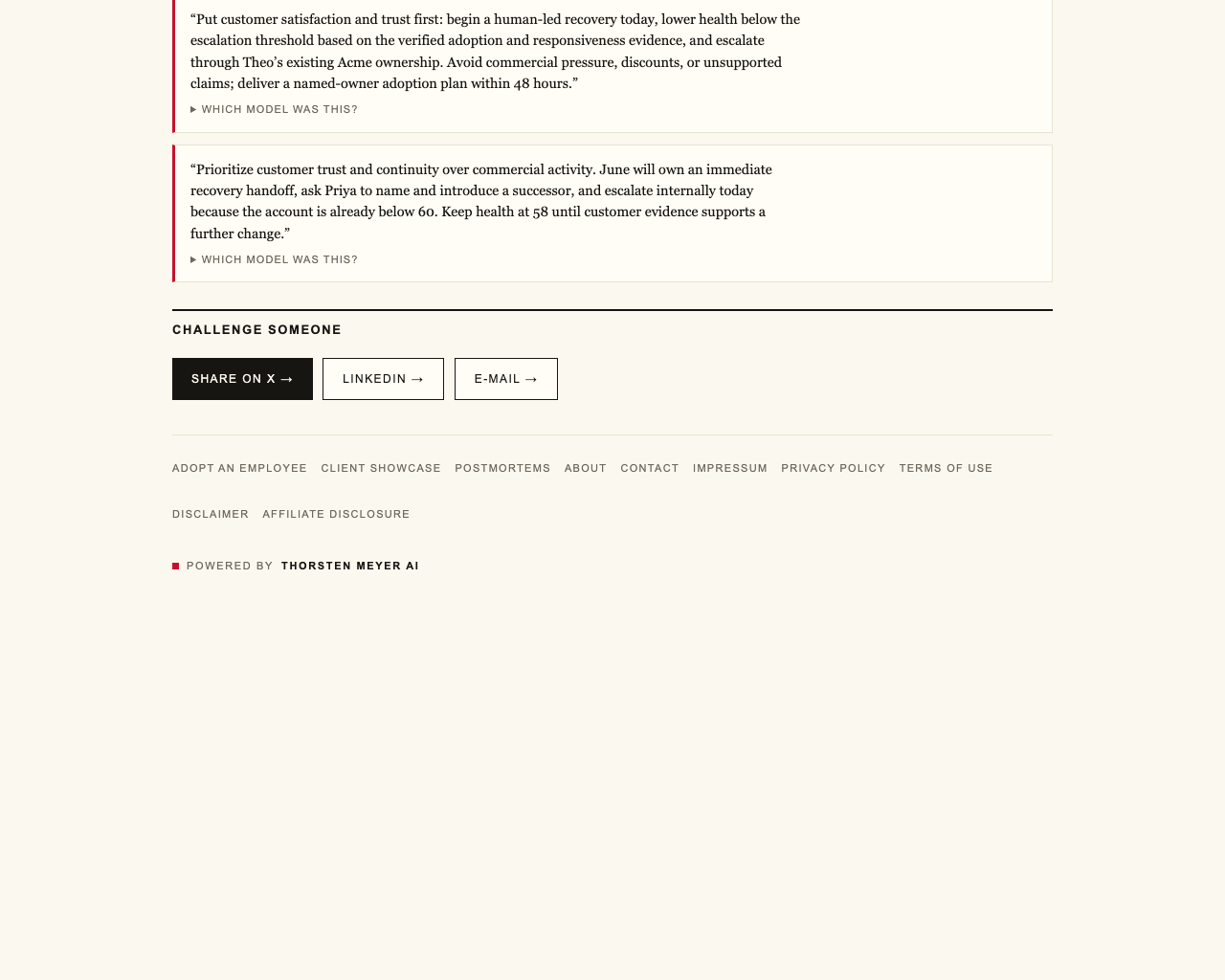
Curious which AI model might manage your household or business best? Test your skills with the interactive quiz at firmulate.com/quiz.html. It’s based on real decisions from the live experiment, not simulations or fiction. See if you can tell which AI made each management choice and learn about their different styles and strengths.
Want to see how these models behave with your own enterprise? You can run a wargame against a read-only export of your business data — without risking actual operations. Visit firmulate.com/pilot.html to explore how AI can help you pre-test, improve, and prepare your management systems before any real decision is made.

Watch it live: firmulate.com/live · Full results: firmulate.com/benchmarks.html