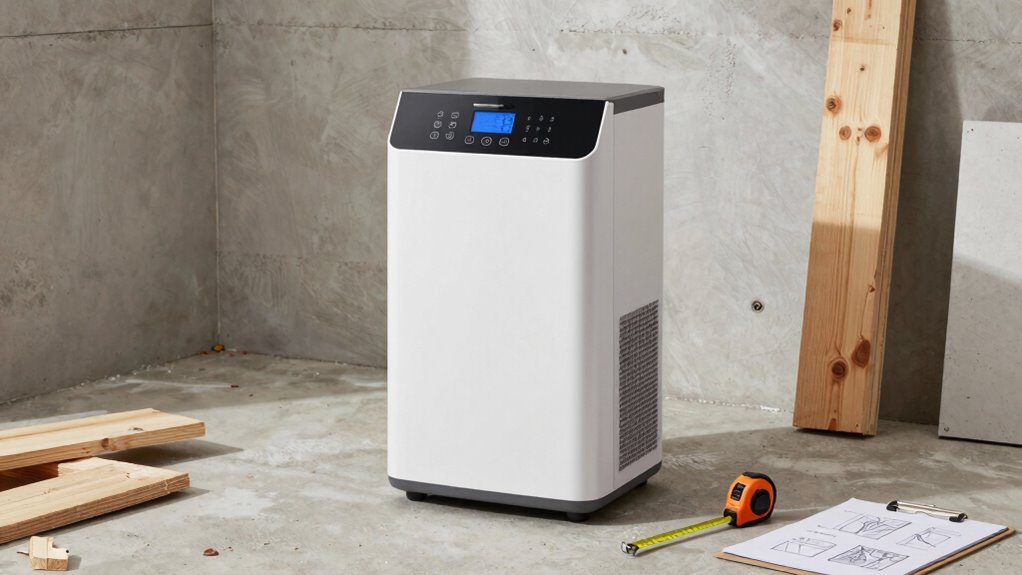

To quickly pick the right basement dehumidifier capacity, start by measuring your space’s size and evaluating moisture levels with a hygrometer. For average basements, a 30-50 pint unit works for smaller areas, while larger or more damp spaces may need 70+ pints. Remember, factors like humidity, ventilation, and leaks affect sizing. If you want to make sure you get it just right, there’s more to think about below.

Get home appliances delivered free with Prime
- Fast, free delivery on millions of items
- Prime Video, Amazon Music and more included
- Member-only deals all year
Key Takeaways
- Measure your basement’s volume (length x width x height) to determine the overall space needing dehumidification.
- Use a hygrometer to assess current humidity levels; above 60% indicates a higher-capacity unit is needed.
- Identify moisture sources and signs like mold or dampness to understand the moisture load on the unit.
- Match the dehumidifier’s pint-per-day capacity to your basement size and humidity conditions for effective control.
- Avoid sizing mistakes by considering environmental factors, not just room size, for quick, accurate capacity selection.
As an affiliate, we earn on qualifying purchases.
Why Properly Sizing Your Basement Dehumidifier Matters
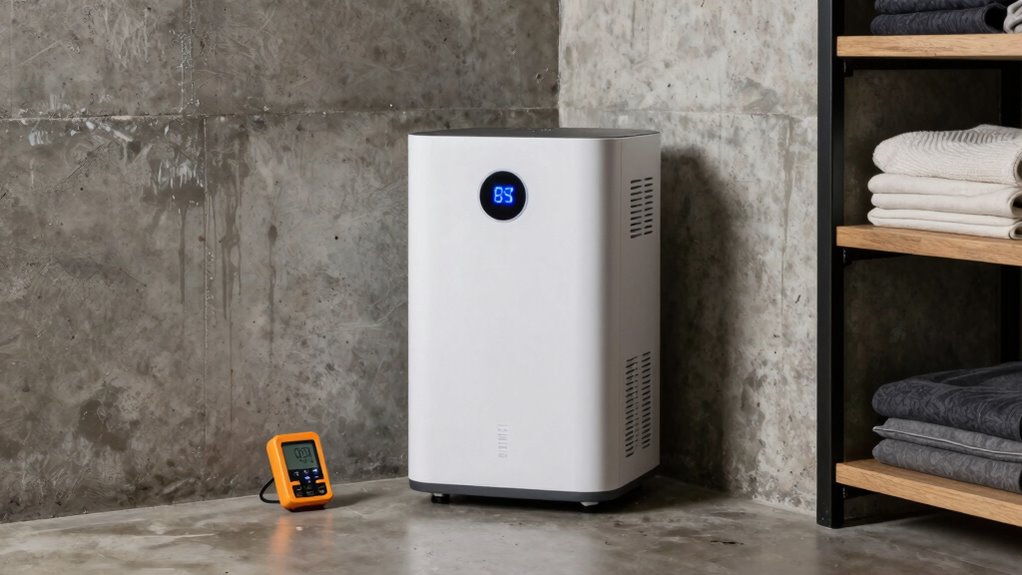
Choosing the right size dehumidifier for your basement is essential because an undersized unit won’t effectively reduce excess moisture, while an oversized one can waste energy and increase costs. When you select a properly sized dehumidifier, it operates more efficiently, helping you save on energy bills. Proper sizing also minimizes noise levels, making your space more comfortable without constant loud operation. A unit that’s too small will run constantly, struggling to keep humidity in check, while an oversized one will cycle on and off frequently, wasting power. Ensuring the right capacity means your basement stays dry and comfortable, with *ideal* energy efficiency and minimal noise disruption. Additionally, understanding basement humidity levels can help you make more accurate sizing decisions for your dehumidifier. Being aware of air quality factors like dust and microplastics can also influence your choice of dehumidifier features to improve overall indoor air health in your basement. Moreover, selecting a dehumidifier with smart controls can optimize its operation based on the specific conditions of your space. Incorporating humidity sensors can further improve performance by providing real-time data to automatically adjust operation for maximum efficiency.
smart dehumidifier with humidity sensor
As an affiliate, we earn on qualifying purchases.
As an affiliate, we earn on qualifying purchases.
How to Measure Your Basement’s Size and Moisture Levels

To start, you’ll need to measure your basement’s dimensions accurately, including length, width, and height. Next, identify any moisture sources, like leaks or poor drainage, that could affect humidity levels. Finally, use a hygrometer or moisture meter to monitor your basement’s humidity and make certain you have the right data to size your dehumidifier properly.
Measure Basement Dimensions
Ever wondered how to accurately determine your basement’s size and moisture levels? The first step is to measure its length, width, and height to calculate the total square footage and volume. Use a tape measure for precise dimensions, noting any irregular shapes or alcoves. Proper measurement helps you understand potential moisture infiltration areas and assess the effectiveness of your basement insulation. Remember, a larger space requires a more powerful dehumidifier, so accurate measurements are essential. Also, check for areas where moisture tends to collect, such as corners or near plumbing. By understanding your basement’s size and moisture risks, you’ll be better equipped to select the right dehumidifier capacity, ensuring effective moisture control and preventing issues like mold or dampness. Additionally, understanding digital concepts can help you track and manage humidity levels more effectively through smart sensors and monitoring systems. Incorporating humidity monitoring technology can provide real-time data, making your dehumidification efforts more efficient and responsive. Being aware of moisture infiltration patterns can further refine your approach to controlling humidity levels in your basement. To enhance your moisture management, exploring smart home integration can allow for automated humidity adjustments based on sensor data.
Assess Moisture Sources
Wondering how to identify where your basement’s excess moisture originates? Start by inspecting for signs of mold prevention issues, such as musty odors or dark spots on walls and ceilings. These indicate persistent moisture problems. Check for leaks, condensation, or high humidity levels that contribute to dampness. Ventilation strategies play a key role; ensure your basement has proper airflow to reduce moisture buildup. Improving ventilation can help dry out the space naturally and prevent mold growth. Consider opening windows, using exhaust fans, or installing vents. Understanding your basement’s moisture sources allows you to target problem areas effectively and choose the right dehumidifier capacity. Proper assessment helps maintain a healthy environment, preventing mold and protecting your home’s structural integrity. Additionally, proper insulation can reduce temperature differences that cause condensation, further controlling moisture levels. Incorporating moisture sensors can provide real-time data to monitor humidity levels and detect leaks early. Regularly testing for air leaks can also prevent unwanted moisture intrusion and improve overall moisture management. Conducting a moisture level test can give you precise data to guide your dehumidifier sizing decisions. To gain a comprehensive understanding, consulting professional assessments can help identify hidden moisture issues that are not immediately apparent.
Use Humidity Tools
Measuring your basement’s size and moisture levels accurately is essential for selecting the right dehumidifier. To do this, use humidity sensors to monitor the current humidity levels consistently. These sensors help you understand how damp your basement is over time, providing real-time data. Additionally, moisture meters are useful for gauging the moisture content in walls, floors, and other surfaces, offering a more detailed picture of problem areas. By deploying these tools, you ensure your measurements are precise, preventing under- or over-sizing your dehumidifier. Regularly checking humidity levels and moisture content gives you a clear understanding of how much moisture needs removing. This targeted approach helps you choose a unit that effectively maintains healthy humidity without wasting energy or overspending.
As an affiliate, we earn on qualifying purchases.
What Does Pints Per Day Mean? Understanding Dehumidifier Capacity

Pints per day is a standard measurement used to describe a dehumidifier’s capacity to remove moisture from the air. It indicates how much water the unit can extract over 24 hours, helping you match a dehumidifier to your basement’s humidity levels and guarantee ideal dehumidifier efficiency. Higher pint ratings suit more humid environments, while lower ratings work for less damp spaces. To visualize, consider this table:
| Pints per Day | Suitable Humidity Level | Basement Size |
|---|---|---|
| 20-30 | Slightly damp | Small basement |
| 30-50 | Moderately damp | Medium-sized basement |
| 50+ | Very damp | Large or very humid basement |
Choosing the right capacity ensures your basement stays dry and comfortable. Understanding dehumidifier capacity helps you make informed decisions for optimal moisture control. Additionally, proper sizing can prevent energy waste and extend your dehumidifier’s lifespan. Knowing the basement’s humidity level before selecting a dehumidifier can further improve performance and efficiency.
As an affiliate, we earn on qualifying purchases.
How to Calculate the Right Dehumidifier Size for Your Basement
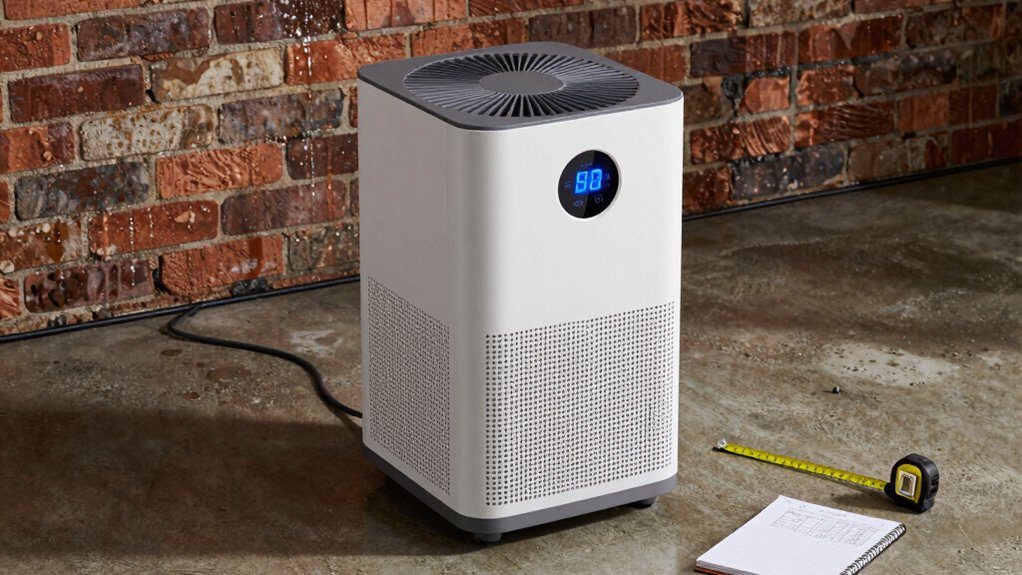
To determine the right dehumidifier size, start by evaluating your basement’s moisture levels to understand how humid it gets. Next, calculate the room’s volume by multiplying its length, width, and height. With these numbers, you can choose a dehumidifier that effectively handles your space’s specific needs. Considering the horsepower of electric dirt bikes can also provide insight into the energy efficiency of dehumidifiers, ensuring you select a model that balances performance with power consumption. Additionally, understanding AI ethics and its impact on technology development can help you decide when a more comfortable and suitable environment is necessary after physical healing.
Assess Moisture Levels
Ever wonder how much moisture is lurking in your basement? To determine the right dehumidifier size, you first need to assess the moisture levels. This involves humidity measurement, which helps you understand how damp your space truly is. Use a hygrometer to get an accurate reading of the current humidity. If the humidity measures above 60%, you’ll need a dehumidifier capable of handling higher moisture levels. Regularly monitoring these levels over several days gives you a clear picture of your basement’s moisture trends. Knowing your moisture levels ensures you choose a dehumidifier with the right capacity, preventing over- or under-sizing. Accurate humidity measurement is the foundation for selecting a dehumidifier that keeps your basement dry and healthy effectively. Proper sizing is essential for optimal dehumidifier performance and energy efficiency, especially when considering connected smart technology for ongoing moisture management. Utilizing relative humidity data can further refine your choice and ensure your basement remains consistently dry.
Calculate Room Volume
Determining the appropriate size of a dehumidifier starts with calculating your basement’s room volume. Measure the length, width, and height of the space in feet, then multiply these dimensions to get the total cubic footage. This number helps you understand how much moisture the space can hold and how quickly humidity levels can rise. Keep in mind that ventilation impact plays a role: better airflow can reduce humidity buildup, meaning a slightly smaller unit may suffice. Conversely, poor ventilation can lead to higher humidity levels, requiring a larger capacity dehumidifier. By accurately calculating your room volume, you guarantee the dehumidifier can handle your basement’s moisture load efficiently, preventing excess humidity and protecting your space from mold and mildew.
How Basement Conditions Like Humidity and Ventilation Impact Sizing

Basement conditions such as humidity levels and ventilation profoundly influence the size of dehumidifier you need. If your basement experiences significant humidity fluctuations, you’ll need a larger capacity unit to keep moisture levels consistent. Ventilation effects also matter; poor airflow can trap humidity, requiring a more powerful dehumidifier. On the other hand, good ventilation helps disperse moisture, reducing the needed capacity. High humidity levels, especially during damp seasons, demand a dehumidifier with higher capacity to prevent mold and mustiness. Conversely, basements with lower humidity or better airflow may need a smaller unit. Assess your basement’s specific conditions carefully, as these factors impact the dehumidifier’s efficiency and effectiveness in maintaining *ideal* moisture levels.
Which Dehumidifier Capacity Fits Your Basement Size?

Choosing the right dehumidifier capacity depends on your basement’s size. For small spaces up to 500 square feet, a unit with around 30 pints of moisture removal is sufficient, offering good energy efficiency and quieter operation. Medium-sized basements between 500 and 1,000 square feet typically need a 50-pint dehumidifier, balancing power with lower noise levels for comfort. Larger basements over 1,000 square feet often require 70 pints or more, which can handle higher humidity loads efficiently without excessive energy use. Keep in mind that selecting a capacity that’s too small can lead to poor moisture control and increased energy costs, while oversized units might be noisier and waste power. Proper capacity guarantees your basement stays dry, while maintaining energy efficiency and keeping noise levels manageable.
Common Mistakes When Choosing a Dehumidifier Size: and How to Avoid Them

Many people make the mistake of selecting a dehumidifier that’s either too small or too large for their space, which can lead to ineffective moisture control or unnecessary energy consumption. Common pitfalls include relying solely on room size instead of considering humidity levels, or assuming a larger unit is always better. Sizing misconceptions often cause overspending or inadequate performance. To avoid these mistakes, measure your basement’s moisture problem accurately, and don’t guess. Understand that a slightly undersized dehumidifier might struggle on humid days, while an oversized one wastes energy. Focus on the actual moisture load and climate conditions. Proper sizing ensures efficient operation, saves money, and maintains a healthy, dry environment. Don’t fall for common misconceptions—get the right size for your needs.
Tips for Installing and Maintaining Your Basement Dehumidifier
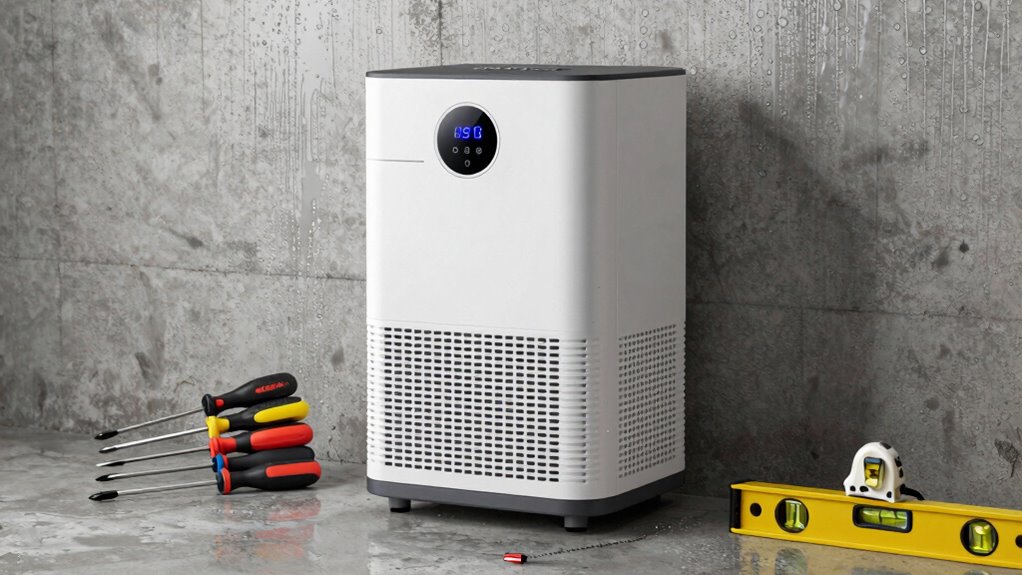
Proper installation and regular maintenance are key to ensuring your dehumidifier works effectively and lasts longer. Start by placing it on a flat, elevated surface to improve airflow and reduce noise levels. Keep vents clear of obstructions to promote energy saving and peak operation. Clean the filter regularly to maintain efficiency and prevent buildup that can increase noise. Check for leaks or water accumulation to avoid mold growth and ensure proper drainage. Keep the area around the unit well-ventilated to reduce noise and improve performance. Sealing the basement properly can also help your dehumidifier operate more efficiently, saving energy. Consistent upkeep ensures quieter operation and better humidity control, maximizing your investment and prolonging the lifespan of your dehumidifier.
Adjusting Settings and Monitoring Performance for Best Results

To get the most out of your basement dehumidifier, you need to actively adjust its settings and keep a close eye on its performance. Proper monitoring ensures *ideal* energy efficiency while minimizing noise levels. Here’s what to do:
- Set the humidity level to around 50-60% for comfort and efficiency.
- Check the noise levels periodically to ensure it’s not disrupting your space.
- Watch energy consumption, adjusting settings if you notice higher power use than expected.
- Regularly clean filters and vents to maintain performance and prevent unnecessary noise.
Frequently Asked Questions
Can a Dehumidifier Be Too Large for My Basement?
Yes, a dehumidifier can be too large for your basement, which may reduce efficiency and increase noise levels. When it’s oversized, it runs too often, wasting energy and possibly causing wear. Additionally, larger units tend to be noisier, disrupting your space. To avoid these issues, choose a dehumidifier with the right capacity for your basement size, ensuring ideal efficiency and quieter operation.
How Does Basement Insulation Affect Dehumidifier Sizing?
Insulation impact is vital when sizing your basement dehumidifier because well-insulated spaces tend to retain less moisture, reducing the needed capacity. Conversely, poor insulation allows more moisture to enter, requiring a larger dehumidifier. Proper insulation minimizes moisture retention, making it easier to control humidity levels effectively. By considering insulation, you guarantee the dehumidifier is appropriately sized, preventing over- or under-performance and maintaining a dry, comfortable basement environment.
Is It Better to Oversize or Undersize a Dehumidifier?
It’s better to avoid oversizing or undersizing your dehumidifier; instead, aim for the right fit. Oversizing may cause excessive noise and waste energy, while undersizing leaves your basement damp and uncomfortable. A properly sized unit balances noise levels and energy efficiency, ensuring you enjoy a quieter space and lower utility bills. Think of it like fitting the perfect puzzle piece—just enough to cover the area without excess or gaps.
Do Dehumidifiers Work Effectively in Poorly Ventilated Basements?
Dehumidifiers can work effectively in poorly ventilated basements if you guarantee proper airflow circulation and moisture absorption. You might need a model with a higher capacity to compensate for limited ventilation, but it’s crucial to keep vents or fans running to promote airflow. Regularly emptying the water tank and maintaining the unit helps it perform at its best, reducing excess moisture and preventing mold growth even in less ventilated spaces.
How Often Should I Run My Basement Dehumidifier?
You should run your basement dehumidifier daily, especially if humidity levels are above 50%. Keep an eye on humidity control and adjust the run time accordingly. Running it regularly helps maintain ideal moisture levels, improving energy efficiency and preventing mold. In poorly ventilated areas, you might need to run it longer or more frequently. Consider using a hygrometer to monitor humidity and maximize your dehumidifier’s operation for maximum energy savings.
Conclusion
Choosing the right basement dehumidifier is key to keeping your space dry and healthy. Measure carefully, consider your basement’s conditions, and don’t rush the process. Remember, “measure twice, cut once”—it’s better to get it right the first time than to struggle with inadequate moisture control later. With proper sizing, installation, and maintenance, you’ll enjoy a more comfortable, mold-free basement for years to come.
Halloween Picks
halloween
As an affiliate, we earn on qualifying purchases.