Choosing the right BTU for your air conditioner is key to avoiding an underpowered unit that can’t handle your space. If your AC is too small, it will run nonstop, waste energy, and struggle to cool your home effectively. By accurately measuring your room size and matching it to the proper BTU, you’ll save money, improve comfort, and extend your system’s lifespan. Keep exploring to discover how to select and maintain the perfect AC size for your home.
Key Takeaways
- Properly measuring room size ensures the AC has the correct BTU capacity to meet cooling needs.
- Matching BTU to room size prevents undercooling and guarantees consistent comfort.
- Accurate sizing reduces energy waste and prevents the AC from running nonstop or cycling frequently.
- Considering sunlight exposure and insulation helps select the right BTU for optimal efficiency.
- Using the BTU rule avoids underpowered units, ensuring effective cooling and longer system lifespan.
Top picks for "rule save underpower"
Open Amazon search results for this keyword.
As an affiliate, we earn on qualifying purchases.
What Factors Affect Your Home’s Cooling Needs?

Have you ever wondered what determines how much your home needs to be cooled? Several factors influence your cooling needs, starting with ventilation options. Good ventilation helps regulate indoor air flow, reducing heat buildup and improving comfort. Proper airflow management can also help prevent hotspots and ensure even cooling throughout your space. Poor ventilation can trap warm air, making your AC work harder. Indoor humidity also plays a significant role; high humidity makes the air feel warmer and more uncomfortable, increasing cooling requirements. Conversely, lower humidity levels can make your space feel cooler without needing extra cooling power. Other factors include your home’s insulation, window size and placement, and the number of occupants. All these elements together influence how much cooling capacity your AC needs to keep your home comfortable and energy-efficient. Additionally, ventilation systems can significantly impact indoor climate control, affecting overall cooling efficiency. Understanding building design elements can help optimize your cooling strategy and reduce energy consumption. Recognizing the importance of indoor air quality can further enhance comfort and efficiency in your home. Maintaining proper air circulation is essential for a healthy and comfortable indoor environment.
Why Picking the Right BTU Matters for a Comfortable Home

Choosing the right BTU for your air conditioner is essential to guarantee your home stays comfortable without wasting energy. An improperly sized unit can lead to zoning challenges, where some rooms stay too hot or cold, and humidity control problems, making the space uncomfortable and damp. Selecting the correct BTU ensures efficient cooling, better humidity management, and consistent comfort. Proper air conditioner sizing is crucial for maintaining optimal indoor conditions and avoiding unnecessary energy costs. A well-sized unit can also prevent short cycling, which reduces wear and extends the lifespan of your AC. Additionally, correct sizing helps optimize the overall performance of your cooling system. When sizing an AC unit, considering factors like insulation, ceiling height, and local climate is important for energy efficiency. Here’s a quick guide:
| Room Size | Recommended BTU | Notes |
|---|---|---|
| 200-300 sq ft | 6,000-8,000 | Ideal for small rooms |
| 300-500 sq ft | 8,000-10,000 | Suitable for medium rooms |
| 500+ sq ft | 10,000+ | Larger spaces, zoning challenges |
Getting the right size prevents underperformance and keeps humidity levels in check.
The Simple BTU Rule: Match Your AC to Your Room Size

Choosing the right BTU for your room guarantees proper cooling capacity and maintains your space comfortable. When you match your AC to your room size, you avoid overcooling or undercooling, which can waste energy. This not only helps you use energy more efficiently but also prevent system strain, extending the lifespan of your air conditioner. Additionally, selecting an appropriately sized AC ensures optimal sleep comfort, and enhances your overall rest experience. Understanding cooling capacity is essential to making the best choice for your environment and energy efficiency. Properly sizing your air conditioner can also prevent issues like bitter taste caused by inadequate cooling, ensuring your system operates smoothly. Recognizing the importance of vehicle protection and accessories can further optimize your comfort and efficiency.
Proper Room Cooling Capacity
Ever wonder how to guarantee your air conditioner cools your room effectively without wasting energy? The key is choosing the proper cooling capacity. Here are three important points to consider:
- Room Size: Match your AC’s BTU rating to your room’s square footage to ensure ideal cooling without overworking the unit. Proper sizing prevents overcapacity issues that can lead to unnecessary energy consumption. Additionally, understanding cryptid mysteries can shed light on the cultural significance of local folklore related to mysterious creatures, which sometimes influence regional legends and stories. Recognizing contrast ratio and its impact on image quality can help you select the right projector for your home theater needs. Moreover, considering piercings that might affect the room’s aesthetics is an unconventional but interesting perspective on personal expression influencing environment design.
- Air Quality & Noise Levels: A properly sized unit maintains better air quality and operates quietly, enhancing comfort and sleep.
- Energy Efficiency: Correct capacity prevents excessive energy use, reducing your utility bill and environmental impact. Additionally, selecting an electric dirt bike with appropriate power can be an eco-friendly alternative for transportation needs.
Avoid Over or Undercooling
To avoid overcooling or undercooling your space, it’s essential to match your air conditioner’s BTU rating precisely to your room size. An undersized unit won’t cool effectively, leading to constant operation, higher noise levels, and poor humidity control. Conversely, an oversized AC cools too quickly, causing it to cycle on and off frequently, which can create uneven temperatures and humidity issues. Proper sizing ensures consistent comfort and better humidity control, reducing the risk of excessive noise that can disturb your environment. When your AC is correctly matched, it runs efficiently, maintains a stable temperature, and minimizes energy waste. Additionally, correct unit sizing can prevent unnecessary wear and tear, thereby extending the lifespan of your AC. Accurate capacity matching also helps optimize energy consumption, leading to lower utility bills and increased unit lifespan. Knowing the proper BTU rating for your space is crucial for achieving a balanced, comfortable environment while prolonging the lifespan of your unit and minimizing unnecessary noise or humidity fluctuations.
Efficient Energy Usage
Matching your air conditioner’s BTU rating to your room size not only guarantees effective cooling but also helps you use energy more efficiently. When your AC is properly matched, it runs less often, saving you money and reducing energy waste. Consider these factors:
- Window placement: Keep curtains or blinds closed during the hottest part of the day to prevent heat gain, reducing the workload on your AC.
- Ambient temperature: Lowering the room’s temperature gradually avoids overworking the unit, conserving energy.
- Proper insulation: Seal leaks around windows and doors to prevent cool air from escaping, ensuring your AC runs ideal without unnecessary energy consumption.
How to Calculate the Best BTU for Your Space

To find the right BTU for your space, start by measuring your room size accurately. Then, consider how good your insulation is and how much sunlight the room gets throughout the day. These factors help guarantee your AC is powerful enough to keep you comfortable without wasting energy.
Measure Room Size Accurately
Accurately measuring your room size is essential for determining the right BTU rating for your air conditioner. Knowing the exact space helps prevent under or overcooling, saving energy and money. To do this effectively:
- Measure the length and width of your room in feet, then multiply these numbers to get the square footage.
- Consider your thermostat settings; higher settings may require a slightly more powerful unit.
- Account for window treatments like blinds or curtains, which can influence cooling needs by blocking heat from sunlight.
Consider Insulation Quality
Since insulation plays a crucial role in maintaining your room’s temperature, it’s important to take into account its quality when selecting a BTU rating. Good insulation reduces the workload on your AC, meaning you might need a lower BTU capacity. Check for insulation gaps around windows and walls, as these gaps can let heat leak in or out, forcing your unit to work harder. Window placement also impacts insulation efficiency; south-facing windows, for example, can increase heat gain, requiring a higher BTU. Improving insulation quality and sealing gaps can help you select a more accurate BTU size, ensuring your AC cools effectively without overworking or wasting energy. Proper insulation consideration leads to better comfort and energy savings.
Account for Sunlight Exposure
Sunlight exposure substantially impacts the cooling capacity your space needs. The sunlight impact can notably increase indoor temperatures, meaning your AC must work harder. To account for this, consider these factors:
- Evaluate how much sunlight enters your space through windows daily.
- Use effective window treatments like blackout curtains or reflective films to minimize heat gain.
- Adjust your BTU calculation by adding units for rooms with high sunlight exposure, especially if windows face the sun during peak hours.
Common Mistakes When Choosing an AC Based on BTU
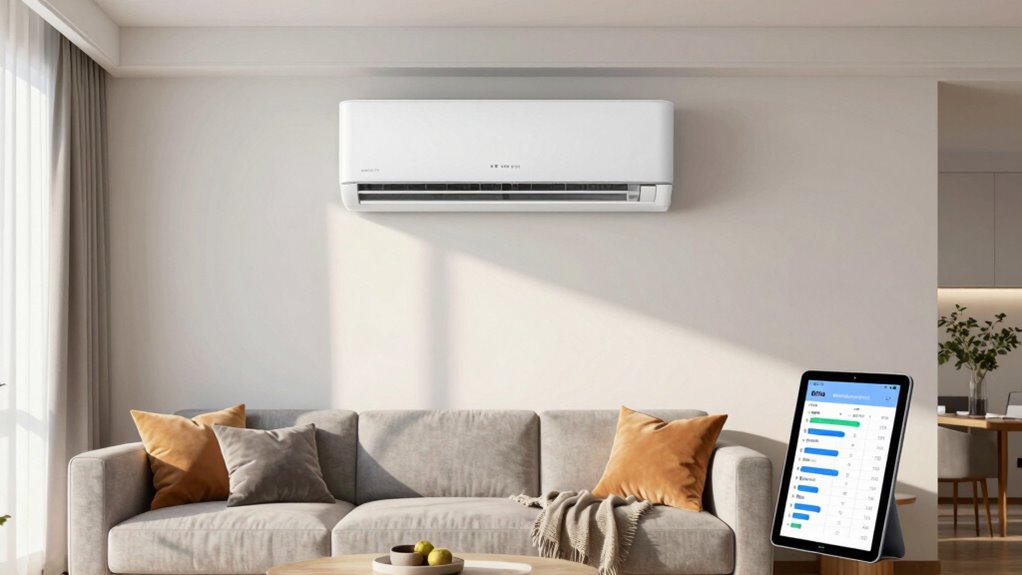
One common mistake when choosing an AC based on BTU is overestimating the size needed for your space. This often leads to an overly powerful unit that cools too quickly, causing uneven temperature control and short cycling. When an AC is too large, it may struggle to remove humidity effectively, leaving your room feeling clammy. Additionally, oversized units tend to run noisier because they cycle on and off more frequently, increasing noise levels and disrupting your comfort. Instead, focus on selecting an AC with the right BTU for your room size, ensuring steady temperature control and quieter operation. Proper sizing helps maintain consistent cooling, reduces energy waste, and enhances your overall comfort. Avoid the temptation to overbuy—accuracy is key.
Why Oversized or Undersized ACs Cost You More

Choosing an AC that’s too big or too small can lead to higher energy bills and frequent repairs. An oversized unit wastes energy by cycling on and off too often, while an undersized one struggles to cool your space effectively. Both situations make your home less comfortable and cost you more in the long run.
Energy Waste Risks
Ever wonder why an AC that’s too big or too small can end up costing you more? It’s mainly because of energy waste. An improperly sized unit can cause:
- Longer cycles, wasting energy as the system struggles to reach the set thermostat settings, especially when outdoor temperature fluctuates.
- Frequent on/off cycling, which uses more power and wears out components faster.
- Inefficient cooling, forcing you to increase thermostat settings or run fans longer, leading to higher utility bills.
Oversized ACs cool quickly but shut off prematurely, causing humidity issues and unnecessary energy use. Undersized units run nonstop, using excess energy to keep up. Proper sizing helps optimize efficiency and reduce waste.
Comfort Level Issues
When your AC is too large or too small, it can lead to uncomfortable temperature swings and humidity problems, making your home less cozy. An oversized unit cools quickly but cycles on and off frequently, reducing humidity control and causing inconsistent comfort. This frequent cycling also increases noise, disrupting your peace. Conversely, an undersized AC struggles to reach your desired temperature, running constantly and failing to remove enough humidity, which can leave your home feeling damp and clammy. Both scenarios lead to discomfort and higher energy bills. Proper sizing guarantees your AC maintains steady temperatures, effective humidity control, and quieter operation, creating a more comfortable environment. Avoiding size mismatches helps you enjoy consistent comfort without the noise and humidity issues that come with improper AC sizing.
Tips to Double-Check Your AC’s BTU Before Buying

Before purchasing an air conditioner, it’s essential to double-check its BTU rating to make sure it’s the right size for your space. Proper sizing ensures effective humidity control and minimizes noise levels. To verify, consider these tips:
Always verify your air conditioner’s BTU rating to ensure proper size, humidity control, and noise levels.
- Measure your room’s square footage accurately—larger rooms need higher BTUs.
- Check the manufacturer’s specifications and avoid overestimating for better humidity control.
- Test the unit’s noise levels and ensure they’re acceptable for your environment, especially if you’re sensitive to sound.
How Proper BTU Matching Saves Energy and Lowers Bills

Matching your AC’s BTU rating to the size of your room is key to saving energy and reducing your utility bills. When you choose the right BTU, your system runs efficiently, avoiding excessive cycling or continuous operation. This not only lowers energy consumption but also helps maintain better air quality by reducing stale air and humidity buildup. Properly sized units operate more quietly because they don’t have to work as hard, which decreases noise levels and creates a more comfortable environment. An undersized AC struggles to cool effectively, wasting energy and increasing costs, while an oversized unit short-cycles, wasting power and causing discomfort. By matching BTU to your space, you optimize performance, save money, and enjoy improved air quality and quieter operation.
What Happens if Your AC Is Too Small or Too Large?

If your AC is too small for your space, it will struggle to cool the room effectively, running constantly and never reaching your desired temperature. An undersized unit causes excessive wear, higher energy bills, and uneven airflow. Conversely, an oversized AC cools too quickly, leading to short cycling, which hampers airflow optimization and wastes energy. To avoid these issues, focus on proper thermostat placement to guarantee accurate temperature reading and consistent comfort. Additionally, a correctly sized unit maintains balanced airflow, preventing hot spots and drafts. Here are key points to consider:
An improperly sized AC causes inefficiency, discomfort, and increased wear—choose the right size for optimal performance.
- Properly match BTU output to room size for efficiency.
- Optimize airflow by adjusting vents and ductwork.
- Place the thermostat in a central, draft-free location for accurate readings.
Easy Ways to Maintain Your AC’s Cooling Power and Efficiency

Keeping your AC running at peak efficiency doesn’t have to be complicated. Regular maintenance helps improve energy conservation and indoor air quality, ensuring your system cools effectively. Simple steps include changing filters, sealing leaks, and scheduling professional inspections. These actions prevent strain on your AC, saving energy and extending its lifespan. To further optimize, consider the following:
| Action | Benefits | Tips |
|---|---|---|
| Replace filters regularly | Better airflow, cleaner air | Check monthly, change every 1-3 months |
| Seal leaks around windows and doors | Improved efficiency | Use weatherstripping and caulking |
| Clean condenser coils | Enhanced cooling power | Turn off unit and gently wash coils |
| Maintain proper thermostat settings | Energy savings | Set to 78°F in summer |
| Schedule professional tune-ups | Maximize system performance | Annually, before peak season |
These habits boost efficiency and indoor air quality while conserving energy.
Frequently Asked Questions
Can a Room’s Insulation Affect Its BTU Needs?
Yes, a room’s insulation quality and wall thickness directly impact its BTU needs. Better insulation reduces heat transfer, meaning you’ll need fewer BTUs to cool the space effectively. Conversely, thicker walls and poor insulation increase heat gain, requiring a higher BTU capacity. Keep these factors in mind when sizing your AC unit, so it’s powerful enough to keep your room comfortable without wasting energy.
Does Ceiling Height Influence the Required BTU?
Ceiling height can dramatically increase your AC’s BTU needs, like filling a football stadium instead of a cozy room. Higher ceilings mean more air volume to cool, especially if insulation quality isn’t ideal. You’ll need a more powerful unit to keep the space comfortable. So, don’t overlook ceiling height when calculating BTUs—it’s a game-changer that impacts your cooling efficiency and energy bills.
How Often Should I Recalibrate My Ac’s BTU Requirements?
You should recalibrate your AC’s BTU requirements at least once a year to maintain energy efficiency. Seasonal adjustments are vital because temperature changes and humidity levels impact cooling needs. By reassessing your unit’s capacity, you guarantee peak performance and avoid overworking your system. Regular recalibration helps your AC adapt to seasonal shifts, saving energy and money while keeping your space comfortably cooled year-round.
Are There Specific BTU Needs for Different Room Types?
Yes, different room types have specific BTU needs based on window size and room layout. For example, larger windows or open layouts require higher BTU ratings to cool effectively. Small bedrooms may need around 5,000-8,000 BTUs, while larger living rooms might need 10,000-20,000 BTUs. Consider factors like insulation, sunlight, and room size to choose the right BTU for each space, ensuring efficient cooling.
How Does Local Climate Impact Optimal BTU Selection?
Your local climate impacts your ideal BTU selection because hotter, more humid climate zones demand higher BTU ratings to keep you comfortable. In humid areas, you’ll need a more powerful AC to handle moisture, while in cooler zones, a lower BTU unit may suffice. Always consider climate zones and humidity levels when choosing your AC, ensuring it’s capable of maintaining a comfortable indoor temperature without overworking.
Conclusion
So, next time you think bigger is better, remember this: choosing an underpowered AC might leave you sweating, but an oversized one can waste energy and money. It’s funny how the perfect BTU, a simple number, can make or break your comfort and bills. Don’t fall for the trap of guessing—measure, match, and enjoy a cool home without the irony of endless inefficiency. Your wallet and comfort will thank you.