
Set up a bedroom space heater so it warms the room while reducing fire, burn, and electrical risks. This guide is for anyone choosing or using a portable heater at home; no specialist experience is needed. Allow about 20-30 minutes to check the room, review the heater, and choose a safe position. Once set up, follow the same checks whenever you move or operate it.

Get home appliances delivered free with Prime
- Fast, free delivery on millions of items
- Prime Video, Amazon Music and more included
- Member-only deals all year

DREO Portable Ceramic Space Heater with Thermostat
- ✔ Heating element: PTC ceramic
- ✔ Power: 1500 watts
- ✔ Stated coverage: Up to 200 sq. ft.

DREO Atom One Portable Ceramic Space Heater
- ✔ Heating element: PTC ceramic
- ✔ Power: 1500 watts
- ✔ Stated coverage: Up to 200 sq. ft.

WINHL Portable 1500W Ceramic Space Heater with 70° Oscillation, Remote and Thermostat
- ✔ Heating element: PTC ceramic
- ✔ Power: 1500 watts
- ✔ Maximum temperature: 95°F
Difficulty: Beginner | Time: 20-30 minutes for selection and setup; daily use varies
What You’ll Need
Tools & Materials:
- Space heater with a readable manufacturer label and intact power cord
- Tape measure or a way to estimate clearance distances
- Access to the heater’s manual
- Working smoke alarm in or near the bedroom
Knowledge:
- Ability to identify the heater’s controls and power rating
- Basic awareness of the room’s outlets, furniture, curtains, and walking paths
Use a heater designed for indoor use and follow its manual and the safety rules where you live. Check local fire guidance if you are unsure whether portable heaters are allowed in your building. Do not use a heater with a damaged cord, loose plug, cracked case, or signs of overheating. A heater is for supplemental warmth; it should not replace a faulty furnace or other permanent heating system.
DREO Portable Ceramic Space Heater with Thermostat
For a bedroom heater, the details that matter most are easy temperature control and unobtrusive operation. This DREO leads our list with a stated noise level of 34 dB, lower than the Atom One’s 37.5 dB, plus a thermostat adjustable in 1°F increments. Those specifications make it the most compelling fit for someone who wants to adjust warmth without relying only on a few fixed settings. Its remote, 12-hour timer, and memory function also make routine use easier from bed.The heater is listed for rooms up to 200 square feet and uses a 1500-watt PTC ceramic element for rapid heating. Compared with the Atom One, it prioritizes quieter stated operation and a slightly lighter body at three pounds; the Atom One has the advantage of 70° oscillation for moving warmth across a room. This model does include four speeds and multiple heating modes, but its description does not list oscillation, so it may be less suitable when heat needs to reach several parts of a bedroom.Tip-over and overheat protection, flame-resistant materials, and a safety plug are listed. Still, this is a corded 120-volt heater, and its specified coverage is limited to indoor spaces up to 200 square feet. We would choose it for a smaller bedroom where quiet-focused specifications and precise controls matter more than sweeping heat distribution.
Pros:
- Reported 34 dB operation is the lowest stated figure in this comparison.
- Thermostat adjusts in 1°F increments across a 41°F–95°F range.
- Remote, 12-hour timer, child lock, and memory function are included.
- Tip-over and overheat protection are listed.
Cons:
- No oscillation is listed, unlike the Atom One and WINHL.
- Specified for indoor spaces up to 200 square feet, not larger areas.
- Requires a corded electrical outlet.
Best for: Bedroom users who want fine thermostat adjustment, a remote, and the lowest stated noise level among these three.
Not ideal for: People who need oscillation to distribute warmth across a wide or irregularly shaped room.
Bottom line: We rank this DREO first for its bedroom-friendly noise specification and precise controls, provided oscillation is not essential.
“We rank this DREO first for its bedroom-friendly noise specification and precise controls, provided oscillation is not essential.”
DREO Atom One Portable Ceramic Space Heater
When warmth needs to reach beyond the spot directly in front of a heater, the Atom One has the clearest advantage in this group: 70° oscillation. It pairs that movement with five modes, ECO mode, and a programmable thermostat. Compared with our overall pick, the first DREO, the Atom One gives up the lower stated noise figure and memory function, but it makes a stronger case for a bedroom where a fixed stream of warm air would leave other areas chilly.Its thermostat adjusts from 41°F to 95°F in 1°F increments, and the remote and 1–12 hour timer support convenient adjustments without getting up. The reported noise level is 37.5 dB, modestly higher than the other DREO’s 34 dB. That difference may matter to noise-sensitive sleepers, though these are reported specifications and the actual sound in a room can depend on placement and mode.With a stated 200-square-foot coverage and 1500-watt output, it shares the same broad capacity description as the other two. Its detachable filter is a practical distinction, while its 1.75 kg weight is heavier than the compact WINHL. We see it as the more versatile choice when oscillation and ECO controls outweigh the quietest listed operation; buyers seeking a simple compact heater for one nearby spot can choose WINHL instead.
Pros:
- 70° oscillation helps distribute heat across more of the room.
- ECO mode and programmable thermostat add control options.
- Remote, 12-hour timer, and detachable filter are included.
- Tip-over and overheat protection are listed.
Cons:
- Its reported 37.5 dB noise level is higher than the first DREO’s stated 34 dB.
- At 1.75 kg, it is heavier than the WINHL.
- Designed for indoor use and specified for up to 200 square feet.
Best for: People who want oscillating warmth, ECO mode, and thermostat control in a bedroom described as up to 200 square feet.
Not ideal for: Noise-sensitive sleepers who prefer the lowest stated noise figure, or buyers who want the lightest unit.
Bottom line: We recommend the Atom One when oscillation and ECO control are more useful than the quietest stated operation.
“We recommend the Atom One when oscillation and ECO control are more useful than the quietest stated operation.”
WINHL Portable 1500W Ceramic Space Heater with 70° Oscillation, Remote and Thermostat
WINHL makes the most sense when the heater needs to occupy little space and warm someone nearby. At 9.85 inches tall and 5.91 inches wide, it is the shortest listed model here, and its tabletop format suits a desk or nightstand more naturally than a room-floor placement. Like the Atom One, it offers 70° oscillation; unlike that DREO, the supplied details emphasize five speed settings and compact personal use rather than a detachable filter.The 1500-watt PTC ceramic element, ECO thermostat control, remote, and 12-hour timer give it a broad set of controls for its size. The description also lists overheat and tip-over shutoff, and says the heater is ETL listed. These are useful bedroom features, but the product’s own framing is for personal spaces and small rooms. We would not choose it over the first DREO for its lower reported noise figure, since WINHL does not provide a noise specification in the supplied information.There are practical caveats: its remote needs two AAA batteries that are not included, and it must be plugged directly into a 15A wall outlet. That outlet instruction is more specific than the other listings, so it should factor into placement before purchase. For a compact corner or bedside spot where oscillation is welcome, WINHL is the space-saving pick; for broader room use, the Atom One’s stated 200-square-foot coverage and clearer feature detail make it easier to evaluate.
Pros:
- Compact 9.85-inch height suits tabletop placement.
- 70° oscillation helps spread warmth beyond one fixed direction.
- Includes ECO thermostat control, remote, and 12-hour timer.
- ETL listed, with tip-over shutoff and overheat protection.
Cons:
- Positioned for personal spaces and small rooms rather than whole-house heating.
- Remote requires two AAA batteries, which are not included.
- Must be plugged directly into a 15A wall outlet.
Best for: Buyers looking for a compact tabletop heater for personal warmth near a bed or desk, with oscillation and remote control.
Not ideal for: Those seeking a heater for a larger bedroom or who cannot plug it directly into a 15A wall outlet.
Bottom line: We choose WINHL for compact personal warmth, while the two DREO models offer stronger bedroom-wide or quiet-focused reasons to buy.
“We choose WINHL for compact personal warmth, while the two DREO models offer stronger bedroom-wide or quiet-focused reasons to buy.”
As an Amazon Associate we earn from qualifying purchases.
Before You Start
Read the heater’s manual before plugging it in. The manufacturer gives the required clearance, suitable room conditions, and instructions for the specific model. Keep combustible materials, including bedding, clothing, paper, and curtains, at least 3 feet (about 1 metre) from the heater unless the manual requires a greater distance. Keep the heater out of doorways and walking routes. Never use a portable heater while sleeping or leave it running unattended. If the bedroom cannot stay warm enough while you are awake and monitoring the heater, use the home’s main heating system or seek another safe solution.
Step-by-Step Instructions
Step 1: Choose a heater suited to the room
Pick an indoor heater with safety features such as tip-over shutoff and overheat protection. Check the label and manual for the recommended room size, voltage, and operating instructions. A thermostat and timer can help control heat, but they do not make unattended or overnight operation safe. Choose a model with stable feet or a base and controls that are easy to reach without leaning over the heater.
Tip: Do not buy or use a heater with missing labeling, a damaged plug, or a recalled model. Avoid fuel-burning portable heaters in bedrooms; they can produce carbon monoxide and need ventilation.
Check: You can identify the model, read its instructions, and confirm that it is intended for indoor use and appropriate for the room.
Step 2: Inspect the room and the heater
Look for a clear, flat, dry floor space near a wall outlet. Check that the smoke alarm works by using its test button. Inspect the heater’s case, controls, plug, and full length of its cord. Remove lint or dust only as the manual directs, with the heater unplugged and cool. Do not operate it if the cord is frayed, the plug is bent or loose, the case is cracked, or the unit smells burnt.
Tip: Keep water, humidifiers, and wet items away from the heater unless the manual specifically says the model is suitable for that location.
Check: The heater and cord show no damage, the alarm responds to its test, and you have identified a dry, uncluttered floor area.
Step 3: Set the heater in a clear position
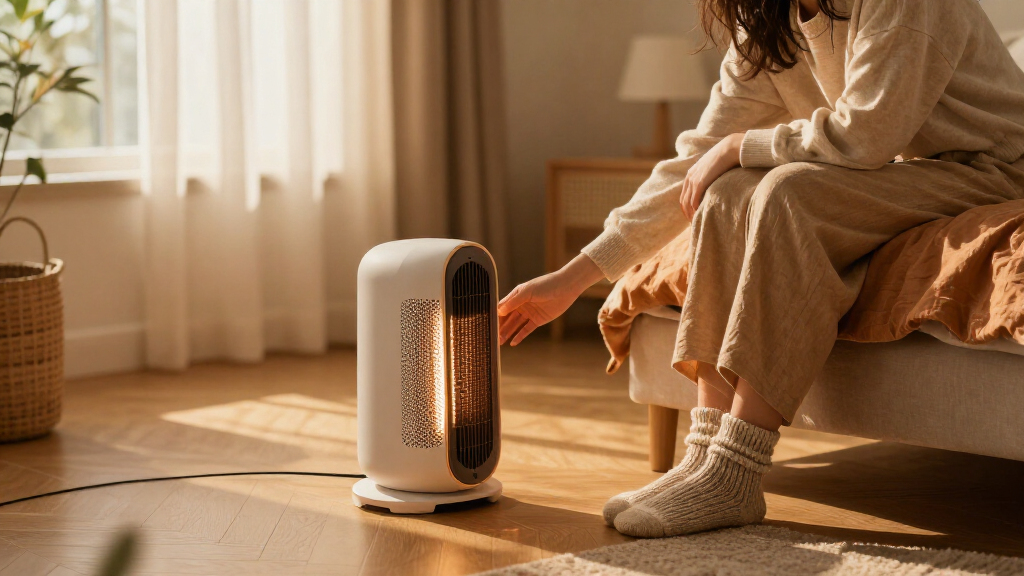
Place the heater upright on a level, hard surface where it cannot be bumped, tipped, or covered. Leave at least 3 feet (about 1 metre) between the heater and bedding, furniture, curtains, clothing, paper, and other flammable items, or use the larger distance listed in the manual. Point the heat into an open part of the room, not toward the bed, curtains, or furniture. Keep it away from the room’s exit and out of reach of children and pets.
Tip: Do not set a heater on a bed, carpet that blocks its vents, furniture, or any surface the manual prohibits. Do not dry clothes on it or drape fabric over it.
Check: The heater stands securely, its vents are unobstructed, and the required clear space surrounds it on every side.
Step 4: Connect it directly to a wall outlet
Plug the heater directly into a suitable wall outlet, following the manual’s electrical requirements. Do not use an extension cord, power strip, plug adapter, or multi-outlet cube. Keep the cord visible and out of the walking path; do not run it under a rug, bedding, or furniture. Avoid sharing the outlet with other high-power appliances.
Tip: If the plug feels loose, the outlet is cracked, or the plug or outlet becomes hot, switch the heater off, unplug it if safe, and stop using that outlet until it has been checked by a qualified electrician.
Check: The plug fits firmly, the cord lies uncovered without being stretched, and no other high-power device shares the connection.
Step 5: Start the heater while you are awake
Turn the heater on using the controls described in its manual. Start at a moderate setting and adjust the thermostat gradually. Stay in the room while it runs, especially during the first few minutes. Watch for smoke, a burning smell, unusual noise, flickering lights, a hot plug, or a tripped circuit breaker. Turn it off and unplug it if you notice any of these signs and can do so safely.
Tip: A new heater may give off a brief odor during its first use if the manual describes this as normal. Stop using it if the odor is strong, persists, or resembles burning plastic or wiring.
Check: The heater operates steadily, the outlet and plug remain cool, and there is no smoke, abnormal odor, or electrical interruption.
Step 6: Turn it off before leaving or sleeping
Switch the heater off and unplug it before leaving the room or going to sleep. Use the built-in controls rather than pulling the cord. Let the heater cool before moving, cleaning, or storing it. Keep bedding and other items away while it cools, and do not store it until it is fully cool and dry.
Tip: A timer or thermostat is not a substitute for switching the heater off before sleep or when the room is unattended. If you need warmth overnight, use suitable bedding or the home’s fixed heating system.
Check: The heater is off and unplugged before you sleep or leave, and it is cool before you touch or store it.
Common Mistakes to Avoid
- Placing the heater too close to bedding or curtains. — Measure or clearly mark at least 3 feet (about 1 metre) of clearance on all sides, and follow a larger distance if the manual specifies one.
- Running the heater through an extension cord or power strip. — Use a suitable wall outlet directly. Stop if the outlet is loose or becomes hot, and have it checked.
- Leaving the heater on while asleep or away from the room. — Switch it off and unplug it before sleep or leaving, even if it has a thermostat, timer, or automatic shutoff feature.
- Covering the heater or blocking its air openings. — Keep clothing, blankets, and objects off the unit and away from its vents. Place it on a level surface permitted by the manual.
Troubleshooting
Problem: The heater does not turn on.
Solution:
Switch it off and check that the plug is firmly seated in a suitable wall outlet. Check the manual for reset or control-lock instructions. If the outlet has no power, trips repeatedly, or the plug is loose, stop using it and contact a qualified electrician. Do not bypass a safety feature or open the heater.
Problem: The heater switches off after running briefly.
Solution:
Turn it off and unplug it. Once cool, check that it is upright on a level surface and that the air openings are clear. Review the manual for tip-over, overheating, or timer behavior. If it continues to shut off in a clear, stable position, stop using it and contact the manufacturer or replace it.
Problem: The plug or outlet becomes hot, or a breaker trips.
Solution:
Switch the heater off and unplug it only if you can do so without touching a hot or damaged part. Do not reconnect it to that outlet or use an extension cord. Arrange for the outlet or circuit to be checked by a qualified electrician. Stop using the heater if its plug or cord is damaged.
Problem: The room still feels cold.
Solution:
Check that the heater is suitable for the room size and that doors and windows are closed where practical. Keep its vents clear and use the thermostat as directed. Do not move it closer to bedding or raise it onto furniture. If safe supplemental heating is not enough, use the fixed heating system or get help addressing drafts or heating problems.
What Success Looks Like
The heater is an intact indoor model placed upright on a stable, dry surface with its vents open and the manual’s required clearance around it. It is plugged directly into a suitable wall outlet, with the cord uncovered and out of the way. While you monitor it awake, it runs without unusual odors, smoke, hot plugs, or electrical faults. You switch it off and unplug it before leaving the room or sleeping.
Next Steps
Before each use, check the cord, plug, outlet, clearance, and smoke alarm. Keep the manual where you can find it, and clean or store the heater only as its instructions allow. Stop using the unit if it is damaged, repeatedly overheats, or has a persistent burning odor; contact the manufacturer or replace it. If the bedroom needs heat overnight, plan for a fixed heating source or suitable bedding rather than running a portable heater while you sleep.
Frequently Asked Questions
Can I leave a space heater on while I sleep?
No. Switch it off and unplug it before going to sleep. A thermostat, timer, or tip-over switch does not remove the risk from unattended operation.
How far should a space heater be from a bed?
Keep at least 3 feet (about 1 metre) between the heater and the bed, bedding, curtains, furniture, or other flammable items. Follow the manual if it calls for more space.
Can I plug a bedroom heater into an extension cord?
No. Plug it directly into a suitable wall outlet unless the manufacturer gives different instructions for that specific model. Do not use a power strip or adapter.
Which type of space heater is best for a bedroom?
Choose an indoor model sized for the room, with tip-over and overheat shutoff, a stable base, and clear instructions. The best choice depends on the room and the manufacturer’s guidance; operate any portable model only while awake and present.
What should I do if my heater smells strange?
Switch it off and unplug it if safe. Check the manual for normal first-use odors, but stop using it if the smell is strong, persists, or resembles burning plastic or wiring. Have the unit checked or replace it.