
TL;DR
An electric turkey roaster is a covered countertop appliance that can free your oven for side dishes and produce tender, moist turkey. Check the manual for capacity and setup, then use a food thermometer to confirm 165°F (74°C) in the thickest breast and innermost thigh and wing; expect less crisp skin than from a conventional oven.
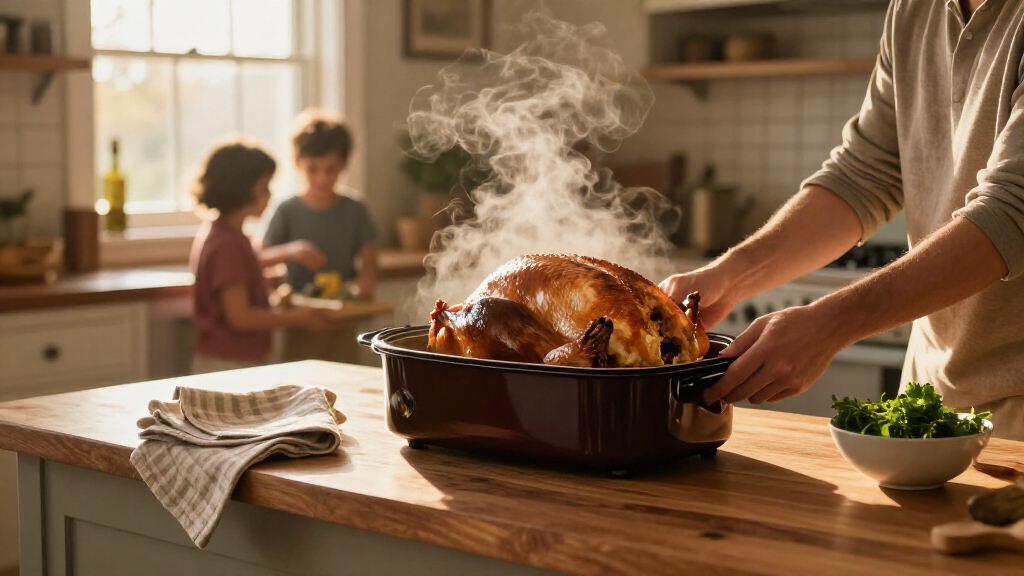
When the turkey takes over your oven, the sweet potatoes, rolls, and pie all have to wait their turn. An electric turkey roaster gives you another covered cooking chamber on the counter, which can make a crowded holiday kitchen feel less like a game of musical chairs.

Get home appliances delivered free with Prime
- Fast, free delivery on millions of items
- Prime Video, Amazon Music and more included
- Member-only deals all year
This guide explains what a roaster does, what it can and cannot do for the bird, and how to choose a size that fits both your turkey and your kitchen. You’ll also get a practical cooking checklist, food-safety guidance, and a clear-eyed look at browning, cleanup, and energy claims.
A roaster can help you serve dinner on time, but it is not a magic shortcut. Its value is mainly in moving the turkey out of the oven so other dishes can cook; that only helps if you have a suitable counter spot and enough time to learn how your particular appliance behaves. The bird’s shape, the appliance manual, and the temperature at its center matter more than a promise printed on a box.
An electric roaster can free your oven for side dishes, but cooking speed depends on the bird and appliance.
Check a turkey’s shape and the roaster’s interior dimensions; weight or quart ratings alone may not show whether it fits.
Use a food thermometer to confirm 165°F (74°C) in the thickest breast and innermost thigh and wing.
Expect moist meat and potentially less crisp skin; use only a browning method compatible with the appliance.
Plan for a heat-resistant counter spot, safe clearance, careful cleanup, and enough storage space.
What an Electric Turkey Roaster Does for Your Kitchen
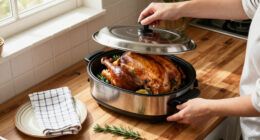
An electric turkey roaster is a countertop appliance with a covered cooking chamber and an electric heating element. Many models can roast a whole turkey, while some also handle large cuts of meat, baking, or slow cooking; permitted uses vary, so your manual is the final word. In practice, the appliance is a small dedicated oven: it supplies heat around the food while the lid limits how readily moisture escapes.
Its clearest advantage is extra cooking space. Imagine hosting six people in a kitchen with one oven: the turkey cooks in the roaster while green beans and rolls use the oven. The benefit is not necessarily a faster bird; it is the ability to cook dishes at the same time instead of waiting for the oven to become free. That can simplify serving, though it also means coordinating two appliances and keeping track of what is cooking where.
The lid holds heat and moisture around the bird. That can help reduce surface drying and produce tender meat, but moist air also makes it harder for the skin to dry and brown evenly. The result may be juicy slices with a softer, paler exterior. If crisp skin is central to the meal, you may need a compatible finishing step, and that can reduce the convenience of keeping the turkey in one appliance from start to finish.
Electric turkey roasters heat a smaller chamber than a full-size oven, which may be convenient for an occasional large meal. A smaller chamber alone does not establish lower energy use: the heating element cycles, cooking duration varies, and the turkey and appliance both affect consumption. Actual energy use depends on the model, cooking time, and your electricity rate, so treat savings claims as questions to check, not guaranteed results.
Think of a roaster as a second cooking station. It can ease oven traffic, but it adds a hot appliance to your counter, and your thermometer—not the clock—tells you when the turkey is ready.
Products Worth Considering

Levoit Eleva 300X Air Purifier with Fully Sealed HEPA Filtration and Smart Control

Ring Battery Doorbell (2nd Gen) and Floodlight Cam Plus Wired Bundle

Bose Smart Dolby Atmos Soundbar with Alexa, A.I. Dialogue Mode, and Bluetooth, Black
As an affiliate, we earn on qualifying purchases.
How to Choose a Roaster That Fits Your Bird and Counter
Choose an electric turkey roaster by checking bird fit, interior dimensions, and counter clearance, not by trusting a capacity number alone. Manufacturers may list capacity by quarts or pounds, but those numbers compress a three-dimensional fit into one figure. Turkey shape matters: a broad bird can touch the lid or sides even when its weight sounds suitable, leaving less room for heat to circulate or making the lid difficult to close.
Before buying, measure the spot where you plan to cook and the cupboard where you’ll store the appliance. A full roaster can be bulky and heavy, so the counter needs to support it and leave room to handle the lid safely. For example, if your counter sits below low cabinets, check the manual’s clearance requirements and allow room for the lid and escaping steam. Clearance is a cooking concern as well as a convenience: directing hot steam toward a cabinet can damage surfaces or expose someone reaching overhead.
Compare the controls, removable parts, and construction, too. A clearly marked temperature dial is easier to use during a busy meal than a tiny, hard-to-read control, especially when a recipe asks you to adjust heat. A removable pan and rack can simplify cleanup because food residue is easier to reach, but check which pieces are dishwasher-safe; do not assume a nonstick surface can handle every tool or cleaning product. A feature only saves effort if its care instructions work for your routine.
Before checkout, walk through these checks:
- Measure the bird. Check both its weight and shape against the manufacturer’s stated capacity and interior dimensions. This helps avoid buying a model that technically meets the weight rating but cannot close over the turkey.
- Measure the location. Confirm you have a stable, heat-resistant surface and the manual’s required clearance. Include space to lift the lid without directing steam toward people or cabinets.
- Check the outlet and cord guidance. Set the roaster close enough for safe placement without stretching the cord. This also helps prevent someone from catching a cord while moving around a crowded kitchen.
- Review cleanup and warranty details. Confirm care instructions and which parts you can remove. A difficult-to-clean or awkwardly stored appliance may be used less often than its advertised versatility suggests.
Suppose you cook a small turkey once a year but have little storage space. A large multi-use model might be less useful than a smaller one that fits your usual bird and has a place to live after the holiday. The right size is the one that accommodates the meal you actually make without turning setup and storage into a second project.
How to Cook Turkey Safely in an Electric Roaster
Cook turkey in an electric roaster by following the appliance manual and checking the meat with a food thermometer. USDA guidance sets the safe internal temperature for poultry at 165°F (74°C); time charts can help with planning, but they cannot account for every bird, starting temperature, or appliance. The thermometer matters because a cooked exterior does not show whether the center has reached a safe temperature, and roaster performance can vary even between models with similar capacity.
Start with a safely thawed turkey. Remove packaging and the giblets, then set up the appliance as its manual directs. If it specifies a rack or limits the bird’s size, follow those instructions. For instance, squeezing an oversized bird under a lid can interfere with fit and heat circulation. A bird that sits as intended leaves the appliance able to heat as designed and reduces the chance that you will need to adjust the setup mid-cook.
Check temperature in the innermost part of the thigh and wing and in the thickest part of the breast. Avoid touching bone with the thermometer probe, because the reading may not represent the surrounding meat accurately. Checking several locations accounts for uneven heating: a large bird can finish at different rates in its breast and legs. If you cook stuffing inside the bird, the center of the stuffing also needs to reach 165°F (74°C), which is one reason separate stuffing is easier to monitor.
Use this sequence as your kitchen checklist:
- Thaw safely and remove packaging and giblets. Starting with a safely thawed bird makes cooking more predictable and avoids relying on a time estimate that may not fit a partly frozen turkey.
- Set up the roaster as its manufacturer directs, on a stable, heat-resistant surface. Correct placement protects the counter and leaves room to handle the hot lid.
- Cook according to the manual, using time estimates only to plan your meal. Start checking with a thermometer as the estimated finish approaches rather than treating the chart as proof of doneness.
- Measure several locations with a food thermometer and confirm they reach 165°F (74°C). If any location is below that temperature, continue cooking and check again.
- Rest the turkey before carving, then refrigerate leftovers promptly. Resting makes carving easier, while prompt refrigeration keeps leftovers from sitting out longer than needed.
For example, if the breast reaches temperature but a thigh does not, keep cooking and check again. The bird is ready when all required locations reach the safe temperature—not when the first reading does, or when the pleasant smell drifting into the dining room suggests it might be.
How to Get Tender Meat Without Expecting Oven-Crisp Skin
An electric turkey roaster’s covered cooking chamber can help the meat stay moist, but it may brown the skin less evenly than a conventional oven. The lid retains moisture, so the surface may not dry as readily; exposed oven heat can brown the skin more directly. This is a tradeoff between the enclosed environment that supports tender meat and the dry surface conditions that help create crisp skin.
Picture a family carving two birds at the same table: one cooked in the roaster, the other in an oven. The roaster bird may have juicy slices and paler skin, while the oven bird may have a crackling, deeper-brown exterior. Neither result is automatically better; it depends on what your guests value. If the skin is mostly a garnish, the roaster’s convenience may outweigh the difference. If it is a favorite part of the meal, that difference could shape whether the appliance feels successful.
If you want more browning, follow a tested method that suits your appliance. Some cooks finish the turkey in a conventional oven, but any transfer needs safe handling and should follow the roaster instructions and food-safety guidance. The added step also means you need oven space and must move a heavy, hot bird without spills. Do not improvise with a hot, heavy bird balanced awkwardly between counters.
Water, roasting bags, and other add-ons also deserve a manual check. Add water only if the appliance instructions or a tested recipe calls for it. Water can affect the cooking environment and may work against browning, so adding it by habit can produce a result different from the one you expect. Check both the roaster manufacturer and bag labeling before using an oven roasting bag; compatibility is not universal, and the wrong bag or setup may not be safe at the appliance’s operating temperature.
A practical example: if your guests care most about juicy breast meat and you have a busy oven, the roaster may suit the menu well. If golden skin is the centerpiece, plan a compatible browning step or choose conventional oven roasting instead. Deciding which result matters more helps you judge the roaster by what it can reliably do, rather than by an oven-style appearance its covered chamber may not produce.
Which Cooking Setup Suits Your Holiday Menu?
A roaster suits a meal where freeing oven space matters more than uniform crisp skin; a conventional oven suits cooks who want direct browning in the same appliance. Both can cook turkey, but the practical difference is how they allocate kitchen space and manage surface texture. Your choice also affects workflow: a roaster needs its own counter location and outlet, while an oven keeps the turkey within the kitchen’s usual cooking setup.
For example, if your oven will be packed with casseroles at 4 p.m., moving the turkey to a roaster can keep dinner on schedule. It does so by allowing separate dishes to cook at once, not by guaranteeing a shorter turkey cook. If the turkey’s bronzed skin is the main event and you have room to roast it in the oven, the familiar setup may be a better fit. Your menu and kitchen layout should decide.
| What matters | Electric roaster | Conventional oven |
|---|---|---|
| Kitchen space | Frees the oven for other dishes | Uses the main oven |
| Cooking chamber | Covered, smaller chamber | Open oven roasting environment |
| Skin texture | May brown less evenly | Often better for exposed browning |
| Counter planning | Needs a stable surface and clearance | Needs oven capacity and a roasting pan |
| Energy claims | Use depends on model and cooking time | Use depends on oven and cooking time |
This table cannot predict your exact cooking time or electricity cost. Appliance performance, turkey size, starting temperature, and household rates all vary. Treat claims such as “faster” or “more efficient” as product-specific and look for independent measurements before relying on them. In particular, a faster estimate does not necessarily mean a faster meal if you still need a separate oven step to get the browning you want.
Many models also claim versatility, from roasting other meats to slow cooking. That can justify the storage space if you use those functions, but each use needs to fit the model’s instructions and your routine. A roaster that spends eleven months in a closet is a harder sell than one that earns a place in your kitchen for several meals. Think about how often you would realistically use those functions before treating them as added value.
How to Set Up, Clean, and Store Your Roaster
Set an electric turkey roaster on a stable, heat-resistant surface with the clearance its manual requires. Its exterior and escaping steam can get hot, so a crowded countertop beside paper towels or a low cabinet may not be a safe spot. Clearance also gives you room to open the lid without directing steam toward your hands or nearby surfaces. Keep the cord routed as the manual directs and use the outlet guidance provided by the manufacturer.
For example, a host may set the roaster beside the sink for convenience, then discover that the lid vents steam toward a cabinet door. Read the setup instructions before the turkey goes in, and choose a position that leaves room to lift the lid safely. Keep children away from hot surfaces and use appropriate protection when handling hot parts. Planning the location before the meal starts avoids trying to move a hot, heavy appliance when the counter is already busy.
After cooking, unplug the appliance and let it cool completely before cleaning. Wash removable pans and racks according to their care instructions. Keeping the heating base and electrical components dry protects the appliance and reduces electrical risk; pouring water over the base can damage it. Removable parts are useful because they let you clean food residue without wetting the parts that supply heat.
Check storage space before buying, not after the first feast. A roaster may be awkward to lift onto a high shelf, especially when its pan and lid are stored together. A low, dry cupboard or pantry shelf can turn cleanup day into a simple put-away job instead of a wrestling match. This matters to the purchase decision because a bulky appliance that is difficult to store may not earn its counter space through occasional holiday use alone.
Product features change over time, and updated controls, nonstick finishes, or multi-use claims do not prove a model cooks faster or browns better. Check the specific manual and independent testing for claims that affect your decision. The manual explains constraints such as clearance, cleaning, and compatible accessories; independent testing can help assess performance claims. That quick check can save you from buying a feature that sounds useful but does not suit your kitchen.
Frequently Asked Questions
Does an electric roaster cook a turkey faster than an oven?
It can cook at a different rate, but there is no universal timing rule for every model and turkey. Follow the appliance manual and use a thermometer to confirm 165°F (74°C) in the required locations.
Will turkey taste different from an electric roaster?
The covered chamber can help keep meat moist, while the skin may be less crisp or evenly browned than oven-roasted skin. The difference is most obvious when your favorite part is a deeply browned, crackling exterior.
Can I put an electric roaster on any countertop?
Use a stable, heat-resistant surface and follow the manual’s clearance and ventilation instructions. The exterior and escaping steam can get hot, so check the placement before you start cooking.
Should I add water to an electric turkey roaster?
Add water only when the appliance instructions or a tested recipe calls for it. Adding it without guidance can affect browning and cooking conditions, so check your specific model first.
Can I use an oven roasting bag in a countertop roaster?
Check the roaster manufacturer’s instructions and the bag’s labeling before use. Do not assume a bag made for a conventional oven is suitable for every countertop appliance.
Can I cook stuffing inside the turkey in a roaster?
Yes, but the center of the stuffing must also reach 165°F (74°C). Cooking it separately is easier to check, especially when you are already measuring several parts of the bird.
Conclusion
Choose an electric turkey roaster if a second cooking chamber will make your meal easier and you have a safe place to use and store it. Check the bird’s fit, follow the manual, and let a thermometer confirm 165°F (74°C); those steps matter more than a cooking-time promise.
Then make room for the sides, set the table, and let the kitchen fill with the smell of a turkey that’s ready because you checked—not because the clock guessed.