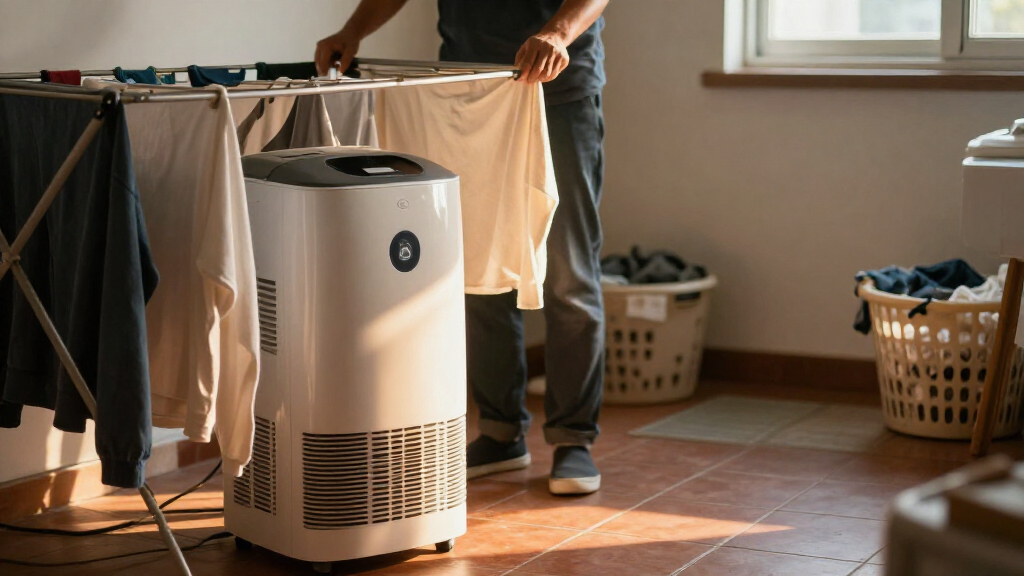

The best dehumidifier for drying clothes overall in this roundup is the DREO Smart Dehumidifier, 95-Pint, which pairs high moisture-removal capacity with smart controls for frequent laundry loads. The Frigidaire 50-Pint stands out for Wi-Fi convenience, while the COSVII offers a dedicated dry-clothes mode for people who want a more direct laundry setting. The main tradeoff is between faster moisture removal from larger compressor units and the smaller footprint and simpler setup of compact models. Tank size, continuous drainage, room conditions, and noise can matter as much as the advertised coverage area. Read on for the full comparison and guidance on which type best fits your laundry routine.

Get home appliances delivered free with Prime
- Fast, free delivery on millions of items
- Prime Video, Amazon Music and more included
- Member-only deals all year
Complete the kit


Key Takeaways
- The 95-pint DREO leads this lineup for frequent, high-volume indoor drying, but its larger capacity is more than many small laundry areas need.
- Dedicated controls separate convenience picks from raw-capacity picks: COSVII has a dry-clothes mode, while the Frigidaire and DREO models offer smart or Wi-Fi features.
- Continuous drainage can matter more than a larger tank when drying loads back-to-back, making hose-equipped options such as the KNKA and COSVII worth a closer look.
- Compact models trade drying pace for easier placement; the OWAAE and ToLife suit smaller spaces better than the 50-pint-and-up units.
- Capacity labels and room-coverage claims do not tell the whole story: laundry volume, humidity, temperature, airflow, and drainage setup all shape how quickly clothes dry.
| DREO Smart Dehumidifier, 95-Pint, 7 L Tank |  | Best for Fast, High-Volume Clothes Drying | Moisture removal: Up to 95 pints per day | Listed floor area: 3,000 square feet | Tank capacity: 7 liters (1.85 gallons) | VIEW LATEST PRICE | See Our Full Breakdown |
| Frigidaire 50-Pint Portable Dehumidifier with Wi-Fi |  | Best for a Larger Bucket and Washable Filter | Moisture removal: 50 pints per day | Tank volume: 2.7 gallons | Airflow: 235 cfm | VIEW LATEST PRICE | See Our Full Breakdown |
| DREO Smart Dehumidifier, 75-Pint, for Rooms up to 4,500 Sq Ft |  | Best for Large Rooms and Scheduled Drying | Moisture removal: 75 pints per day | Recommended floor area: 4,500 square feet | Tank capacity: 7 liters (1.85 gallons) | VIEW LATEST PRICE | See Our Full Breakdown |
| GE 50-Pint Dehumidifier for Up to 5,000 Sq. Ft. |  | Best for Easy Room-to-Room Adjustment | Moisture removal: 50 pints per day | Coverage area: Up to 5,000 square feet | Tank volume: 15 pints | VIEW LATEST PRICE | See Our Full Breakdown |
| OWAAE Compact Dehumidifier with Auto Shutoff and Sleep Mode |  | Best Compact Pick for Small Laundry Spaces | Dehumidification capacity: 1 L per day | Coverage area: Up to 1,000 square feet | Tank capacity: 95 fl oz | VIEW LATEST PRICE | See Our Full Breakdown |
| DR.PREPARE 38-Pint Dehumidifier for Rooms up to 2,500 Sq. Ft. |  | Best Mid-Size Compressor Pick | Dehumidification capacity: 38 pints per day | Recommended floor area: Up to 2,500 sq. ft. | Humidity range: 30%–80% | VIEW LATEST PRICE | See Our Full Breakdown |
| ToLife Portable Dehumidifier, 95 oz Tank, Sleep Mode and Auto Shutoff |  | Best for Quiet, Light-Duty Laundry Areas | Dehumidification capacity: 1 liter per day | Listed coverage area: Up to 1,000 sq. ft. | Tank capacity: 95 fl oz | VIEW LATEST PRICE | See Our Full Breakdown |
| 1000 sq ft Dehumidifier with 95 oz Tank and Auto Shutoff |  | Best Compact Nightstand-Sized Option | Daily moisture removal: 34 oz per day at 86°F and 80% RH | Listed floor area: 1,000 sq. ft. | Tank capacity: 95 oz | VIEW LATEST PRICE | See Our Full Breakdown |
| 80-Pint Dehumidifier for Spaces up to 4,500 Sq. Ft. |  | Best for Large Laundry Rooms and Damp Basements | Dehumidification capacity: Up to 80 pints per day | Coverage area: Up to 4,500 sq. ft. | Tank capacity: 1.72 gallons | VIEW LATEST PRICE | See Our Full Breakdown |
| COSVII Dehumidifier with Dry Clothes Mode, 78 oz Tank and Drain Hose |  | Best for a Dedicated Clothes-Drying Mode | Moisture removal: Up to 34 oz (1,000 ml) per day under ideal conditions | Listed coverage area: 1,000 sq. ft. | Tank capacity: 78 fl oz (2.25 L) | VIEW LATEST PRICE | See Our Full Breakdown |
| KNKA 34-Pint Dehumidifier with Drain Hose |  | Best for Balanced Laundry-Room Use | Dehumidification capacity: Up to 34 pints per day | Coverage area: Up to 2,500 square feet | Tank volume: 3 liters (0.79 gallons) | VIEW LATEST PRICE | See Our Full Breakdown |
| dehumidifiers for drying clothe | Dimensions | Weight | Tank capacity | Drainage |
|---|---|---|---|---|
| DREO Smart Dehumidifier | 9.17 × 14.57 × 24.49 in (D × W × H) | 34.3 lb | 7 liters (1.85 gallons) | Manual tank emptying or continuous hose drainage; drain hose included |
| Frigidaire 50-Pint Portable De | 12.19 × 24.25 × 24.25 in (D × W × H) | 44.5 pounds | — | Bucket or continuous draining |
| DREO Smart Dehumidifier | 9.17 × 14.57 × 24.49 in | 33 pounds | 7 liters (1.85 gallons) | — |
| GE 50-Pint Dehumidifier for Up | 11.4 × 14.4 × 24.1 inches | 41.1 pounds | — | Tank or continuous drain hose connection; hose not included |
| OWAAE Compact Dehumidifier wit | 7.8 × 4.9 × 13 in | 2.4 kg | 95 fl oz | — |
| DR.PREPARE 38-Pint Dehumidifie | 9.8 × 8.7 × 17.5 inches | — | 2 liters (0.53 gallons) | Removable tank or included drain hose |
| ToLife Portable Dehumidifier | — | 2.66 kg | 95 fl oz | — |
| 1000 sq ft Dehumidifier with 9 | 8 × 5 × 13 inches | 5 lbs | 95 oz | Tank with automatic shutoff; no hose listed |
| 80-Pint Dehumidifier for Space | 8.6 × 14.6 × 23.8 inches | 30 lbs | 1.72 gallons | Tank or included drain hose |
| COSVII Dehumidifier with Dry C | Listed as 1 × 1 × 1 in; appears incomplete | — | 78 fl oz (2.25 L) | Tank or included drain hose |
| KNKA 34-Pint Dehumidifier with | 13.23 × 10.31 × 20.87 inches | 8 kg | — | — |
More Details on Our Top Picks
DREO Smart Dehumidifier, 95-Pint, 7 L Tank
For laundry that regularly leaves a large room damp, I’d put the DREO 95-Pint near the top of the shortlist: its stated moisture removal capacity is higher than the DREO 75-Pint and the two 50-pint models here. That extra capacity can help manage moisture from frequent loads, while app controls let you adjust humidity and check energy use without walking back to the unit. At its lowest stated noise level of 41 dB, it may also suit a laundry area near living space better than a louder-running appliance.
The tradeoff is the 7 L tank: without the supplied hose connected for continuous drainage, it can need frequent emptying during heavy drying. At 34.3 pounds, it is not an effortless room-to-room choice either. I’d choose it over the Frigidaire when moisture-removal headroom matters more than a larger bucket; skip it if you cannot set up a drain and want minimal handling.
Pros:- Up to 95 pints per day gives it the highest stated removal capacity among these five picks.
- App control supports remote humidity adjustment and energy-use monitoring.
- Supplied drain hose enables continuous drainage during longer laundry-drying runs.
- Stated 41 dB operation may be easier to live with near occupied rooms.
Cons:- The 7 L tank can fill quickly during intensive use if the hose is not connected.
- At 34.3 pounds, it is cumbersome to carry between floors or rooms.
- Its high capacity may be more than needed for occasional small laundry loads.
Best for: Households air-drying frequent or bulky laundry in a large room that can use continuous hose drainage and wants app-based humidity and energy monitoring.
Not ideal for: People who need to move a dehumidifier often or prefer a large onboard tank, since this unit weighs 34.3 pounds and its 7 L tank may need regular emptying.
- Moisture removal:Up to 95 pints per day
- Listed floor area:3,000 square feet
- Tank capacity:7 liters (1.85 gallons)
- Noise level:41 dB
- Airflow:163 cfm
- Fan speeds:3
- Dimensions:9.17 × 14.57 × 24.49 in (D × W × H)
- Weight:34.3 lb
- Drainage:Manual tank emptying or continuous hose drainage; drain hose included
Our verdict“Choose this DREO when fast moisture removal and app control matter more than a large tank or easy portability.”
Frigidaire 50-Pint Portable Dehumidifier with Wi-Fi
The Frigidaire suits laundry rooms where a larger onboard bucket matters more than maximum extraction. Its 2.7-gallon front-loading bucket is roomier than the 7 L tanks on both DREO models, and the handle and splash guard make removal and carrying more manageable. That can mean fewer interruptions when you are drying clothes without a drain nearby. Its washable dust filter is another practical advantage in a busy utility space.
At 50 pints per day, it has less stated removal capacity than either DREO, so I would not rank it ahead of them for repeated heavy loads in a very damp room. Continuous draining is available, but the unit weighs 44.5 pounds, making it the heaviest of these five. Choose it over the GE if a bigger bucket and front access suit your setup; the GE offers a 15-pint tank and wheels for easier repositioning.
Pros:- The 2.7-gallon front-loading bucket holds more than the 7 L tanks on the DREO models.
- Bucket handle and splash guard make manual emptying less awkward.
- Washable filter can be cleaned and reused.
- Continuous drainage is supported for extended operation.
Cons:- Its 50-pint daily capacity is lower than the DREO 95-Pint and DREO 75-Pint.
- At 44.5 pounds, it is difficult to move frequently.
- The bucket still needs emptying when continuous drainage is not used.
Best for: Laundry-room users who want a larger removable bucket, a washable filter, and the option to drain continuously.
Not ideal for: People who need the highest moisture-removal capacity or expect to carry the unit between floors; it is rated at 50 pints per day and weighs 44.5 pounds.
- Moisture removal:50 pints per day
- Tank volume:2.7 gallons
- Airflow:235 cfm
- Fan speeds:3
- Power:470 watts
- Dimensions:12.19 × 24.25 × 24.25 in (D × W × H)
- Weight:44.5 pounds
- Filter:Washable
- Drainage:Bucket or continuous draining
Our verdict“Pick the Frigidaire if bucket capacity and straightforward filter care matter more to you than maximum extraction or easy portability.”
DREO Smart Dehumidifier, 75-Pint, for Rooms up to 4,500 Sq Ft
I’d favor this DREO 75-Pint when the drying area is broad and scheduling matters more than getting the highest extraction rate. Its stated coverage reaches 4,500 square feet, compared with 3,000 square feet for the DREO 95-Pint, while app controls add schedules and energy monitoring. For someone who hangs laundry in a large basement or shared utility area, that combination makes it a more area-focused choice than the 95-pint model, even though its daily removal capacity is lower.
ENERGY STAR 2025 certification, sleep mode, and a stated 41 dB lowest fan speed add useful flexibility for regular operation. The limitation is the same small 7 L tank found on its DREO counterpart: without continuous drainage, heavy laundry use can mean frequent emptying. At 33 pounds, it is still not especially portable. Compared with the Frigidaire, it trades a larger bucket for app scheduling and a higher listed coverage area.
Pros:- Listed coverage of up to 4,500 square feet suits a large drying area.
- App controls include humidity adjustment, scheduling, and energy monitoring.
- Continuous drainage can reduce manual tank emptying.
- ENERGY STAR 2025 certification, sleep mode, and a stated 41 dB lowest fan speed support regular use.
Cons:- Its 75-pint daily capacity is below the DREO 95-Pint.
- The 7 L tank may need frequent emptying without hose drainage.
- At 33 pounds, it is not an especially light option to relocate.
Best for: People drying clothes in a large basement or shared room who want app scheduling, energy-use monitoring, and continuous drainage.
Not ideal for: Laundry setups without a drain and buyers who need the greatest stated daily extraction; the tank is 7 L and capacity is 75 pints per day.
- Moisture removal:75 pints per day
- Recommended floor area:4,500 square feet
- Tank capacity:7 liters (1.85 gallons)
- Noise level:41 dB at lowest fan speed
- Airflow:163 cfm
- Fan speeds:3
- Dimensions:9.17 × 14.57 × 24.49 in
- Weight:33 pounds
- Certification:ENERGY STAR 2025
Our verdict“Choose this DREO for a large laundry-drying area where scheduling and listed coverage matter more than maximum daily extraction.”
GE 50-Pint Dehumidifier for Up to 5,000 Sq. Ft.
The GE is a practical fit for people who move laundry between rooms and want the unit to adjust itself as humidity changes. Smart Dry changes fan speed based on room humidity, while wheels and pocket handles make repositioning less of a chore than with the 44.5-pound Frigidaire. Its listed coverage is up to 5,000 square feet, the broadest figure among these five products, though its 50-pint daily capacity is lower than either DREO model.
For clothes drying, I’d value its 15-pint tank over the 7 L tanks on the DREO models when collecting water manually. It can also connect to a continuous drain hose, but the hose is not included and there is no pump, which limits placement when gravity drainage is unavailable. The washable filter, auto restart, and auto defrost add useful household functions; choose the Frigidaire instead if a larger bucket is your priority.
Pros:- Smart Dry adjusts fan speed in response to room humidity.
- Wheels and pocket handles help with movement around the home.
- The 15-pint tank is larger than the 7 L tanks on the DREO models.
- Washable filter, auto restart, and auto defrost support routine household use.
Cons:- Its 50-pint daily capacity is lower than both DREO models in this group.
- Continuous drainage hose is not included.
- No pump means drainage depends on a suitable gravity-fed setup.
Best for: Households that move a dehumidifier among laundry areas and want humidity-responsive fan control, wheels, and a moderate-size tank.
Not ideal for: People who need to pump water upward or place the drain far from a floor drain; this model has no pump and the hose is not included.
- Moisture removal:50 pints per day
- Coverage area:Up to 5,000 square feet
- Tank volume:15 pints
- Humidity setting range:30–70%
- Fan speeds:3
- Dimensions:11.4 × 14.4 × 24.1 inches
- Weight:41.1 pounds
- Drainage:Tank or continuous drain hose connection; hose not included
- Pump:No
Our verdict“Choose the GE if you want an easier-to-move 50-pint unit with automatic fan adjustment and a larger tank than the DREO options.”
OWAAE Compact Dehumidifier with Auto Shutoff and Sleep Mode
The OWAAE fills a different role from the compressor-style, high-capacity options here: it is a compact, quiet supplemental unit for a closet, small bathroom, bedroom, or RV where laundry is occasional and space is limited. Its 1 L-per-day capacity is far below the GE’s 50 pints or the DREO models’ 75 and 95 pints, so I would not choose it to dry repeated loads in a damp basement. Its stated sleep-mode noise below 30 dB and 2.4 kg weight are better matched to quiet, portable placement than those larger machines.
The 95-ounce removable tank and automatic shutoff help contain water when the unit fills, while the built-in handle makes relocation easier. The tradeoff is modest moisture removal, and the supplied data lists 220 V, so buyers should check that this matches their electrical setup. Choose it over the larger models only when compact size and low-noise operation outweigh drying speed.
Pros:- Compact 2.4 kg body and built-in handle make it easier to place or move than the larger models.
- Sleep mode is rated below 30 dB.
- Automatic shutoff responds when the tank is full or incorrectly positioned.
- Removable 95-ounce tank and seven-color LED lighting suit flexible small-room placement.
Cons:- At 1 L per day, moisture removal is far below the capacity of the DREO and GE models.
- The description says it works best in moderate-to-high humidity, limiting its fit for tougher drying conditions.
- The listed 220 V specification may not match every household electrical setup.
Best for: People who air-dry a small amount of laundry in a closet, bathroom, bedroom, or RV and prioritize compact size and quiet sleep-mode operation.
Not ideal for: Households drying full loads or managing a large, persistently damp room; its stated removal capacity is only 1 L per day.
- Dehumidification capacity:1 L per day
- Coverage area:Up to 1,000 square feet
- Tank capacity:95 fl oz
- Sleep-mode noise:Under 30 dB
- Power:85 W
- Voltage:220 V
- Dimensions:7.8 × 4.9 × 13 in
- Weight:2.4 kg
- Features:Automatic shutoff, removable tank, sleep mode, built-in handle, seven-color LED lighting
Our verdict“Pick the OWAAE for occasional small-space laundry drying when quiet operation and portability matter more than speed.”
DR.PREPARE 38-Pint Dehumidifier for Rooms up to 2,500 Sq. Ft.
For a regular laundry room where drying clothes adds moisture day after day, I’d choose this 38-pint compressor model over the smaller semiconductor units in this lineup. Its higher moisture-removal capacity and Continuous mode are better suited to pulling damp air from a room while laundry hangs, and the included hose can avoid repeated tank emptying if a suitable drain is nearby. The 2-liter tank is small for a compressor unit, though, so manual drainage may become a chore during heavy use. Compared with the 80-Pint Dehumidifier, this DR.PREPARE is a more manageable fit for a smaller laundry space, but it cannot match that model’s capacity for a large, persistently damp area. Sleep mode is rated at 35 dB, yet drying clothes quickly is more likely to call for a stronger operating mode.
Pros:- Removes up to 38 pints of moisture per day, well above the compact semiconductor models here.
- Continuous mode and included drain hose support extended operation during laundry drying.
- Sleep mode is rated at 35 dB for quieter use when the room is not in active drying mode.
- Casters and a built-in handle make repositioning easier.
Cons:- The 2-liter tank may need frequent emptying if the drain hose is not used.
- Its capacity falls well short of the 80-pint model for large or very damp spaces.
- The product guidance calls for keeping doors and windows closed during operation, limiting airflow between rooms.
Best for: Households drying laundry in a dedicated room up to 2,500 square feet that can use a drain hose or manage a smaller tank.
Not ideal for: People who need high-capacity moisture removal across a large basement or want to avoid frequent tank emptying without a drain.
- Dehumidification capacity:38 pints per day
- Recommended floor area:Up to 2,500 sq. ft.
- Humidity range:30%–80%
- Operating modes:Auto, Continuous, Sleep
- Tank capacity:2 liters (0.53 gallons)
- Sleep mode noise:35 dB
- Dimensions:9.8 × 8.7 × 17.5 inches
- Drainage:Removable tank or included drain hose
Our verdict“Choose the DR.PREPARE for a medium-size laundry room where compressor-level drying matters and hose drainage is practical.”
ToLife Portable Dehumidifier, 95 oz Tank, Sleep Mode and Auto Shutoff
The ToLife makes more sense as a quiet helper for a small drying space than as the main appliance for a load of wet laundry. Its semiconductor system removes a listed 1 liter per day, so it is a less forceful option than the DR.PREPARE 38-Pint when a room needs substantial moisture pulled from the air. In return, the ToLife is compact, portable and rated under 30 dB in Sleep mode, a useful combination for a bedroom or small laundry nook where noise matters. The 95-ounce tank and auto shutoff reduce the chance of overflow, but they do not replace continuous drainage; the supplied details list no hose. I’d also treat the stated coverage cautiously: the modest removal rate is a better guide to laundry-drying ability than the up-to-1,000-square-foot claim. Conflicting dimensions make fit harder to confirm.
Pros:- Sleep mode is rated under 30 dB, making it one of the quieter options listed.
- The 95-ounce tank provides more collection capacity than the COSVII’s 78-ounce tank.
- Auto shutoff responds when the tank is full or incorrectly placed.
- Compact body and handles support moving it between small rooms.
Cons:- Listed moisture removal of 1 liter per day is limited for accelerating laundry drying.
- No continuous-drain hose is listed, so the tank needs manual attention.
- Product information gives conflicting dimensions, making placement planning uncertain.
Best for: People who hang a small amount of laundry in a bedroom, closet, or compact utility area and prioritize quiet operation.
Not ideal for: Households drying multiple loads in a damp room or anyone seeking compressor-level extraction and hose drainage.
- Dehumidification capacity:1 liter per day
- Listed coverage area:Up to 1,000 sq. ft.
- Tank capacity:95 fl oz
- Operating modes:2, including Sleep mode
- Sleep mode noise:Under 30 dB
- Power:93 W
- Voltage:220 V
- Weight:2.66 kg
Our verdict“Pick the ToLife for quiet, occasional moisture control around a small laundry load, not for fast drying or heavy dampness.”
1000 sq ft Dehumidifier with 95 oz Tank and Auto Shutoff
This compact unit suits a small, quiet drying corner where portability matters more than speed. Its stated removal rate of 34 ounces per day is modest beside the compressor-based DR.PREPARE 38-Pint, so I would not rely on it to dry a full laundry load quickly or control a heavily damp basement. At five pounds, with a carry handle and a 95-ounce tank, it is easier to move between a closet, bathroom or RV than the larger compressor models. The automatic shutoff helps prevent overflow, but the tank still needs emptying, and there is no continuous-drain hose listed. The low-noise claim of 40 dB or less and adjustable ambient light may suit a bedroom, though the light is an extra rather than a laundry-drying advantage.
Pros:- At 5 pounds, it is easier to carry between small rooms than the 30-pound 80-Pint Dehumidifier.
- Rated noise of 40 dB or less is suited to quieter spaces.
- The 95-ounce tank and automatic shutoff help reduce spill risk between emptying.
- Small listed dimensions can fit on limited floor space.
Cons:- Removal capacity of 34 ounces per day is modest for drying clothes.
- No drain hose is listed, so ongoing use requires manual tank emptying.
- The 95-ounce tank may fill quickly in a humid room despite its compact form.
Best for: Apartment dwellers or RV owners who want a portable unit for light laundry drying in a small room and value quiet operation.
Not ideal for: People drying frequent or bulky loads, or those who need continuous drainage or strong moisture removal in a large space.
- Daily moisture removal:34 oz per day at 86°F and 80% RH
- Listed floor area:1,000 sq. ft.
- Tank capacity:95 oz
- Noise level:≤40 dB
- Dimensions:8 × 5 × 13 inches
- Weight:5 lbs
- Drainage:Tank with automatic shutoff; no hose listed
- LED light:Seven adjustable colors
Our verdict“Choose this model for light-duty laundry moisture in a small room where easy carrying matters more than drying speed.”
80-Pint Dehumidifier for Spaces up to 4,500 Sq. Ft.
When clothes dry in a large basement or a room that stays damp, I’d put this 80-pint compressor model ahead of the smaller DR.PREPARE and semiconductor options. Its stated extraction capacity is the strongest among the five products here, and the 90° adjustable air outlet gives more control over where dry air moves around a drying area. Continuous drainage with the included hose is especially useful for long runs, while the 1.72-gallon tank offers a fallback when a drain is unavailable. That capacity comes with a real handling tradeoff: at 30 pounds, it is less convenient to move between floors than the compact ToLife or 5-pound 1,000 sq ft unit. Sleep mode is listed at 40 dB, but this is a substantial appliance for a small bedroom or occasional single garment.
Pros:- Up to 80 pints per day gives it the highest stated extraction capacity in this batch.
- Included hose supports continuous drainage during extended laundry-drying sessions.
- Adjustable air outlet helps direct airflow toward a clothes-drying area.
- Automatic defrost, overload protection, and washable filter support ongoing residential use.
Cons:- At 30 pounds, it is much less portable than the compact semiconductor models.
- The 1.72-gallon tank needs emptying when continuous drainage is not available.
- Its large-room capacity may be excessive for a small laundry nook or occasional light use.
Best for: Households air-drying frequent loads in a large laundry room or damp basement with access to a drain.
Not ideal for: People with a small bedroom, limited storage, or a need to carry the unit regularly between floors.
- Dehumidification capacity:Up to 80 pints per day
- Coverage area:Up to 4,500 sq. ft.
- Tank capacity:1.72 gallons
- Noise level:40 dB
- Humidity range:30%–80%
- Dimensions:8.6 × 14.6 × 23.8 inches
- Weight:30 lbs
- Drainage:Tank or included drain hose
- Air outlet:90° adjustable
Our verdict“Choose this model when a large, damp laundry area needs sustained high-capacity extraction and a drain hose can be used.”
COSVII Dehumidifier with Dry Clothes Mode, 78 oz Tank and Drain Hose
The COSVII is the most directly laundry-focused compact option here because its Dry Clothes mode adds stronger airflow and gentle warm air—features aimed at helping hanging garments dry, rather than simply reducing room humidity. That makes it a more targeted pick than the ToLife Portable Dehumidifier, which is quieter in Sleep mode but has no listed clothes-specific setting. The COSVII’s extraction rate is still only up to 34 ounces per day under ideal conditions, so it cannot compete with the 80-Pint Dehumidifier for a large or very damp laundry room. Its included hose is a practical advantage over other compact models, although the 78-ounce tank is smaller than the ToLife’s 95-ounce tank if hose drainage is not convenient. The listed dimensions of 1 × 1 × 1 inch appear incomplete, so placement needs confirmation.
Pros:- Dry Clothes mode combines stronger airflow with gentle warm air for a laundry-specific setting.
- Included drain hose enables continuous drainage, unlike the listed compact ToLife and 1,000 sq ft models.
- Sleep mode is rated at 36 dB, and the ambient light can be turned off.
- Automatic shutoff and a water-level window make tank use easier to monitor.
Cons:- Up to 34 ounces per day is limited compared with compressor models such as the DR.PREPARE.
- The 78-ounce tank is smaller than the ToLife’s 95-ounce tank if the hose is not used.
- Listed dimensions of 1 × 1 × 1 inch appear incomplete or inaccurate.
Best for: People who air-dry a small laundry load indoors and want a dedicated warm-air mode plus optional hose drainage.
Not ideal for: Households with large or frequent loads, or buyers who need reliable size information before planning a tight installation.
- Moisture removal:Up to 34 oz (1,000 ml) per day under ideal conditions
- Listed coverage area:1,000 sq. ft.
- Tank capacity:78 fl oz (2.25 L)
- Laundry setting:Dry Clothes mode with stronger airflow and gentle warm air
- Sleep mode noise:36 dB
- Drainage:Tank or included drain hose
- Additional features:Auto shutoff, touch controls, water-level window, seven-color ambient light
- Dimensions:Listed as 1 × 1 × 1 in; appears incomplete
Our verdict“Choose the COSVII for small indoor laundry loads when a dedicated warm-air mode and hose option matter more than high extraction capacity.”
KNKA 34-Pint Dehumidifier with Drain Hose
The KNKA pairs 34-pint daily moisture removal with a dedicated DRY mode, making it a practical fit for a laundry room where damp clothes raise humidity but a larger-capacity unit would be more than needed. Its included drain hose lets it run continuously near a suitable drain, while the small built-in tank gives you another option when a hose setup is inconvenient. Compared with the DR.PREPARE 38-Pint Dehumidifier, the KNKA has slightly lower stated capacity but offers three drainage options and a sleep mode for quieter household use.
The tradeoff is that its 0.79-gallon tank may need frequent emptying during heavier drying, and the larger external tank is sold separately. At 2,500 square feet of stated coverage, it suits more than a small laundry nook, but buyers should not read that figure as a promise of fast clothes drying in every room. The recommended 24-hour upright wait after delivery also delays setup.
Pros:- DRY mode and adjustable 30%–80% RH settings support laundry-room humidity control.
- Included drain hose allows continuous drainage without relying on the built-in tank.
- Sleep mode, a stated 37 dB noise level, and a humidity indicator support quieter everyday operation.
- Wheels and a washable filter simplify moving the unit and routine upkeep.
Cons:- The 0.79-gallon built-in tank can require frequent emptying during sustained use.
- The 2.64-gallon external tank is sold separately.
- The manufacturer recommends leaving the unit upright for 24 hours after delivery before use.
Best for: Households drying laundry in a medium-sized room that want adjustable humidity, a hose for continuous drainage, and a quieter-use mode.
Not ideal for: People who need the highest moisture-removal capacity for frequent, heavy laundry loads or want a large included tank with fewer emptying stops.
- Dehumidification capacity:Up to 34 pints per day
- Coverage area:Up to 2,500 square feet
- Tank volume:3 liters (0.79 gallons)
- Drain hose length:3.28 feet (1 meter)
- Humidity settings:30%–80% RH
- Modes:AUTO, DRY, SETTING
- Noise level:37 dB
- Dimensions:13.23 × 10.31 × 20.87 inches
- Weight:8 kg
Our verdict“Choose the KNKA for a laundry room that needs flexible drainage and moderate-to-high moisture removal, but skip it if maximum capacity or a large included tank matters most.”
How We Picked
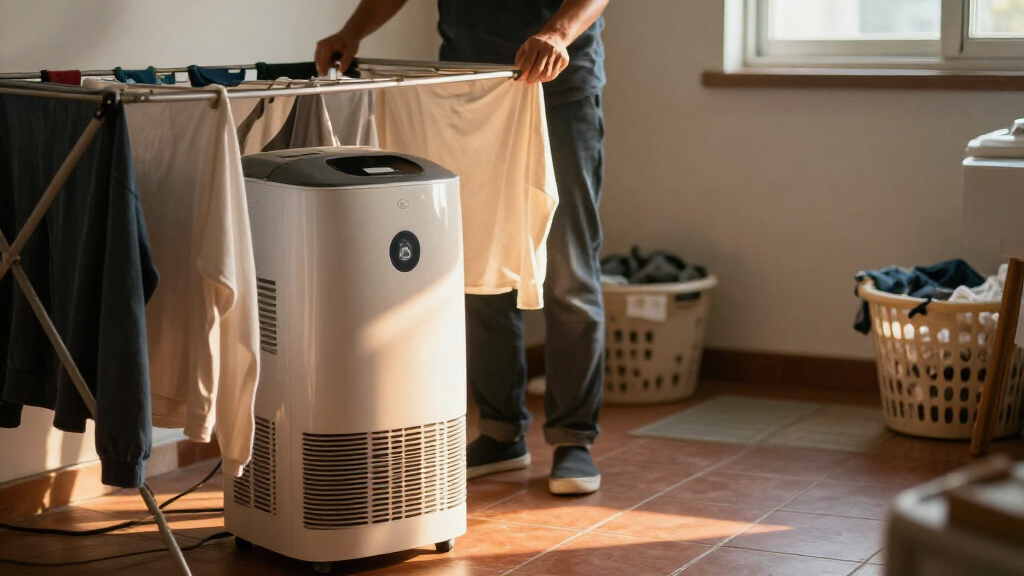
I ranked these models around their usefulness for drying clothes indoors, not just their ability to reduce general room humidity. I weighed stated moisture-removal capacity, laundry-oriented modes, drainage options, tank handling, controls, portability, and the practical fit between the unit and a typical drying space. I also looked at whether a feature could reduce interruptions, such as a drain hose for extended operation or app controls for remote adjustments.
The ranking favors models that appear better suited to repeated laundry loads and sustained moisture removal, while recognizing that maximum capacity is not the right answer for every household. The 95-pint DREO takes the lead for capacity and smart operation; the Frigidaire and COSVII earn attention for convenience and laundry-specific controls. Compact models rank lower for heavy loads but remain relevant for occasional use or tighter rooms. Because performance depends on room temperature, humidity, ventilation, and load size, I treat published capacity and coverage figures as comparison points rather than guarantees of drying time.
| dehumidifiers for drying clothe | Drainage |
|---|---|
| DREO Smart Dehumidifier | Manual tank emptying or continuous hose drainage; drain hose included |
| Frigidaire 50-Pint Portable De | Bucket or continuous draining |
| DREO Smart Dehumidifier | — |
| GE 50-Pint Dehumidifier for Up | Tank or continuous drain hose connection; hose not included |
| OWAAE Compact Dehumidifier wit | — |
| DR.PREPARE 38-Pint Dehumidifie | Removable tank or included drain hose |
| ToLife Portable Dehumidifier | — |
| 1000 sq ft Dehumidifier with 9 | Tank with automatic shutoff; no hose listed |
| 80-Pint Dehumidifier for Space | Tank or included drain hose |
| COSVII Dehumidifier with Dry C | Tank or included drain hose |
| KNKA 34-Pint Dehumidifier with | — |
Factors to Consider When Choosing Best Dehumidifiers For Drying Clothes
Choosing a dehumidifier for laundry is less about finding the biggest number and more about matching moisture removal to your routine, room, and willingness to manage water collection. These broader checks can help prevent buying a unit that is either undersized for repeated loads or cumbersome for occasional use.
Match Capacity to Laundry Volume and Room Conditions
Capacity indicates how much moisture a unit can remove under specified conditions, but it does not predict an exact clothes-drying time. A household drying several loads in a cool basement has a different job for a dehumidifier than someone drying one small load in a warm spare room. Cold air can reduce the effectiveness of many compressor models, so check the unit’s operating-temperature range if your laundry space is chilly. Treat square-foot coverage as a rough room-sizing aid, not a promise that wet clothes will dry quickly across that entire area. If your needs vary, a stronger unit can offer more headroom, but it may take up more space and need more frequent attention to its tank. For occasional laundry, a mid-capacity model may be a better match than paying for capacity you rarely use.
Plan for Airflow Around the Clothes
A dehumidifier removes moisture from the room air; it does not replace air movement through a crowded rack. Leave space between garments and position the unit so its intake and exhaust are not blocked by laundry, walls, or furniture. A fan can help move damp air away from fabric and toward the dehumidifier, particularly when clothes hang close together. Avoid aiming warm or dry exhaust directly at delicate garments unless the manufacturer’s instructions allow it. A common mistake is to focus on appliance capacity while hanging a dense load in a closed, poorly arranged space. A clear path for airflow can improve the setup without requiring a more powerful machine.
Choose a Drainage Setup You Will Actually Use
Tank capacity affects how often you need to stop and empty the unit, especially during a long drying session or several loads in a row. A small tank can be manageable for occasional use but become a regular interruption in a busy laundry routine. A hose connection can support longer operation, though it only helps if you have a nearby drain and can route the hose without kinks or uphill sections. Check whether the hose is included, whether gravity drainage is required, and how the unit behaves when the tank is full. If a drain is unavailable, prioritize a tank that is easy to remove and carry rather than relying on capacity alone. Think through placement before buying, since a model that cannot drain where you need it may be less useful than a smaller unit with a practical setup.
Balance Laundry Modes, Controls, and Noise
A dedicated dry-clothes mode can simplify operation, but it is not a guarantee of faster drying or a substitute for checking fabric-care instructions. Humidity targets and adjustable fan settings can be more useful if the appliance will also serve a bedroom or living area. App or Wi-Fi controls help when you want to change settings without entering a laundry room, though they add little value if you prefer simple manual controls. Noise matters when the unit runs near bedrooms or shared living spaces, so look for sleep modes and consider where the appliance will sit during a cycle. Quiet settings may reduce fan activity, which can affect moisture removal, so they may not suit every laundry session. Choose controls that fit your routine rather than paying attention to feature count alone.
Check Maintenance and Long-Term Placement
Filters collect dust and lint, so a unit used around laundry needs regular cleaning to maintain airflow. Look for a filter that is accessible and straightforward to remove; a difficult maintenance routine can discourage upkeep. Leave room to pull out the tank, clean the filter, and reach a drain hose without moving a rack every time. Some dehumidifiers also need space around their vents, which can rule out narrow alcoves or tight closets. Before purchasing, measure the intended spot and check the unit’s dimensions, cord reach, and required clearances. A convenient maintenance layout can matter more over months of use than an extra feature you rarely touch.
Decide When Paying for More Capacity Makes Sense
Higher-capacity models make the most sense when you regularly dry multiple loads, manage a damp room, or want one appliance to handle broader household humidity. They can be excessive for a small, well-ventilated room used for occasional air-drying, where a compact model may be easier to place and move. Compare the full setup, including drainage, controls, and intended operating conditions, rather than treating capacity as a quality ranking by itself. A larger unit can still require careful placement and airflow to help laundry dry. If you are choosing between a feature-rich unit and a simpler model, ask which feature will change your routine: a hose, app access, or a laundry mode may be more useful than extra capacity. Buy for your typical load and space, not an unusually demanding scenario you rarely face.
Frequently Asked Questions
Will a dehumidifier dry clothes as quickly as a tumble dryer?
No. A dehumidifier lowers the moisture in the surrounding air, helping water evaporate from hanging clothes, while a tumble dryer actively heats and circulates air through the load. Drying time with a dehumidifier varies with fabric, load density, room temperature, humidity, and airflow. Spacing garments apart and using a suitable fan can help, but indoor air-drying is usually a slower process. It can be a useful alternative when you want to avoid a tumble dryer or have no suitable outdoor drying area.
Should I choose a compressor or a compact thermoelectric-style dehumidifier for laundry?
For repeated or large laundry loads, a higher-capacity compressor model is generally the more relevant type to compare because it is designed to remove more moisture than many small compact units. Compact models can be easier to place and may suit a small room or occasional use, but their smaller tanks and lower stated capacities can mean slower progress with wet clothes. Room temperature also matters: compressor units may perform less effectively in cold spaces, so check their specified operating range. Choose based on your laundry volume and room conditions rather than the unit’s footprint alone.
Is a drain hose worth prioritizing if I dry clothes often?
A drain hose can be a meaningful convenience if you run the dehumidifier for long periods or dry several loads in succession. It reduces the need to monitor and empty the tank, provided the hose can reach a suitable drain and water can flow as the manufacturer requires. Without a drain nearby, a hose connection may not help, so tank access and manageable tank weight become more important. Check whether the hose is supplied and whether the unit stops automatically when its tank fills. For occasional laundry, manual emptying may be perfectly workable.
Can I put the dehumidifier directly beside a drying rack?
Place it close enough to draw in humid room air, but leave the clearances specified in the manual around its intake and exhaust. Blocking a vent with clothes or positioning the unit where water could drip onto it can interfere with operation or create a safety concern. Hanging garments with space between them helps air circulate, and a separate fan can move damp air through the rack. Keep cords and hoses away from walkways and avoid placing the unit on an unstable or wet surface. The best position is one that supports airflow while keeping the appliance accessible for tank or filter maintenance.
Is a dry-clothes mode more useful than Wi-Fi for indoor laundry?
It depends on how you prefer to operate the appliance. A dry-clothes mode offers a direct setting for laundry sessions, which may make everyday use simpler, while Wi-Fi is more useful when you want remote monitoring or adjustments. Neither feature alone proves that a unit will dry clothes faster; capacity, room conditions, and airflow still play major roles. If you tend to set a machine and leave it running, app controls may be convenient, while a dedicated mode may suit someone who wants fewer manual choices. Give priority to the feature you will use, along with practical drainage and capacity.
Conclusion
For the broadest fit in this group, I would start with the DREO Smart Dehumidifier, 95-Pint: its stated capacity and smart controls suit frequent laundry drying, though it may be more machine than a small room needs. For best value in practical features, compare the KNKA 34-Pint if its drain-hose setup matches your space and your loads are moderate. The Frigidaire 50-Pint is my best premium convenience pick for shoppers who want Wi-Fi controls, while the COSVII is the clearest choice for a dedicated dry-clothes mode. Beginners with occasional loads and limited space may prefer a compact option such as the OWAAE, accepting lower capacity. If you dry clothes often in a larger or persistently damp room, favor a higher-capacity model and a workable drain route; for a small occasional setup, prioritize fit and easy tank handling over headline capacity.