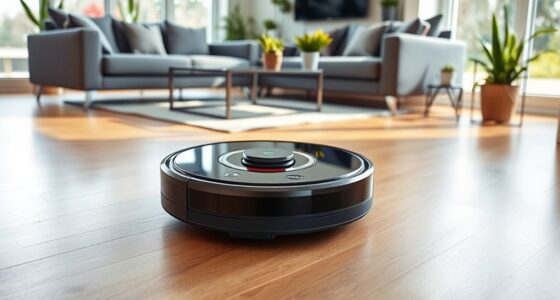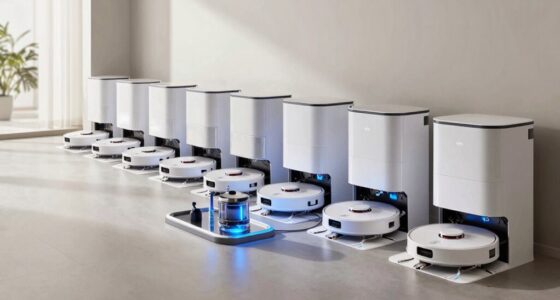
For robot vacuums with self-emptying docks, my best overall pick is the Roborock Q7 M5+, which pairs a self-empty dock with 10,000Pa suction and mopping. The Shark AI Ultra AV2501AE stands out for its bagless base and HEPA filtration, while the iRobot Roomba 105 Vac keeps the setup focused on vacuuming. The main tradeoffs are how much automation you want, whether you prefer bags or a bagless base, and whether mopping adds useful flexibility or extra upkeep. Dock capacity also varies, so a longer interval between emptying can matter as much as suction for busy homes. Read on for the full comparison, buying advice, and picks for different needs.

Get home appliances delivered free with Prime
- Fast, free delivery on millions of items
- Prime Video, Amazon Music and more included
- Member-only deals all year
Complete the kit


Key Takeaways
- Roborock Q7 M5+ leads this lineup for buyers who want a high stated suction figure, mopping, and an auto-empty dock in one machine.
- Shark AI Ultra AV2501AE offers a distinct bagless option with HEPA filtration and a stated 60-day base capacity; its dock design may suit buyers who want to avoid replacement bags.
- The listed Redroad R11 pairs the lineup’s highest stated suction figure, 20,000Pa, with a stated 120-day self-emptying interval, though those claims alone do not establish real-world cleaning performance.
- The two Roomba 105 models make the vacuum-only versus vacuum-and-mop choice explicit, while the Shark Navigator offers a shorter stated 30-day capacity for buyers who do not need the longest interval.
- Several models have generic or unfamiliar product names, so buyers should verify replacement bags, filters, parts, app support, and warranty terms before choosing them over established-brand options.
| Tikom L8000 Plus Robot Vacuum and Mop with Self-Emptying Base |  | Best for Multi-Floor Homes | Suction: 6,000Pa | Dustbag capacity: 3L | Stated emptying interval: Up to 90 days | VIEW LATEST PRICE | See Our Full Breakdown |
| Q10 PRO Robot Vacuum and Mop with Self-Emptying Base, 8000Pa Suction |  | Best for Stronger Suction | Suction: 8,000Pa | Station capacity: 3.3L | Stated hands-free interval: Up to 60 days | VIEW LATEST PRICE | See Our Full Breakdown |
| Shark AI Ultra AV2501AE Robot Vacuum with XL HEPA Self-Empty Base |  | Best Bagless Pick | Navigation: LiDAR Precision Home Mapping with Matrix Clean | Self-empty base: Bagless; up to 60-day capacity | Filtration: True HEPA; captures 99.97% down to 0.3 microns | VIEW LATEST PRICE | See Our Full Breakdown |
| D13S MAX 3-in-1 Robot Vacuum with LiDAR Navigation and Self-Emptying |  | Best for Maximum Listed Suction | Suction: 11,500Pa | Cleaning functions: Vacuum, sweep, and mop | Navigation: LiDAR | VIEW LATEST PRICE | See Our Full Breakdown |
| Lefant M2 Plus Robot Vacuum and Mop Combo, Black |  | Best for Carpet-Aware Mopping | Suction: 6,000Pa | Dust bags: 2 × 2.5L | Stated emptying interval: Up to 75 days | VIEW LATEST PRICE | See Our Full Breakdown |
| Redroad R11 Robot Vacuum and Mop, 20,000Pa, 120-Day Self-Emptying, LiDAR Navigation, White |  | Best for Long Hands-Free Intervals | Suction power: 20,000 Pa | Dust bag capacity: 4 L | Stated self-emptying duration: Up to 120 days | VIEW LATEST PRICE | See Our Full Breakdown |
| Roborock Q7 M5+ Robot Vacuum and Mop with Self-Empty Dock, 10000Pa Suction |  | Best for Pet Hair and Room-by-Room Control | Suction power: 10,000 Pa | Dust bag capacity: 2.7 L | Stated self-emptying duration: Up to 7–9 weeks | VIEW LATEST PRICE | See Our Full Breakdown |
| Robot Vacuum and Mop with Self-Emptying Station, 6000Pa Suction, LiDAR Navigation |  | Best for Simple Mapped Cleaning | Suction power: 6000 Pa | Stated self-emptying duration: Up to 90 days | Navigation: 360° LiDAR | VIEW LATEST PRICE | See Our Full Breakdown |
| iRobot Roomba 105 Combo Robot Vacuum and Mop with AutoEmpty Dock |  | Best for Keeping Rugs Dry While Mopping | Stated self-emptying duration: Up to 75 days | Navigation: ClearView LiDAR | Cleaning modes: Vacuum only, mop only, vacuum and mop | VIEW LATEST PRICE | See Our Full Breakdown |
| iRobot Roomba 105 Vac Robot Vacuum with AutoEmpty Dock |  | Best Vacuum-Only Pick | Stated self-emptying duration: Up to 75 days | Allergen trapping: 99% of allergens as small as 0.7 microns | Suction claim: 70X more power-lifting suction than Roomba 600 series | VIEW LATEST PRICE | See Our Full Breakdown |
| H6 Pro 6000Pa Robot Vacuum and Mop with Self-Emptying and LiDAR Navigation |  | Best for Vacuuming and Mopping Together | Model: H6 Pro | Cleaning type: 3-in-1 robot vacuum and mop | Suction power: 6,000Pa | VIEW LATEST PRICE | See Our Full Breakdown |
| Shark AI Ultra Robot Vacuum, 60-Day Self-Emptying Base, Black, AV2511AE |  | Best for Pet Hair | Model: AV2511AE | Navigation: 360° LiDAR with object detection | Cleaning pattern: Matrix Clean precision grid | VIEW LATEST PRICE | See Our Full Breakdown |
| Shark Navigator Robot Vacuum, 30-Day Self-Emptying Base, White, AV2110S |  | Best for Straightforward Vacuuming | Model: AV2110S | Navigation: LiDAR SmartPath | Self-empty base type: Bagless | VIEW LATEST PRICE | See Our Full Breakdown |
| robot vacuums with self emptying | Navigation |
|---|---|
| Tikom L8000 Plus Robot Vacuum | 360° LiDAR |
| Q10 PRO Robot Vacuum and Mop w | 360° LiDAR with SLAM |
| Shark AI Ultra AV2501AE Robot | LiDAR Precision Home Mapping with Matrix Clean |
| D13S MAX 3-in-1 Robot Vacuum w | LiDAR |
| Lefant M2 Plus Robot Vacuum an | LiDAR with multi-floor mapping |
| Redroad R11 Robot Vacuum and M | 360° LiDAR |
| Roborock Q7 M5+ Robot Vacuum a | PreciSense LiDAR |
| Robot Vacuum and Mop with Self | 360° LiDAR |
| iRobot Roomba 105 Combo Robot | ClearView LiDAR |
| iRobot Roomba 105 Vac Robot Va | ClearView LiDAR |
| H6 Pro 6000Pa Robot Vacuum and | 360° LiDAR |
| Shark AI Ultra Robot Vacuum | 360° LiDAR with object detection |
| Shark Navigator Robot Vacuum | LiDAR SmartPath |
More Details on Our Top Picks
Tikom L8000 Plus Robot Vacuum and Mop with Self-Emptying Base
The Tikom L8000 Plus pairs a 3L self-emptying base, rated for up to 90 days of debris, with maps for as many as five floors. That combination makes it a strong fit for homes where the robot needs to remember different layouts without frequent bin attention. Its 6,000Pa suction is below the Q10 PRO’s 8,000Pa and the D13S MAX’s 11,500Pa, so I’d rank it for mapping flexibility and long intervals between emptying rather than raw pickup power. The 150-minute runtime and recharge-and-resume support larger cleaning runs, though the listed maximum applies only in gentle suction mode. For mopping, the holder must be removed or carpets excluded with no-go zones. Buyers wanting stronger suction should compare the D13S MAX; buyers with several floors may value Tikom’s five-map capacity more.
Pros:- 3L self-emptying bag is rated for up to 90 days of debris
- Stores up to five floor plans
- LiDAR mapping supports no-go zones and virtual walls
- 150-minute runtime with automatic recharge and resume
Cons:- 6,000Pa suction is lower than the Q10 PRO and D13S MAX
- Mop holder must be removed or carpets excluded to avoid wetting them
- 150-minute maximum runtime is limited to gentle suction mode
Best for: Households with several floors that want stored maps and infrequent emptying
Not ideal for: Carpet-heavy homes seeking the strongest listed suction or automatic carpet-safe mopping without setup
- Suction:6,000Pa
- Dustbag capacity:3L
- Stated emptying interval:Up to 90 days
- Navigation:360° LiDAR
- Multi-floor maps:Up to 5
- Maximum runtime:150 minutes in gentle suction mode
- Suction levels:3
- Connectivity:2.4GHz and 5GHz Wi-Fi; Alexa compatible
Our verdict“Choose the Tikom L8000 Plus if multi-floor mapping and a long stated interval between emptying matter more than maximum suction.”
Q10 PRO Robot Vacuum and Mop with Self-Emptying Base, 8000Pa Suction
The Q10 PRO makes the most sense for buyers who want a higher stated suction figure while keeping self-emptying and LiDAR mapping in the package. Its 8,000Pa suction and automatic carpet boost give it an edge over the Tikom L8000 Plus and Lefant M2 Plus, both listed at 6,000Pa. The 3.3L station is rated for up to 60 days between dust disposal, shorter than those two models’ stated 75- and 90-day intervals. I’d favor it when pickup power is the priority over stretching station maintenance. It also supports recharge-and-resume and is specified for homes up to 2,000 square feet. The tradeoffs are 2.4GHz-only Wi-Fi and a mop holder that needs removal or carpet no-go zones to prevent dampening rugs.
Pros:- 8,000Pa suction with automatic carpet boost
- 3.3L self-emptying station is rated for up to 60 days
- LiDAR mapping and recharge-and-resume support scheduled cleaning
- Works with Alexa and Google Assistant
Cons:- Only supports 2.4GHz Wi-Fi
- Mop holder must be removed or carpet no-go zones set to prevent wetting rugs
- Its stated 60-day interval is shorter than the Tikom L8000 Plus and Lefant M2 Plus
Best for: Homes with low-pile carpet and hard floors where stronger stated suction and carpet boost are priorities
Not ideal for: Homes using 5GHz-only Wi-Fi or buyers who want the longest stated interval between station emptying
- Suction:8,000Pa
- Station capacity:3.3L
- Stated hands-free interval:Up to 60 days
- Navigation:360° LiDAR with SLAM
- Maximum runtime:150 minutes
- Dustbin capacity:1.5L
- Coverage area:Up to 2,000 sq. ft.
- Connectivity:2.4GHz Wi-Fi; Alexa and Google Assistant
Our verdict“Pick the Q10 PRO if stronger stated suction and carpet boost matter more to you than dual-band Wi-Fi or a longer emptying interval.”
Shark AI Ultra AV2501AE Robot Vacuum with XL HEPA Self-Empty Base
The Shark AI Ultra AV2501AE is the lineup’s distinct choice for buyers who want a bagless self-empty base rather than a dustbag system. Its station holds up to 60 days of debris and uses True HEPA filtration, while the self-cleaning brushroll is aimed at households dealing with hair. Matrix Clean sends the robot through methodical multi-pass routes, a different emphasis from the D13S MAX’s headline suction or the Tikom L8000 Plus’s five-floor map capacity. Shark’s listed runtime is 120 minutes, shorter than both of those models’ 150- and 160-minute figures. I’d choose it for bagless collection and filtration, with the caveat that the base still needs periodic emptying and Wi-Fi or voice setup is needed for full hands-free control.
Pros:- Bagless self-empty base is rated for up to 60 days
- True HEPA filtration captures 99.97% of dust and allergens down to 0.3 microns
- Self-cleaning brushroll supports pet-hair pickup
- LiDAR mapping with Matrix Clean multi-pass navigation
Cons:- The base requires periodic emptying after capacity is reached
- 120-minute runtime is shorter than the Tikom L8000 Plus and D13S MAX
- Full hands-free control depends on Wi-Fi and voice assistant setup
Best for: Pet households that prefer a bagless base, HEPA filtration, and methodical vacuuming
Not ideal for: Buyers seeking mopping, very long runtime, or a station that never needs hands-on emptying
- Navigation:LiDAR Precision Home Mapping with Matrix Clean
- Self-empty base:Bagless; up to 60-day capacity
- Filtration:True HEPA; captures 99.97% down to 0.3 microns
- Brushroll:Self-cleaning
- Runtime:Up to 120 minutes
- Recharge and resume:Yes
- Voice compatibility:Amazon Alexa and Google Assistant
- Floor types:Carpet and hard floor
Our verdict“Choose the Shark AI Ultra if you want bagless self-emptying with HEPA filtration and do not need a mop or the longest runtime.”
D13S MAX 3-in-1 Robot Vacuum with LiDAR Navigation and Self-Emptying
The D13S MAX has the highest stated suction in this group at 11,500Pa, making it the pick for buyers focused on lifting debris from carpets and hard floors. It also vacuums, sweeps, and mops, with a self-emptying station rated for up to 90 days. That suction figure surpasses the Q10 PRO’s 8,000Pa and the 6,000Pa Tikom and Lefant models, but the D13S MAX’s onboard dustbin is only 240ml and its water tank is 230ml. The station reduces frequent dustbin handling; it does not remove the need to wash mop pads. Its 160-minute runtime is the longest among these five products, though buyers still need to make room for the base. I’d put it ahead for suction and runtime, not for low-maintenance mopping.
Pros:- 11,500Pa stated suction with carpet auto-boost
- Self-emptying station is rated for up to 90 days
- 160-minute runtime
- LiDAR mapping supports no-go zones
Cons:- 240ml onboard dustbin and 230ml water tank are relatively small
- Mop pads require regular washing
- Self-emptying station takes additional floor space
Best for: Carpet and hard-floor households prioritizing high stated suction and long cleaning runs
Not ideal for: Buyers who want minimal mop-pad care, larger onboard tanks, or a compact dock footprint
- Suction:11,500Pa
- Cleaning functions:Vacuum, sweep, and mop
- Navigation:LiDAR
- Runtime:Up to 160 minutes
- Onboard dustbin:240ml
- Water tank:230ml
- Self-emptying interval:Up to 90 days
- Special features:Carpet auto-boost, no-go zones, edge cleaning, Do Not Disturb mode
Our verdict“Choose the D13S MAX if high stated suction and a long runtime outweigh small onboard capacities and regular mop-pad washing.”
Lefant M2 Plus Robot Vacuum and Mop Combo, Black
The Lefant M2 Plus suits buyers who want a mop combo with carpet detection and two dust bags supplied by its station. The listed capacity is two 2.5L bags, and the station is described as supporting up to 75 days between dust disposal. That falls between the Tikom L8000 Plus and D13S MAX, both rated for up to 90 days, and the Q10 PRO at 60 days. Its 6,000Pa suction is also lower than the Q10 PRO and D13S MAX, so I’d rank it around managing mixed hard-floor and carpet routines rather than maximum pickup power. Three suction and water-flow levels, LiDAR maps, and no-go zones add control. The product data still warns that mopping requires managing the holder around carpets, so carpet detection should not be read as automatic protection from a wet mop.
Pros:- Two 2.5L dust bags and a stated interval of up to 75 days
- LiDAR navigation supports multi-floor mapping and no-go zones
- Three suction and three water-flow settings
- 140-minute runtime and listed carpet detection
Cons:- 6,000Pa suction is below the Q10 PRO and D13S MAX
- Mop holder needs management around carpets
- Hard floors are the recommended surface, limiting its fit for carpet-heavy homes
Best for: Households with mostly hard floors and some carpet that want adjustable cleaning and multi-floor maps
Not ideal for: Carpet-heavy homes seeking the strongest suction or fully hands-off mop management
- Suction:6,000Pa
- Dust bags:2 × 2.5L
- Stated emptying interval:Up to 75 days
- Robot dustbin:250ml
- Water tank:300ml
- Navigation:LiDAR with multi-floor mapping
- Runtime:Up to 140 minutes
- Connectivity:2.4GHz and 5GHz Wi-Fi; Alexa, app, and iWatch
Our verdict“Pick the Lefant M2 Plus for adjustable hard-floor cleaning and carpet-aware features if you are comfortable managing the mop holder yourself.”
The Redroad R11 is the strongest fit here for buyers who want to empty the dock as rarely as the listed capacity allows. Its 4L dust bag is rated for up to 120 days, longer than the Roborock Q7 M5+’s stated 7–9 weeks and the Roomba 105 models’ 75 days. The 20,000Pa suction and anti-tangle roller also make it a more compelling match for carpet and pet hair than the 6000Pa self-emptying option in this lineup. LiDAR mapping can store up to four maps, which helps in multi-floor homes. The tradeoff is that mopping is a supporting feature rather than a solution for stuck-on messes, and the long emptying interval still depends on replacing dust bags and setting up the app and Wi-Fi.
Pros:- 4L dust bag is rated for up to 120 days between emptying
- 20,000Pa stated suction suits homes with carpets and pet hair
- LiDAR supports up to four stored maps
- Anti-tangle roller and extendable side brush target hair and edges
Cons:- Mopping may not handle heavy or stuck-on messes well
- Requires replacement dust bags for continued self-emptying
- Smart controls depend on Wi-Fi and app setup
Best for: Multi-floor households with pets that want strong stated suction and fewer trips to the dust bag
Not ideal for: Buyers focused on scrubbing dried spills or avoiding app and Wi-Fi setup
- Suction power:20,000 Pa
- Dust bag capacity:4 L
- Stated self-emptying duration:Up to 120 days
- Navigation:360° LiDAR
- Map storage:Up to 4 maps
- Battery capacity:3,200 mAh
- Cleaning functions:Vacuum, sweep, mop
- Connectivity:2.4GHz and 5GHz Wi-Fi
Our verdict“Choose the R11 if long intervals between dock maintenance and multi-floor mapping matter more than stronger mopping.”
Roborock Q7 M5+ Robot Vacuum and Mop with Self-Empty Dock, 10000Pa Suction
The Roborock Q7 M5+ balances a self-emptying dock rated for 7–9 weeks with features aimed at pet hair and organized cleaning. Its JawScrapers main brush and anti-tangle side brush address a common maintenance chore, while PreciSense LiDAR and app-set no-go zones help divide a multi-room home into manageable routes. Compared with the Redroad R11, its stated 10,000Pa suction and 2.7L bag offer less on paper, but the Roborock presents a more focused case around brush design and room controls. The limit is its 2.4GHz-only Wi-Fi, which may not suit every network setup. Its three water-flow settings add basic mopping control, though buyers should still expect to handle dock bags periodically.
Pros:- JawScrapers main brush and anti-tangle side brush are designed for pet hair
- PreciSense LiDAR supports mapped multi-room cleaning
- App includes schedules and no-go zones
- Three water-flow settings provide basic mop adjustment
Cons:- 2.4GHz Wi-Fi requirement may limit setup on some networks
- 7–9-week stated interval is shorter than the Redroad R11’s up to 120 days
- Dock still requires periodic dust bag replacement
Best for: Pet owners who want mapped room cleaning, anti-tangle brushes, and app-set boundaries
Not ideal for: Households that rely on 5GHz-only Wi-Fi or want the longest stated emptying interval
- Suction power:10,000 Pa
- Dust bag capacity:2.7 L
- Stated self-emptying duration:Up to 7–9 weeks
- Navigation:PreciSense LiDAR
- Brush system:JawScrapers main brush and anti-tangle side brush
- Water-flow settings:3
- Connectivity:2.4GHz Wi-Fi
Our verdict“Pick the Q7 M5+ if pet-hair brush design and app-managed rooms matter more than the longest interval between bag changes.”
Robot Vacuum and Mop with Self-Emptying Station, 6000Pa Suction, LiDAR Navigation
This option covers the core self-emptying routine without emphasizing premium suction: it combines 6000Pa suction, LiDAR mapping, app scheduling, and Alexa control with a station rated for up to 90 days. That makes it a more straightforward mapped-cleaning pick than the Roborock Q7 M5+, whose listed suction is higher and whose brush system is more specifically aimed at tangles. The 120-minute battery life is a practical constraint for larger homes, and the 250ml onboard dustbin means the robot may need to return to its station during a run. A small bin is less troublesome when self-emptying works as intended, but it does not remove the runtime limit. The mop tank capacity is not listed, so I would not choose it for a demanding mopping routine.
Pros:- Station is rated for up to 90 days of debris collection
- 360° LiDAR mapping supports room routes and no-go zones
- App and Alexa controls support scheduling
- Two-year warranty and lifetime technical support are listed
Cons:- 120-minute battery life may constrain cleaning in larger homes
- 250ml onboard dustbin is small if a run needs mid-cycle handling
- Mop tank capacity is not specified
Best for: Owners of modest-size homes who want LiDAR mapping, basic app scheduling, and infrequent dock emptying
Not ideal for: Large homes needing longer cleaning runs or buyers who want documented mop capacity and stronger suction
- Suction power:6000 Pa
- Stated self-emptying duration:Up to 90 days
- Navigation:360° LiDAR
- Battery life:120 minutes
- Dustbin capacity:250 ml
- Cleaning path width:8.88 inches
- Controls:App and Alexa voice control
- Warranty:2 years, plus lifetime technical support
Our verdict“Choose this model for mapped, scheduled maintenance in a smaller home, but look elsewhere for longer runtime or a more fully specified mop setup.”
iRobot Roomba 105 Combo Robot Vacuum and Mop with AutoEmpty Dock
The Roomba 105 Combo makes carpet handling its clearest distinction: it avoids carpets while mopping, helping keep rugs dry without requiring the buyer to remember to block them off. Its AutoEmpty dock is rated for up to 75 days, matching the Roomba 105 Vac and sitting between the longer stated intervals of the Redroad R11 and the Roborock Q7 M5+. ClearView LiDAR, multiple cleaning modes, and app or voice controls give it flexibility across vacuum-only and mop routines. The micro-pump water control and SmartScrub add more mopping detail than the simpler 6000Pa option, though the listing does not provide a suction figure for a direct power comparison. It also requires 2.4GHz Wi-Fi and compatible mopping solution, so setup and consumables deserve attention.
Pros:- Automatically avoids carpets while mopping
- Up to 75 days of debris storage in the AutoEmpty dock
- ClearView LiDAR supports mapped cleaning
- Offers vacuum-only, mop-only, and combined modes with SmartScrub
Cons:- Requires a 2.4GHz Wi-Fi network
- Dock bags need periodic replacement
- Mopping solution use is limited to compatible products
Best for: Homes with a mix of hard floors and rugs where automatic carpet avoidance during mopping is a priority
Not ideal for: Buyers with 5GHz-only Wi-Fi or those who want to avoid proprietary consumables and bag replacement
- Stated self-emptying duration:Up to 75 days
- Navigation:ClearView LiDAR
- Cleaning modes:Vacuum only, mop only, vacuum and mop
- Mopping system:Microfiber pad with micro-pump water-flow control
- Scrubbing mode:SmartScrub, listed as 2X deeper scrubbing
- Carpet handling:Automatically avoids carpets while mopping
- Allergen bag:Traps 99% of allergens as small as 0.7 microns
- Voice control:Alexa, Siri, and Google Assistant-enabled devices
Our verdict“Choose the Combo if automatic rug avoidance matters more than the longer stated emptying interval of the Redroad R11.”
iRobot Roomba 105 Vac Robot Vacuum with AutoEmpty Dock
For buyers who want self-emptying convenience without adding a mop routine, the Roomba 105 Vac keeps the job focused on vacuuming. Its AutoEmpty dock stores debris for up to 75 days, and the allergen-trapping bag is listed to capture 99% of particles as small as 0.7 microns. ClearView LiDAR supports mapped cleaning, with app, voice, and onboard-button controls for different comfort levels. The Roomba 105 Combo shares the dock interval and mapping approach but adds mopping and carpet avoidance; this Vac model is the simpler fit for homes that do not need a wet-cleaning feature. Its suction claim is framed as 70 times the Roomba 600 series, so it is not directly comparable with the Pa figures listed for the Redroad R11 or Roborock Q7 M5+. Replacement bags and 2.4GHz Wi-Fi remain ongoing requirements.
Pros:- AutoEmpty dock is rated for up to 75 days
- Bag is listed to trap 99% of allergens as small as 0.7 microns
- ClearView LiDAR supports mapped cleaning
- App, voice, and onboard button controls are available
Cons:- Does not include a mopping function like the Roomba 105 Combo
- Requires 2.4GHz Wi-Fi for setup and operation
- Dock depends on replacement bags
Best for: Households seeking a mapped vacuum with an allergen-trapping dock and no need for mopping
Not ideal for: Buyers who want one robot to vacuum and mop or need to use a 5GHz-only network
- Stated self-emptying duration:Up to 75 days
- Allergen trapping:99% of allergens as small as 0.7 microns
- Suction claim:70X more power-lifting suction than Roomba 600 series
- Navigation:ClearView LiDAR
- Connectivity:2.4GHz Wi-Fi
- Voice assistants:Alexa, Siri, Google Assistant
- Controls:App, voice, and onboard buttons
- Spot-cleaning duration:Up to 5 minutes
Our verdict“Pick the Roomba 105 Vac if you want LiDAR-guided vacuuming and a long dock interval without paying attention to mop features.”
H6 Pro 6000Pa Robot Vacuum and Mop with Self-Emptying and LiDAR Navigation
The H6 Pro is the most versatile choice here for households that want vacuuming, mopping, and self-emptying in one routine. Its 6,000Pa suction, LiDAR mapping, and room-specific controls give it more ways to handle mixed flooring than the vacuum-only Shark Navigator AV2110S. The 3 L dock is listed for up to 90 days of hands-free use, so it can reduce frequent bin emptying, though actual intervals depend on debris and use. The tradeoff is that a 310 ml water tank may need refilling during larger mopping jobs, and the dock takes extra floor space. App and voice setup also adds steps for buyers who want simple controls. I’d choose it for mapped homes needing both floor care modes, while skipping it if mopping is not part of the plan.
Pros:- Combines sweeping, vacuuming, and mopping in one pass
- 6,000Pa suction is suited to crumbs, dust, and pet hair
- LiDAR supports multi-level maps, room cleaning, and no-go zones
- 3 L self-emptying station is listed for up to 90 days of use
Cons:- The 310 ml water tank may need refilling during larger jobs
- The self-emptying dock requires extra space and replacement dust bags
- App and voice features depend on network and smart-home setup
Best for: Households with a mix of hard floors and carpets that want scheduled vacuuming and light mopping from one mapped robot
Not ideal for: Buyers who want a simple vacuum-only setup or have large mopping areas that make a 310 ml tank inconvenient
- Model:H6 Pro
- Cleaning type:3-in-1 robot vacuum and mop
- Suction power:6,000Pa
- Navigation:360° LiDAR
- Mapping:Multi-level mapping
- Self-emptying capacity:3 L
- Runtime:150 minutes
- Water tank capacity:310 ml
- Warranty:2 years
Our verdict“Choose the H6 Pro if you want a self-emptying robot that also maps rooms and handles both vacuuming and mopping.”
Shark AI Ultra Robot Vacuum, 60-Day Self-Emptying Base, Black, AV2511AE
For pet homes that want less brush maintenance, the AI Ultra pairs a self-cleaning brushroll with a bagless base rated to hold up to 60 days of debris. That gives it a clear use case alongside the H6 Pro: the Shark focuses on vacuuming carpets and hard floors, while the H6 Pro adds mopping and a longer stated dock interval. Matrix Clean makes multiple passes in a grid pattern, which may suit rooms that need deliberate coverage. LiDAR and object detection support mapped cleaning, with app and voice controls for scheduling. Its stated runtime is up to 90 minutes, shorter than the H6 Pro’s 150 minutes, so larger homes may need recharge-and-resume cycles. I’d favor it for hair-prone floors and a bagless dock, but skip it if mopping is a must.
Pros:- Self-cleaning brushroll helps reduce hair wrap
- Bagless base is listed to hold up to 60 days of debris
- Matrix Clean uses a multi-pass grid pattern
- LiDAR navigation, app control, and voice compatibility support scheduled cleaning
Cons:- Up to 90 minutes of runtime is shorter than the H6 Pro’s listed 150 minutes
- Vacuum-only design does not mop
- Base still needs periodic maintenance and app features require setup
Best for: Pet owners who want a vacuum-focused robot with a brushroll designed to reduce hair wrap and a bagless self-emptying base
Not ideal for: Buyers who need mopping or want longer listed runtime for large areas
- Model:AV2511AE
- Navigation:360° LiDAR with object detection
- Cleaning pattern:Matrix Clean precision grid
- Base type:Bagless self-emptying base
- Base capacity:Up to 60 days of debris
- Runtime:Up to 90 minutes
- Brushroll:Self-cleaning
- Surfaces:Carpets and hard floors
- Controls:SharkClean app, Amazon Alexa, and Google Assistant
Our verdict“Pick the Shark AI Ultra if pet hair and a bagless self-emptying base matter more to you than mopping or longer runtime.”
Shark Navigator Robot Vacuum, 30-Day Self-Emptying Base, White, AV2110S
The Navigator is the more focused Shark pick: it provides row-by-row LiDAR cleaning, a self-cleaning anti-hair-wrap brushroll, and a bagless base rated for 30 days of debris. Compared with the AI Ultra AV2511AE, its stated base interval is half as long, but its core appeal is similarly practical floor coverage without a mop system to configure or maintain. The shorter interval may mean more frequent base attention, especially in homes with shedding pets. Schedules and no-go zones are available through the SharkClean app, and recharge-and-resume helps it continue after charging. Object sensors can miss small obstacles, so floors still need some tidying before a run. I’d choose it for buyers who want mapped vacuuming with fewer extras; the H6 Pro is the better fit when mopping and longer runtime matter.
Pros:- LiDAR SmartPath maps and cleans in orderly rows
- Bagless self-empty base is listed for up to 30 days
- Self-cleaning brushroll is designed to limit hair wrap
- App supports schedules and no-go zones, with voice control compatibility
Cons:- The 30-day base interval is shorter than the AI Ultra AV2511AE’s 60-day capacity
- Vacuum-only design lacks the H6 Pro’s mopping function
- Object detection may miss small obstacles, and app setup is required for advanced controls
Best for: Apartment or smaller-home owners who want mapped, scheduled vacuuming and a bagless self-empty base without a mop
Not ideal for: Large or heavily shedding households seeking a longer base interval, or buyers who need mopping
- Model:AV2110S
- Navigation:LiDAR SmartPath
- Self-empty base type:Bagless
- Self-empty base capacity:Up to 30 days
- Brushroll:Self-cleaning anti-hair wrap
- Object detection:Advanced sensors
- Floor compatibility:Carpet, rugs, and hard floors
- App:SharkClean
- Voice control:Amazon Alexa and Google Voice
Our verdict“Choose the Navigator if you want mapped, bagless self-emptying vacuuming with app scheduling and can manage a shorter dock interval.”

How We Picked
I compared the 13 listed models on how well their features address the reasons people choose a self-emptying robot: less frequent bin handling, practical floor cleaning, manageable upkeep, and a setup that fits the home. I gave weight to stated dock capacity, navigation details, vacuum-only versus mop functionality, filtration, and the clarity of each product’s listed specifications. A larger capacity can mean fewer interruptions, but the stated interval is not a guarantee; household debris levels and cleaning frequency affect how often a dock needs attention.
The ranking favors a useful balance of self-emptying convenience, cleaning versatility, and clear feature information. That puts the Roborock Q7 M5+ first for its combination of a self-empty dock, strong stated suction, and mopping, while the Shark AI Ultra AV2501AE earns a distinct place for bagless emptying and HEPA filtration. I treat headline suction and capacity numbers as claims to compare, not proof of performance. Products with less detail or generic naming are harder to assess and warrant closer checks on parts and support; buyers who prefer a simpler vacuum-only setup may rank the Roomba 105 Vac higher for their own needs.
Factors to Consider When Choosing Robot Vacuums With Self Emptying
A self-empty dock reduces one routine chore, but it does not make a robot vacuum maintenance-free. I would choose by looking at how the dock fits into your cleaning routine, then checking whether the robot’s navigation, cleaning modes, and ongoing supplies suit your home.
Choose a dock format you can maintain
Self-emptying docks usually collect debris in a disposable bag or a reusable bin, and that choice affects recurring upkeep. Bagged systems keep dust contained when you remove the bag, but require compatible replacements to be available. Bagless docks avoid bag purchases, though emptying and cleaning the container can release dust. Do not compare capacity claims as if they all mean the same number of days: homes with pets, children, or frequent cleaning can fill a dock faster. Check whether the dock needs clearance around it and whether it fits near an outlet where the robot can return reliably. Before buying, look up the cost and availability of the exact bags, filters, and brushes for the model.
Treat suction figures as one clue
Pa figures offer a specification to compare, but they do not tell the whole story about pickup on carpet, edge cleaning, or how a robot handles hair. Brush design, airflow, floor type, and the robot’s ability to cover the room all affect what gets collected. The listed Redroad R11 leads this group by its stated 20,000Pa figure, while the Roborock Q7 M5+ lists 10,000Pa; that gap is not by itself a guarantee that one will clean better in every home. Look for a brush that suits your flooring and a design that is easy to clear when hair wraps around it. If a listing gives little detail on brushes or carpet behavior, treat that as an information gap rather than assuming the suction number resolves it.
Decide whether mopping earns its upkeep
A mop attachment can handle light, routine floor maintenance, but it still needs water handling and cloth cleaning after use. Buyers with mostly hard floors may value a combo, while homes with wall-to-wall carpet may get more benefit from a dedicated vacuum. Avoid paying for a mop feature if you do not plan to fill, empty, and wash its components. If you have mixed flooring, check how the robot handles rugs during a mop run and whether the app lets you set no-mop areas. The Roomba 105 Vac and Roomba 105 Combo illustrate the basic choice: vacuum-only simplicity or a second cleaning mode. Think through the weekly routine, not just the feature list.
Match navigation to your floor plan
LiDAR navigation can help a robot map rooms and follow more deliberate routes, which is useful when you want scheduled cleaning or room-specific runs. It does not remove the need to prepare floors: cables, loose socks, and low objects can still interrupt a run. In a small open space, simple navigation may be adequate, while a multiroom home can benefit more from reliable mapping and saved room layouts. Check whether the app supports the map controls you expect, such as room selection and restricted zones. Also consider whether your Wi-Fi and phone setup can support the robot’s connected features. A navigation label is a starting point; the app and mapping controls determine how practical it is day to day.
Check the full ownership picture
The dock is only one part of the recurring work: filters, brushes, wheels, sensors, and mop pads need care or replacement. Before choosing a lesser-known model, confirm that its consumables and replacement parts are sold under the exact model name. Review the warranty, return terms, app support, and instructions for clearing clogs or errors. A familiar brand name can make it easier to find support, while a less established product may offer a feature mix that suits your priorities but needs extra verification. Compare the maintenance steps with the chores you are trying to avoid. A robot that empties itself but is difficult to service can shift the work instead of reducing it.
Pay for the features your home will use
It can make sense to pay more for mapping, a larger dock, filtration, or mopping when each addresses a real need in your home. If you mainly want scheduled pickup in a small space, a simpler vacuum-only model may be easier to manage. Pet owners may prioritize frequent runs, a brush that handles hair, and dust containment when emptying; people with mostly hard floors may put more weight on mop controls. A long stated dock interval has less value if the robot misses rooms or its consumables are hard to find. Write down your top two needs and one feature you can skip before comparing listings. This helps keep headline numbers from outweighing the practical fit.
Frequently Asked Questions
Is a bagless self-emptying dock better than a bagged one?
It depends on which chore you would rather manage. A bagless base, such as the one listed for the Shark AI Ultra AV2501AE, avoids buying replacement bags, but you have to empty and clean its bin. A bagged base usually keeps collected dust contained when the bag is removed, though you need a steady supply of compatible bags. If dust exposure is a concern, filtration and how the bin opens matter alongside the bagless or bagged label. Check the dock’s actual maintenance steps before deciding.
Can I trust a stated 60-day or 120-day self-emptying interval?
Use those intervals as estimates, not a promise about your home. A robot that runs often in a house with pets or several occupants may collect debris much faster than one cleaning a quiet apartment. The Redroad R11 lists 120 days, while the Shark AI Ultra models list 60 days and the Shark Navigator lists 30 days, but the figures may rely on different assumptions. Check whether the manufacturer explains its capacity claim and how full-bin alerts work. If the dock fills early, the robot may pause or leave debris for the next run.
Should I choose a robot vacuum and mop combo or a vacuum-only model?
Choose a combo if you have hard floors and are willing to maintain a water tank and mop cloth as part of your routine. Vacuum-only models avoid that extra handling and can be a better fit when carpets dominate or you rarely mop. The Roomba 105 models make the distinction clear: one is listed as a vacuum and mop combo, and the other is vacuum-only. With mixed flooring, check rug handling and whether no-mop zones are available before buying a combo. A mop attachment is most useful when it replaces a task you already do regularly.
Does higher Pa suction mean a robot will clean my carpets better?
Not on its own. The Redroad R11 lists 20,000Pa and the Roborock Q7 M5+ lists 10,000Pa, but a suction figure does not show brush performance, carpet adjustment, navigation coverage, or how well hair is picked up. Look for carpet-specific behavior and details about the brush, then check whether the robot suits your carpet height. If a listing does not explain those features, the headline Pa number leaves important questions unanswered. Floor type should guide your choice alongside suction.
What should I verify before buying a lesser-known self-emptying model?
Confirm the exact model’s replacement bags or bin parts, filters, brushes, and mop pads are available. Check warranty coverage, return terms, customer support channels, app compatibility, and how long the maker says it will support software features. Product names such as “Robot Vacuum and Mop with Self-Emptying Station” can be difficult to distinguish from similar listings, so match every accessory to the model number. Look for clear maintenance instructions and a way to get help if the robot or dock stops working. Those checks can matter more over time than a higher suction or capacity claim.
Conclusion
For the best overall balance in this roundup, I recommend the Roborock Q7 M5+ to buyers who want mopping alongside a self-empty dock and a strong stated suction figure. My best value direction is the Tikom L8000 Plus for shoppers drawn to a vacuum-and-mop setup with a self-emptying base, provided its parts and support meet their needs. For a premium feature set, I would look at the Shark AI Ultra AV2501AE for bagless emptying and HEPA filtration. Beginners who want a straightforward vacuum-first option can start with the iRobot Roomba 105 Vac; buyers who want an established lineup but prefer a shorter stated dock interval can compare it with the Shark Navigator. For a specific high-capacity claim, the Redroad R11 lists 120 days, while the Roomba 105 Combo suits buyers who want to add mopping. Verify ongoing supplies and support before choosing any model.