
TL;DR
India’s potential for floating solar PV installations is now estimated at over 102 GW, according to a recent NISE report. This significantly increases the country’s total solar capacity potential, with plans for a dedicated scheme to accelerate deployment.
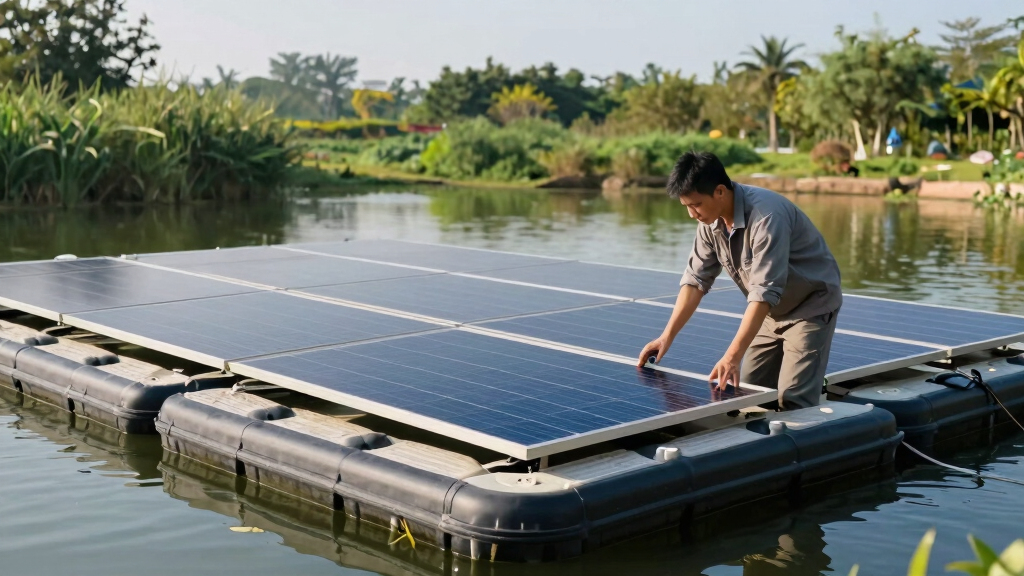
India’s floating solar PV potential has been estimated at over 102 GW, according to a new report from the National Institute of Solar Energy (NISE). This assessment increases the country’s total solar energy potential to 3,445 GW, highlighting significant opportunities for renewable energy expansion. The Ministry of New and Renewable Energy (MNRE) is preparing a dedicated scheme to promote floating solar deployment nationwide.
The NISE report applied specific screening criteria to identify suitable water bodies for floating solar projects, focusing on hydro-lake water bodies of at least 10 hectares, with consistent water availability, depths of 3 to 30 meters, and proximity to infrastructure such as roads and substations. The analysis used assumptions including 545 W modules with 21% efficiency, installed at a 5-degree tilt, and estimated that 0.019 km² of water surface is needed per MW of capacity.
Out of 10,725.99 km² of mapped water bodies across India, 4,546.01 km² were deemed suitable for floating solar development. Applying a cap of 20% utilization per water body to minimize ecological impacts, the effective deployment area is 1,946.24 km², corresponding to a potential of approximately 102 GW. Maharashtra leads with an estimated 16.28 GW potential, followed by Madhya Pradesh, Karnataka, Odisha, and Telangana.
Implications for India’s Renewable Energy Expansion
This development underscores India’s significant renewable energy potential, especially in floating solar, which can help diversify energy sources and reduce land use conflicts. The estimated 102 GW potential could substantially contribute to India’s climate commitments and energy security goals, particularly as the country aims to reach 500 GW of non-fossil fuel capacity by 2030. The move to establish a dedicated floating solar scheme signals government support for scaling up these projects.
floating solar panel kits
As an affiliate, we earn on qualifying purchases.
As an affiliate, we earn on qualifying purchases.
India’s Growing Solar Capacity and Policy Initiatives
India has been rapidly expanding its solar capacity, with previous assessments estimating over 3,343 GW of ground-mounted solar potential. The recent NISE report expands this outlook by including floating solar, which is increasingly viewed as a viable complement to ground-based projects due to benefits like reduced land use and cooling effects. The government’s focus on renewable energy has led to several policy initiatives, including tenders and schemes aimed at boosting floating solar deployment.
Floating solar has gained attention globally for its potential to utilize water bodies efficiently, especially in densely populated countries like India. The assessment reflects a strategic move to leverage water surfaces for renewable energy, aligning with India’s broader climate and energy policies.
“The estimated floating solar potential of over 102 GW marks a significant step in India’s renewable energy roadmap.”
— an anonymous researcher
solar water floating platform
As an affiliate, we earn on qualifying purchases.
As an affiliate, we earn on qualifying purchases.
Uncertainties Surrounding Implementation and Site Suitability
While the potential is now quantified, it remains unclear how much of this capacity will be realized in practice. Factors such as ecological impacts, local water use conflicts, and infrastructure development could influence actual deployment. The assessment also assumes specific technological parameters and site conditions, which may vary in real-world projects.
Further details are needed on how the government’s dedicated scheme will be structured and funded, as well as timelines for project development and regulatory approvals.
solar panel mounting system for water bodies
As an affiliate, we earn on qualifying purchases.
As an affiliate, we earn on qualifying purchases.
Next Steps for Policy Development and Project Deployment
The MNRE is expected to finalize and announce the dedicated floating solar scheme soon, providing guidelines and incentives for project developers. Pilot projects and feasibility studies are likely to follow, testing the practical deployment of the identified sites. Monitoring of ecological impacts and community engagement will be critical as projects move forward.
Stakeholders will watch for official timelines, funding allocations, and regulatory frameworks that could shape the pace and scale of floating solar expansion across India.
high efficiency solar modules 545W
As an affiliate, we earn on qualifying purchases.
As an affiliate, we earn on qualifying purchases.
Key Questions
How does floating solar compare to ground-mounted solar in India?
Floating solar can be deployed on water bodies, reducing land use conflicts and providing cooling effects that improve efficiency. It is seen as a complementary option to ground-mounted solar, especially in densely populated or land-scarce regions.
What are the main challenges for deploying floating solar in India?
Challenges include ecological concerns, water use conflicts, infrastructure development, and regulatory hurdles. Ensuring minimal environmental impact and community acceptance will be key.
When might we see large-scale floating solar projects operational in India?
Following the government’s scheme announcement and pilot projects, large-scale deployments could begin within the next 3-5 years, depending on regulatory and funding progress.
How significant is the 102 GW potential for India’s overall energy goals?
The 102 GW floating solar potential represents a major contribution to India’s renewable energy targets, supporting the country’s aim to reach 500 GW of non-fossil fuel capacity by 2030.
Source: PV Magazine