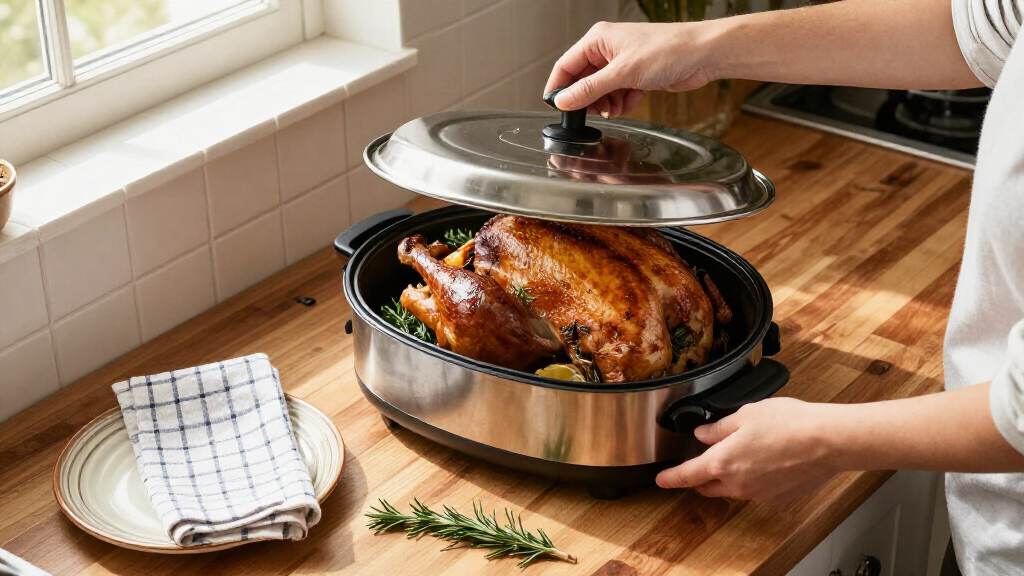

Choosing between an electric turkey roaster and a conventional oven is mainly a question of where you want the turkey to cook—and what else needs to cook at the same time. A countertop roaster gives the bird its own heated space, which can be valuable when the oven is full of sides or unavailable. The conventional oven is already part of most kitchens, offers more room for varied pans, and avoids buying and storing a second appliance.

Get home appliances delivered free with Prime
- Fast, free delivery on millions of items
- Prime Video, Amazon Music and more included
- Member-only deals all year

28-Quart Stainless Steel Electric Roaster Oven with Self-Basting Lid
- ✔ Capacity: 28 quarts
- ✔ Temperature range: 150°F–450°F
- ✔ Wattage: 1450 watts
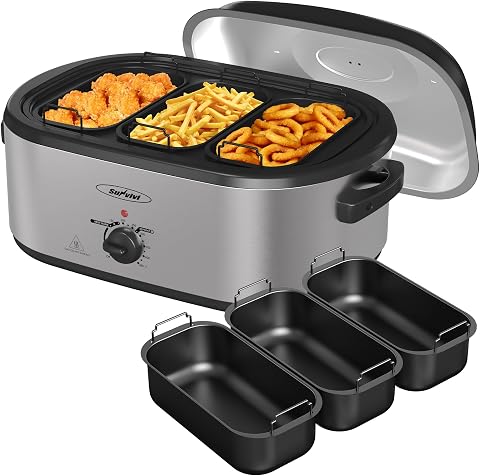
Sunvivi 24-Quart Electric Roaster Oven with 3-Tray Buffet Server
- ✔ Capacity: 24 quarts
- ✔ Temperature range: 150°F–450°F
- ✔ Wattage: 1450 watts

SUNVIVI 24-Quart Electric Roaster Oven with 3 Buffet Trays
- ✔ Capacity: 24 quarts
- ✔ Maximum turkey capacity: Up to 28 pounds
- ✔ Temperature range: 150°F–450°F
The roaster may suit hosts who cook turkey regularly, have limited oven capacity, or want to keep a holiday schedule moving. The oven is usually the more sensible choice for households that roast turkey occasionally, need room to brown or arrange food, or value one versatile appliance over a dedicated one. Capacity, cooking control, cleanup, and total value determine whether the extra appliance earns its place.
At a Glance
| Criteria | Electric turkey roaster | Conventional oven | Winner |
|---|---|---|---|
| Kitchen capacity | Frees the conventional oven for side dishes and other dishes | Uses the main oven, leaving less room for sides | A |
| Bird size and fit | Many models accommodate a whole turkey, but capacity varies; check the maker’s stated limit | Fits according to oven dimensions, rack layout, pan size, and bird size | Depends |
| Cooking control | Dedicated thermostat and heating element; features and temperature precision vary by model | Familiar controls and flexible rack positions; oven accuracy varies | Depends |
| Browning and presentation | Can roast a whole bird, but browning and crisp skin may be less consistent than in a dry oven | Dry oven heat generally favors browning and crisp skin | B |
| Convenience and timing | Runs independently of the oven; useful for coordinating a crowded meal | One appliance and familiar workflow, but turkey competes with other oven dishes | A |
| Cleanup and storage | Removable insert can simplify serving and washing, though the appliance takes storage space | No extra appliance to store; roasting pan and oven still need cleaning | B |
| Cost and overall value | Extra purchase justified most when used often or when oven capacity is a recurring problem | Usually the stronger value for occasional turkey because the oven is already owned | Depends |
28-Quart Stainless Steel Electric Roaster Oven with Self-Basting Lid
For buyers who want one dedicated appliance to handle a holiday bird and more than one cooking task, the 28-quart capacity gives this model the broadest margin in the group. It is larger than either 24-quart SUNVIVI, and its listed functions include baking, roasting, slow cooking, defrosting, and warming. That versatility may help justify the storage space if we expect to use the appliance beyond a single annual meal.The 150°F–450°F controls cover a wide range, while the visible self-basting lid is intended to circulate heat and moisture. A removable pan and rack make serving and cleanup more manageable, and the anti-scald handle is a practical touch when moving hot parts. Compared with the SUNVIVI buffet models, however, this roaster does not include trays for holding sides at the table. Its listed 27-by-22-by-23-inch dimensions also make it the least appealing choice for kitchens with limited storage. Choose it for room and cooking flexibility; skip it if buffet service or a compact footprint matters more.
Pros:
- Largest listed capacity in this comparison at 28 quarts.
- Temperature control spans 150°F to 450°F, with defrost and warm functions.
- Removable pan and rack simplify lifting and cleanup.
- Anti-scald handle is included for handling hot components.
Cons:
- The 27-by-22-by-23-inch footprint needs substantial storage or counter room.
- No buffet trays are listed, unlike both 24-quart SUNVIVI options.
Best for: Cooks who want extra capacity and multiple cooking functions in a dedicated turkey roaster.
Not ideal for: Hosts who want included buffet trays or anyone short on counter and storage space.
Bottom line: We recommend this as the most versatile pick for buyers who value its extra capacity enough to accommodate a large appliance.
“We recommend this as the most versatile pick for buyers who value its extra capacity enough to accommodate a large appliance.”
Sunvivi 24-Quart Electric Roaster Oven with 3-Tray Buffet Server
This Sunvivi makes the most sense when the roaster needs to support the whole meal, not just cook the turkey. Its three buffet trays let us keep multiple sides ready to serve, a distinction neither the 28-quart model nor its other 24-quart competitor can match in the same way. The unit has a 24-quart roasting capacity, a liftable rack, and a removable enamel pan, so it covers the central cooking job while adding a serving setup.Its temperature range and self-basting lid are shared with the other models, so they are not unique reasons to choose it. The stronger case is hosting convenience: the pan and buffet trays are listed as dishwasher safe, which can simplify cleanup after a crowded meal. In exchange, we give up four quarts compared with the 28-quart pick, and the listing warns that steel wool can damage the coating. The exterior needs to be wiped clean and the parts dried after washing to help prevent rust. Compared with the SUNVIVI model that specifies a 28-pound turkey limit and divider pan, this listing is less explicit about maximum bird size, so confirm fit if buying for a particularly large turkey.
Pros:
- Three buffet trays support serving or warming several dishes.
- Adjustable temperature control from 150°F to 450°F.
- Removable enamel roasting pan and buffet trays are dishwasher safe.
- Self-basting lid and liftable rack support roasting and serving.
Cons:
- The 24-quart capacity is smaller than the 28-quart model.
- Coating can be damaged by steel wool, and parts should be dried after washing.
- Exterior requires wiping rather than dishwasher cleaning.
Best for: Hosts who want a 24-quart roaster with included trays for keeping several side dishes ready.
Not ideal for: Buyers prioritizing the largest stated capacity, a low-maintenance exterior, or a specified maximum turkey size.
Bottom line: We would choose this buffet-oriented model when serving flexibility is more useful than the extra room of the 28-quart roaster.
“We would choose this buffet-oriented model when serving flexibility is more useful than the extra room of the 28-quart roaster.”
SUNVIVI 24-Quart Electric Roaster Oven with 3 Buffet Trays
Among the two 24-quart options, this SUNVIVI provides the clearest sizing guidance for a large turkey: its listing says it can accommodate a bird up to 28 pounds. That gives buyers a useful point of comparison when the bird size is already known. It also includes three buffet trays and a divider pan, bringing it close to the other SUNVIVI for serving sides while adding a specific capacity claim the B0D3QGXNXN listing does not provide.The core roasting setup is familiar: adjustable heat from 150°F to 450°F, a self-basting dome lid, a lift-out rack, and a removable enamel pan. Those features make it a practical host-oriented alternative to the 28-quart model, which has more overall capacity but no listed buffet trays. We should note a material distinction in the specifications: the exterior is described as stainless steel, while the roasting pan has an enamel finish. The stated dimensions are 12 inches deep, 25 inches wide, and 17 inches high, so it still needs a broad storage spot. If we want the largest overall roasting volume, the 28-quart model remains the stronger fit; if a 28-pound turkey limit and built-in sides service guide the purchase, this listing is more specific.
Pros:
- States a maximum turkey capacity of up to 28 pounds.
- Three buffet trays and a divider pan support serving side dishes.
- Adjustable thermostat covers warming, defrosting, and roasting.
- Removable enamel pan and buffet trays are dishwasher safe.
Cons:
- At 24 quarts, it has less listed capacity than the 28-quart option.
- The roasting pan is enamel finished even though the exterior is described as stainless steel.
- The 25-inch width requires substantial counter or storage space.
Best for: Hosts who want buffet trays and a listed maximum turkey capacity of up to 28 pounds.
Not ideal for: Buyers who need more than 24 quarts of capacity or expect the roasting pan itself to be stainless steel.
Bottom line: This is the more suitable 24-quart choice when we want buffet service and need a stated turkey size limit to plan around.
“This is the more suitable 24-quart choice when we want buffet service and need a stated turkey size limit to plan around.”
As an Amazon Associate we earn from qualifying purchases.
Key Differences
The biggest practical advantage of an electric turkey roaster is separate capacity. While the bird cooks on the counter, the conventional oven can handle casseroles, vegetables, rolls, or desserts. That can reduce scheduling conflicts during a large meal. The benefit depends on having enough counter space, a suitable electrical outlet, and a roaster sized for the bird; advertised capacity alone does not guarantee a comfortable fit.
The conventional oven wins on versatility and usually on browning. It handles different pan shapes, rack positions, and other cooking tasks throughout the year. A roaster concentrates on one job and may need less space to heat than a large oven, but results vary by model and cooking method. Either appliance requires a food thermometer: cooking time estimates are not a substitute for checking that the turkey reaches a safe internal temperature.
Value turns on how often the appliance will be used and whether freeing the oven solves a real problem. For an annual turkey dinner with a roomy oven, buying and storing a roaster is hard to justify. For frequent entertaining, limited oven space, or a regular need to cook turkey while other dishes bake, the added appliance can repay its cost in convenience. Check the unit’s dimensions, capacity guidance, cleaning instructions, and warranty before deciding.
Detailed Comparison
Kitchen capacity (Electric turkey roaster wins — major)
The electric roaster wins by giving the turkey a separate cooking space while leaving the conventional oven available. This is a major advantage when several dishes need oven heat at once. If the kitchen has ample oven capacity or the menu is simple, the benefit is minor and does not by itself justify another appliance.
Bird size and fit (major difference)
Neither option wins in every kitchen. Roaster capacity is determined by the model’s interior dimensions and manufacturer guidance; oven fit depends on the bird, roasting pan, and usable rack space. Measure the turkey and cooking vessel, then compare them with the appliance’s usable space. This is a major practical check because a bird that does not fit cannot be cooked as planned.
Cooking control (moderate difference)
This is a close call. A roaster offers a dedicated thermostat and heating element, while a conventional oven offers familiar controls and flexible rack placement. Actual temperature accuracy varies across individual units, so neither type guarantees better results without checking temperature. The difference is moderate: choose based on features, capacity, and familiarity rather than assuming the appliance category alone determines control.
Browning and presentation (Conventional oven wins — moderate)
The conventional oven has the advantage for a deeply browned exterior and crisp skin because its dry heat and open cooking space often suit that finish better. This is a moderate advantage for cooks who prioritize presentation. Roasters can produce satisfying turkey, but results differ by model and technique. Follow the product guidance and rely on a thermometer to determine doneness.
Convenience and meal timing (Electric turkey roaster wins — major)
The roaster wins when the main oven is busy. It lets the turkey cook independently, easing competition among dishes and giving the host more scheduling options. That is a major benefit for a crowded holiday menu. With few dishes or a large oven, the separate appliance adds setup and monitoring without much practical gain.
Cleanup and storage (Conventional oven wins — moderate)
The conventional oven wins for storage because it is already built into the kitchen. A roaster’s removable insert can make serving and washing easier, but the appliance itself needs a place to live between meals. This is a moderate tradeoff: frequent users may find dedicated storage worthwhile, while occasional users may resent the space it occupies.
Cost and overall value (major difference)
For occasional turkey, the conventional oven is the stronger value because it avoids an additional purchase and storage burden. A roaster can be worth paying for when it will be used regularly or solves a repeated oven-capacity problem. The difference depends on frequency of use and the value of keeping the main oven free, so compare the model’s price and features with that actual benefit.
Electric turkey roaster: Pros and Cons
Pros:
- Frees the conventional oven for side dishes
- Provides a dedicated space for roasting
- Can simplify timing for a crowded meal
- Removable cooking insert may ease serving and cleanup
Cons:
- Requires an additional purchase
- Takes counter space during use and storage space afterward
- Capacity and fit vary by model
- Browning may be less consistent than in a conventional oven
Conventional oven: Pros and Cons
Pros:
- Already available in most kitchens
- More versatile for other meals and pan sizes
- Typically better suited to crisp, browned skin
- No separate appliance to store
Cons:
- Turkey competes with side dishes for oven space
- Large meals can require careful scheduling
- Usable capacity depends on oven layout and roasting pan
- Using the oven for hours may limit other cooking plans
Who Should Choose What
Choose Electric turkey roaster if:
- You regularly host meals where turkey and several sides need to cook at once.
- Your conventional oven is too small or booked for other dishes.
- You have counter space, safe outlet access, and a storage place for another appliance.
- You will use the roaster often enough to justify its purchase.
Choose Conventional oven if:
- You roast turkey only occasionally and your oven has enough room.
- Crisp browning and flexibility across different dishes matter more than freeing oven space.
- You do not want to buy, clean, and store a single-purpose appliance.
- You already know your oven’s capacity and can plan the meal around it.
Skip both if: Neither fits if you lack safe, suitable space for the appliance or cannot fit the bird in either cooking space; consider a smaller turkey or another cooking method.
Value for Money
For most households that roast turkey once or twice a year, the conventional oven is the better value: it is already on hand, serves many cooking needs, and avoids the cost and storage of a dedicated appliance. Paying more for a roaster makes sense when oven space is a recurring bottleneck, several dishes must bake together, or the appliance will see regular use beyond one holiday. Compare the purchase price with how often it will solve that problem, and include the value of counter space and cleanup in the calculation.
Final Verdict
Choose the conventional oven if you roast turkey occasionally, have enough room for the bird and pan, and want the more versatile setup with no extra purchase. It is the clear default for most households, especially when browned skin and year-round usefulness matter.
Choose an electric turkey roaster if your oven fills up during holiday meals or you cook turkey often enough to make a dedicated appliance worthwhile. The deciding factor is oven capacity: when freeing the oven changes how smoothly the meal comes together, a roaster earns its place. If that problem rarely occurs, keep the money and storage space.
Frequently Asked Questions
Is an electric turkey roaster better than a conventional oven?
It is better for freeing oven space and coordinating a meal with many dishes. A conventional oven is generally more versatile and often better for browning. The better choice depends on which advantage matters in your kitchen.
Does a turkey roaster make the turkey cook faster?
Not reliably. Cooking time depends on the appliance, turkey size, starting temperature, and other conditions. Use the maker’s instructions as a guide and check doneness with a food thermometer rather than relying only on a time estimate.
Will an electric roaster fit a large turkey?
That depends on the model and the bird. Check the roaster’s stated capacity and interior measurements, and account for the pan or rack and lid clearance. Do the same with your conventional oven before buying or thawing a turkey.
Is an electric turkey roaster worth buying for one holiday meal?
Usually not if your oven has enough room and you cook turkey only once a year. It can be worth the expense if oven space is a recurring problem, you host often, or you will use the appliance regularly.