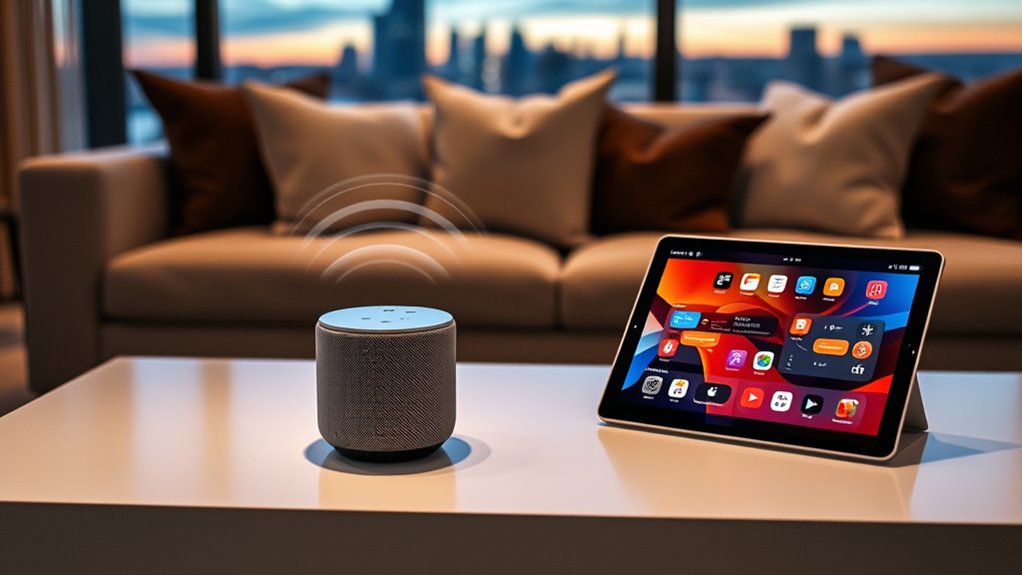

Voice control feels more convenient when you want quick, hands-free access to manage your smart devices, especially when your hands are full or you’re in a rush. It responds instantly and is easy to use naturally. On the other hand, app control offers detailed customization and better security, making it ideal for complex adjustments. Both methods have benefits; exploring each will help you decide which fits your lifestyle best. Keep going to discover how to optimize both options.

Get home appliances delivered free — and shop member deals
- Fast, free delivery on millions of items
- Access to Prime Big Deal Days deals on October 6–7
- Prime Video, Amazon Music and more included
Key Takeaways
- Voice control offers instant, hands-free operation, ideal when multitasking or when manual interaction is inconvenient.
- App control provides detailed customization and scheduling, making it more convenient for complex device management.
- Voice commands are quicker for simple tasks, while app control requires manual navigation but offers greater precision.
- Voice control seamlessly integrates with smart assistants, enabling quick responses without opening apps.
- App control enhances privacy and security, appealing to users concerned about constant listening features.

When choosing how to control your smart devices, you might wonder whether voice commands or app control is the better option. Both methods offer unique benefits, but understanding their differences can help you decide which fits your lifestyle best. Voice control provides a hands-free experience, allowing you to activate lights, adjust thermostats, or play music with simple spoken commands. This convenience is especially noticeable when your hands are full or when you want to quickly manage your devices without searching through menus. On the other hand, app control grants you a visual interface where you can see all your devices at once, customize settings, and set schedules. This method is often more precise and offers more detailed control, especially for complex automation routines.
Choosing between voice commands and app control depends on your need for convenience or detailed customization.
Smart home integration plays a significant role in this decision. If your smart home ecosystem supports seamless integration with voice assistants like Alexa, Google Assistant, or Siri, voice control becomes an incredibly intuitive option. You can issue commands naturally, and your devices respond instantly. Conversely, app control allows you to configure and troubleshoot your devices more thoroughly. You can view detailed device statuses, update firmware, and set preferences directly from the app, which is especially useful for managing multiple devices or complex setups. However, some users worry about privacy concerns associated with voice control. Voice assistants are always listening for wake words, which raises fears about accidental recordings or data collection. While manufacturers implement privacy features, you might feel uneasy about the possibility of your conversations being stored or analyzed.
Additionally, understanding privacy policies and how your data is managed can help you make an informed choice about which control method aligns with your comfort level. In terms of privacy concerns, app control generally offers a greater sense of security. Since you’re directly managing your devices through an app, there’s less risk of unintended recordings. You control when and how your data is shared, and many apps allow you to disable certain features or turn off data collection entirely. Voice control, while incredibly convenient, requires you to trust the provider’s privacy policies and security measures. Some users worry that voice commands could be intercepted or misused, especially if the system isn’t properly secured.
Ultimately, it comes down to your priorities. If you value quick, effortless control, voice commands are hard to beat, especially with good smart home integration. But if you prefer detailed customization and greater privacy assurance, app control might be your best choice. Both methods can coexist, giving you the flexibility to choose based on the situation. Whichever you pick, understanding the strengths and concerns of each will help you create a smarter, more comfortable home.
Frequently Asked Questions
Can Both Control Methods Be Used Simultaneously?
Yes, you can use both control methods simultaneously, enhancing your multitasking efficiency. This flexibility allows you to switch seamlessly between voice commands and app controls, depending on your user familiarity and the situation. For example, you might start a task with a voice command and adjust it later with the app. This integrated approach guarantees you stay efficient and adaptable, making your overall experience more convenient and responsive.
Which Method Offers Better Privacy and Security?
You might think voice control’s convenience outweighs privacy worries, but ironically, it often raises more concerns. Voice commands can be intercepted or recorded, increasing privacy risks. App control, on the other hand, typically offers better security with data encryption and user authentication. So, if privacy’s your priority, app control is smarter — it keeps your data safer while voice control might leave you vulnerable to privacy concerns.
Are There Devices Exclusively Compatible With One Control Type?
You’ll find that some devices have control exclusivity, meaning they only work with either voice control or app control. Device compatibility varies, so check the specifications before purchasing. Certain smart home gadgets, like some smart thermostats or security cameras, are designed to be compatible solely with one control type, making your choice easier if you prefer a specific control method. Always verify compatibility to guarantee seamless operation.
How Do Costs Compare Between Voice and App Control Systems?
When considering cost comparison and expense analysis, you notice voice control systems often come with higher upfront costs due to advanced hardware and technology, while app control options tend to be more affordable, relying on existing devices. You weigh the benefits of convenience against expenses, realizing that choosing between voice and app control impacts your budget differently. Ultimately, your decision hinges on balancing your desired ease of use with your financial considerations.
What Is the Learning Curve for New Users?
When considering the learning curve for new users, you’ll find that app control systems usually have a more intuitive user interface, making user adaptation easier. Voice control might require some practice to master voice commands and reduce errors. Overall, app controls tend to be quicker to learn, especially for those familiar with smartphones, while voice control can feel more natural once you get used to speaking commands clearly.
Conclusion
In the end, choosing between voice control and app control depends on what feels easiest for you, like two sides of the same coin. Voice control offers hands-free convenience, letting you speak your commands like a gentle breeze. App control, on the other hand, gives you precise, tap-by-tap control, like a steady drumbeat. Both are useful, but figuring out which suits your lifestyle best makes your smart device experience smooth and effortless.
Fall yard work Picks
leaf blowers
As an affiliate, we earn on qualifying purchases.