TL;DR

Get home appliances delivered free with Prime
- Fast, free delivery on millions of items
- Prime Video, Amazon Music and more included
- Member-only deals all year
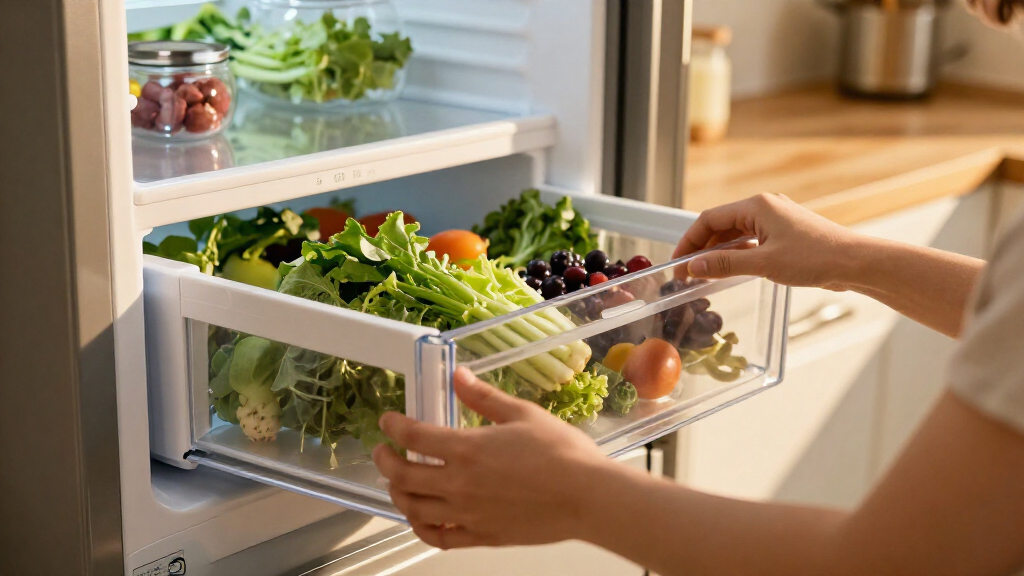
The small slider on many refrigerator crisper drawers controls vents that let humid air escape or keep it inside. Lower humidity generally suits many fruits, while higher humidity helps leafy greens and vegetables that wilt easily. Drawer designs and labels vary, so check your refrigerator’s manual if its settings are unclear.
The slider on a refrigerator’s crisper drawer controls vents that adjust the drawer’s humidity: opening them lets moist air escape, while closing them holds moisture around the produce. Hunker’s report says the settings can help people store different fruits and vegetables in conditions that better suit them, though the best setting can vary with the refrigerator and the food.
At a low-humidity setting, the vents are open, allowing air and moisture to leave the drawer. Hunker says this setting is generally suited to many fruits, including apples, pears, peaches, citrus, berries, avocados and other stone fruits. The report also notes that fruits release ethylene gas as they ripen; allowing air to move out may help prevent that gas from building up in the drawer.
At a high-humidity setting, the vents close and moisture stays in the drawer. Hunker recommends this for produce that can dry out or wilt, including spinach, kale, lettuce and herbs. It also lists cucumbers, eggplants, peppers and carrots as vegetables that can benefit from the higher-humidity setting. The general rule in the report is that vegetables more often need high humidity, while many fruits are better kept at low humidity.
Some refrigerators use pictures or labels near the slider to indicate settings for fruits and vegetables. If a refrigerator has two crisper drawers, the report suggests using one for each humidity setting. With a single drawer, it advises generally setting it to high humidity and storing fruits that need lower humidity elsewhere when appropriate. These are broad guidelines, not a guarantee that every refrigerator or every item will keep best in the same conditions.
How Humidity Affects Produce
Using the slider to match the drawer’s conditions to its contents may help reduce wilting and drying for delicate greens, while allowing more airflow for fruit that is prone to becoming overripe. That can make the drawers more useful than simply treating them as extra refrigerator storage, and may help households keep produce in usable condition for longer.
The practical payoff depends on what is stored together and how the refrigerator is designed. A drawer packed with different kinds of produce may not provide an ideal setting for every item. The report offers general storage guidance; it does not establish a precise shelf life or promise that changing the slider will prevent spoilage.
Products Worth Considering

Shark Navigator Lift-Away Upright Vacuum Cleaner (NV356E)

Coway Mighty AP-1512HH(W) Air Purifier, White

eufy Security Essential 7-Piece Alarm System
As an affiliate, we earn on qualifying purchases.
Why Crisper Drawers Have Vents
Crisper drawers are intended to hold produce in a separate area of the refrigerator, and adjustable vents let users change how much moisture stays there. The slider does not cool the drawer separately; it changes airflow and humidity by opening or closing vents, according to the Hunker report.
Not every refrigerator has an adjustable slider. Hunker says a drawer without one may be designed to retain higher humidity because its vents remain closed. It cautions that a refrigerator may also have a drawer that looks similar but is intended for another purpose, so owners should check the appliance’s labels or manual rather than assume all drawers work alike.
Settings Depend on Your Refrigerator
The supplied report does not identify a particular refrigerator model or provide manufacturer-specific instructions. Slider labels and drawer designs vary, and the article does not quantify how much longer produce may last at either setting. Its produce lists and humidity recommendations should be read as general guidance rather than rules that apply identically to every appliance or food.
Hunker suggests testing an unadjustable drawer by placing lettuce inside and checking it after a few days to see whether it wilts. That is an informal check, not a controlled test. The report also warns readers not to mistake a different type of refrigerator drawer for a crisper.
Check the Drawer Before Adjusting
For a practical next step, identify which drawer is the crisper and look for fruit-and-vegetable labels beside its control. If the settings are not marked, consult the refrigerator’s manual for the model’s instructions. Then sort produce by its storage needs where possible: try lower humidity for many fruits and higher humidity for greens and vegetables that wilt readily.
There is no further news development identified in the supplied material. For readers, the useful follow-up is to monitor the produce and adjust the slider if the drawer’s contents appear to be drying out or staying too damp.
Key Questions
What does the crisper-drawer slider do?
It opens or closes vents to adjust airflow and humidity in the drawer. Open vents let moist air escape; closed vents retain more humidity.
Which setting should I use for leafy greens?
Hunker’s general guidance is to use high humidity for leafy greens such as lettuce, spinach and kale, since they can wilt when they lose moisture.
Which setting is generally better for fruit?
The report recommends low humidity for many fruits, including apples, pears, citrus, berries and stone fruits. Check your refrigerator’s guidance and the needs of the specific fruit.
What if my crisper drawer has no slider?
It may be designed to retain higher humidity with vents that stay closed, according to Hunker. Drawer designs differ, so consult the appliance manual to confirm its intended use.
Should I put every kind of produce in the crisper?
Not necessarily. Hunker notes that some fruits suited to lower humidity can be stored on a counter or in a pantry when appropriate. Follow food-specific storage guidance and your refrigerator manufacturer’s instructions.
Source: hunker.com