TL;DR

Get home appliances delivered free with Prime
- Fast, free delivery on millions of items
- Prime Video, Amazon Music and more included
- Member-only deals all year
The Ambient’s review found Aqara’s Spatial Multi-Sensor FP400 accurate and capable of tracking up to 10 people, with up to eight configurable motion zones. The review praised setup and performance but said the sensor’s high price and need for constant USB-C power make it less flexible than battery-powered alternatives.
The Ambient’s review of the Aqara Spatial Multi-Sensor FP400 found it accurately detects people and can divide a room into up to eight motion zones, but its high price and requirement for constant USB-C power may limit its appeal. Aqara says the sensor can track as many as 10 people, making it a feature-rich option for households seeking room-specific smart-home automations.
The FP400 uses mmWave sensing to detect presence and motion. In the review, the sensor registered the reviewer when they entered an office and continued to show them as present after they sat still at a desk for several minutes. The reviewer also described its placement information as accurate during testing. These are observations from one review, not a guarantee of identical results in every room or installation.
Aqara’s app provides a map of the room and lets users create up to eight detection zones. Those zones can appear as separate motion sensors in supported systems, allowing different actions in different areas—for example, switching on a reading light when someone sits in a particular chair. The device also includes a luminance sensor, which can support automations that account for room brightness.
The FP400 connects over Zigbee or Thread and supports Matter. The reviewer paired it with an Aqara M200 hub and shared it with Apple Home and Homey. The review says Zigbee through an Aqara hub provides more features; Thread can connect to a compatible hub without requiring an Aqara hub, but exposes fewer features. Changing between protocols requires resetting the sensor and changing its firmware.
Room Zones Enable Targeted Automations
The FP400’s main practical distinction is that its room map can turn one physical sensor into several location-based automation triggers. Instead of reacting to any movement anywhere in a room, a smart-home routine can respond to activity around a selected area, such as a desk or sofa. That can make lighting and other automations more specific, particularly in larger or more complex rooms.
Compatibility also affects what owners can do. According to The Ambient, Apple Home supports occupancy-based triggers, while Homey also allows a delay to be set before an action occurs after a person is no longer detected. The review says the FP400’s people-counting data is not exposed as a trigger option in other platforms. Buyers should weigh those platform limits against the sensor’s advanced detection features.
The trade-off is installation flexibility. Unlike battery-powered sensors, the FP400 needs continuous USB-C power. Aqara includes a cable but not a power adapter, and the reviewer found that routing the cable can complicate placement. The device may suit users who value detailed zone detection and have a practical powered mounting location, but less so people who need a sensor they can place freely.
As an affiliate, we earn on qualifying purchases.
Setup, Mounting and Hub Choices
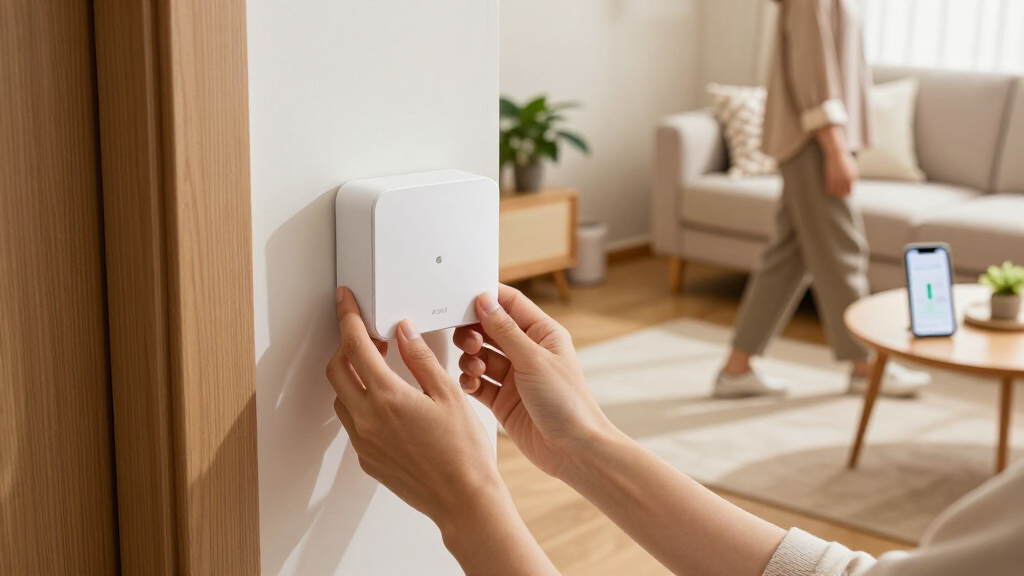
The FP400 is designed for wall or ceiling mounting. It comes with an adjustable stand and a magnetic mount that can be screwed into place or attached with adhesive. Aqara recommends an installation height of 150 to 200 centimeters. A corner installation is also possible, but the review says it requires an optional corner mount, included with the Kit version.
Setup takes place in the Aqara app. The reviewer described the guided process as straightforward: it includes walking around the room’s boundary to set the detection area, followed by an optional AI routine that takes about 30 seconds and must be run in an empty room. The review says the routine is intended to tune out interference. Aqara’s AI Enhanced Person Detection option can also help reduce detection of pets or people, according to the report.
The FP400 is part of a broader shift in presence-sensor design, but it retains a powered installation requirement. The review contrasts it with Aqara’s battery-powered Multi-Sensor FP300 and describes the FP400’s power needs as less convenient. It also compares its zone controls favorably with the Meross Thread Smart Presence Sensor MS605, while noting that the two products define zones differently.
“Exceptionally powerful”
— The Ambient, in its review verdict
As an affiliate, we earn on qualifying purchases.
Price, Availability and Platform Limits
The supplied review material does not state the FP400’s price, release date, or availability by market, so the degree of its cost disadvantage cannot be quantified here. It also does not provide standardized test results, long-term reliability data, or performance measurements across different room layouts. The review’s accuracy findings describe the reviewer’s office setup and should not be treated as a controlled comparison across homes.
Support varies by connection method and smart-home platform. The review reports fewer features when using Thread than when pairing through an Aqara hub with Zigbee, and says people-count data is not available as a trigger in other platforms. The source does not list every function available in each Matter-compatible system, nor does it establish whether later software updates could change those limits.
As an affiliate, we earn on qualifying purchases.
Check Local Pricing and Compatibility
Readers considering the FP400 should check current local pricing, confirm that their hub and preferred smart-home platform support the features they want, and plan where a USB-C cable can reach a power source. The review identifies a guided setup and zone configuration process, but actual usefulness will depend on the room layout and the automations available through the chosen platform.
No product update or follow-up test is specified in the supplied material. The next practical questions for buyers are whether the FP400’s detailed detection justifies its cost, and whether a permanently powered installation fits their space better than a battery-powered alternative.
As an affiliate, we earn on qualifying purchases.
Key Questions
What does the Aqara FP400 detect?
It is an mmWave presence and motion sensor. Aqara says it can track up to 10 people; The Ambient reported that it accurately detected the reviewer entering a room and continuing to register them while sitting still.
How many motion zones can the FP400 create?
The sensor supports up to eight motion zones. The review says selected zones can appear as separate sensors in supported smart-home apps, enabling automations tied to specific parts of a room.
Does the FP400 need to be plugged in?
Yes. It requires continuous USB-C power. Aqara includes a cable but not a power adapter, according to the review.
Does the FP400 work with Apple Home and Matter?
The review reports using an Aqara hub to bridge the FP400 to Apple Home and Homey, and lists Matter support. Available features depend on the connection method and platform; the review says Thread offers fewer features than Zigbee with an Aqara hub.
What are the main drawbacks reported in the review?
The Ambient identified the high price and the need for a constant USB-C power connection as the main disadvantages. It also noted that people-count data is not exposed as a trigger option in other platforms.
Source: rss
NFL season / tailgating Picks
team gear
As an affiliate, we earn on qualifying purchases.