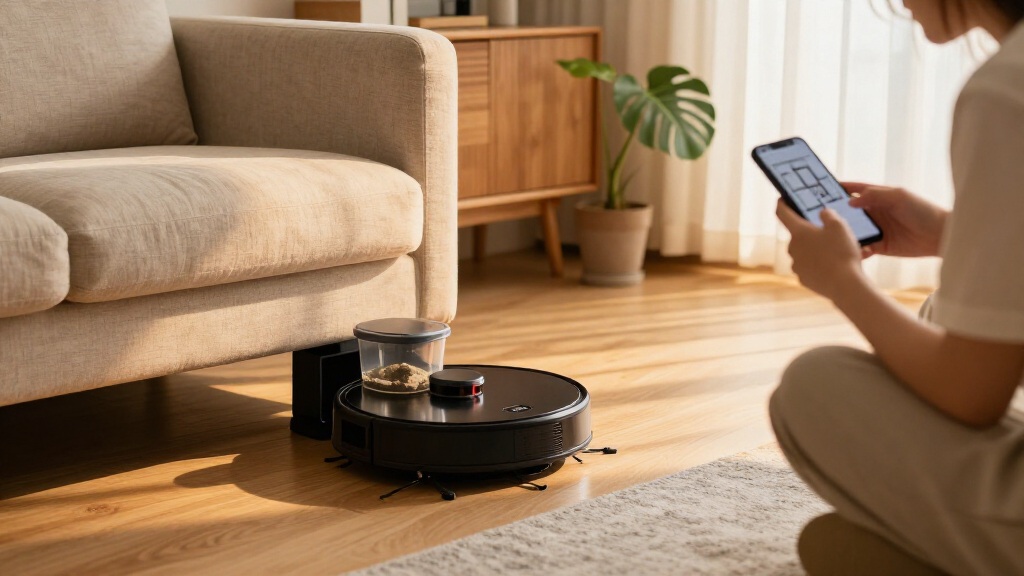
Robot vacuums with self emptying solve the most annoying part of robot ownership: emptying a dusty bin every day or two. My top overall pick is the Redroad R11, which pairs 20,000Pa suction with a 120-day self-emptying dock — the longest capacity in this lineup. For value, the Roborock Q10 S5+ delivers strong 10,000Pa power and mopping at a midrange price, while the Shark AI Ultra AV2511AE offers a bagless 60-day base that spares you from buying disposable bags forever. The main tradeoffs to weigh are suction power versus dock capacity, bagless convenience versus mess-free bag disposal, and whether mopping matters enough to justify a bulkier combo machine. Keep reading for the full breakdown of all 15 models.

Get home appliances delivered free with Prime
- Fast, free delivery on millions of items
- Prime Video, Amazon Music and more included
- Member-only deals all year
Complete the kit


Key Takeaways
- Dock capacity varied more than any other spec — from 30 days (Shark Navigator AV2110S) to 120 days (Redroad R11) — and that gap directly determines how often you touch the machine at all.
- Bagless bases (both Shark AI Ultra models) eliminate recurring bag costs but expose you to a puff of dust when you empty them; bagged docks from Roborock and iRobot stay cleaner but add a running expense.
- Suction numbers are not comparable across brands — Redroad’s 20,000Pa rating is a marketing arms race, while iRobot‘s Roomba 105 Vac cleans carpet effectively with far lower claimed power.
- Mopping models (Q7 M5+, Q10 PRO, D13S MAX) are more versatile but drag microfiber pads that need rinsing — vacuum-only buyers save money and maintenance by skipping the mop entirely.
- LiDAR navigation is now standard even on budget picks like the Tikom L8000 Plus, so the real differentiator has shifted to obstacle avoidance, dock design, and app quality.
| H6 Pro 6000Pa Robot Vacuum and Mop with Self-Emptying and LiDAR Navigation |  | Best for Multi-Story Homes | Suction Power: 6000Pa | Navigation: 360° LiDAR with multi-level mapping | Self-Emptying Capacity: 3 L (up to 90 days) | VIEW LATEST PRICE | See Our Full Breakdown |
| Shark Navigator Robot Vacuum, 30-Day Self-Emptying Base, White, AV2110S |  | Best Value Pick | Navigation: LiDAR SmartPath | Self-Empty Base: Bagless, up to 30 days | Brushroll: Self-cleaning anti-hair wrap | VIEW LATEST PRICE | See Our Full Breakdown |
| Shark AI Ultra Robot Vacuum, 60-Day Self-Emptying Base, Black, AV2511AE |  | Best for Pet Households | Runtime: Up to 90 minutes | Base Capacity: Bagless, up to 60 days | Navigation: 360° LiDAR with object detection | VIEW LATEST PRICE | See Our Full Breakdown |
| Roborock Q10 S5+ Robot Vacuum and Mop, 10,000Pa Suction |  | Best Overall | Suction Power: 10,000 Pa | Self-Emptying Duration: Up to 70 days (2.7 L bag) | Mopping System: VibraRise 2.0 sonic vibration, 3,000 scrubs/min | VIEW LATEST PRICE | See Our Full Breakdown |
| Q10 PRO Robot Vacuum and Mop with Self-Emptying Base, 8000Pa Suction |  | Best for Large Single-Floor Homes | Suction Power: 8000Pa with 15% carpet boost | Self-Empty Station: 3.3 L, up to 60 days | Runtime: 150 minutes | VIEW LATEST PRICE | See Our Full Breakdown |
| Robot Vacuum and Mop with Self-Emptying Station, 6000Pa Suction, LiDAR Navigation |  | Best Budget Entry Point | Suction Power: 6000Pa | Self-Emptying Capacity: Up to 90 days | Navigation: 360° LiDAR | VIEW LATEST PRICE | See Our Full Breakdown |
| Roborock Q7 M5+ Robot Vacuum and Mop with Self-Empty Dock, 10000Pa Suction |  | Best Balanced Performer | Suction Power: 10000Pa | Self-Empty Duration: Up to 7-9 weeks | Dust Bag Capacity: 2.7L | VIEW LATEST PRICE | See Our Full Breakdown |
| Redroad R11 Robot Vacuum and Mop, 20,000Pa, 120-Day Self-Emptying, LiDAR Navigation, White |  | Best Premium Power Pick | Suction Power: 20,000 Pa | Self-Emptying Duration: Up to 120 days | Dust Bag Capacity: 4 L | VIEW LATEST PRICE | See Our Full Breakdown |
| D13S MAX 3-in-1 Robot Vacuum with LiDAR Navigation and Self-Emptying |  | Best Runtime for Large Homes | Suction Power: 11,500 Pa | Runtime: 160 minutes | Self-Emptying Capacity: Up to 90 days | VIEW LATEST PRICE | See Our Full Breakdown |
| iRobot Roomba 105 Vac Robot Vacuum with AutoEmpty Dock |  | Best for Allergy Sufferers | Self-Empty Capacity: Up to 75 days | Allergen Trapping: 99% of allergens as small as 0.7 microns | Navigation: ClearView LiDAR | VIEW LATEST PRICE | See Our Full Breakdown |
| Tikom L8000 Plus Robot Vacuum and Mop with Self-Emptying Base |  | Best Multi-Floor Value | Max Suction: 6000Pa | Dustbag Capacity: 3L (90-day) | Navigation: 360° LiDAR | VIEW LATEST PRICE | See Our Full Breakdown |
| iRobot Roomba 105 Combo Robot Vacuum and Mop with AutoEmpty Dock |  | Best for Carpet Safety | Dock: AutoEmpty Dock (75-day capacity) | Navigation: ClearView LiDAR | Cleaning Modes: Vacuum, Mop, Vacuum and Mop | VIEW LATEST PRICE | See Our Full Breakdown |
| Lefant M2 Plus Robot Vacuum and Mop Combo, Black |  | Best Budget Hands-Free Pick | Max Suction: 6000Pa | Dust Bag Capacity: 2 x 2.5L (75-day) | Navigation: LiDAR | VIEW LATEST PRICE | See Our Full Breakdown |
| Dreame D20 Air Plus Robot Vacuum and Mop |  | Best for Allergies and Pet Hair | Max Suction: 20,000Pa | Dust Bag Capacity: 4L (120-day) | Allergen Retention: 99.9% | VIEW LATEST PRICE | See Our Full Breakdown |
| Shark AI Ultra AV2501AE Robot Vacuum with XL HEPA Self-Empty Base, Bagless |  | Best Bagless HEPA Option | Self-Empty Base: Bagless, 60-day capacity | Filtration: True HEPA, 99.97% at 0.3 microns | Navigation: LiDAR Precision Home Mapping with Matrix Clean | VIEW LATEST PRICE | See Our Full Breakdown |
| robot vacuums with self emptying | Navigation |
|---|---|
| H6 Pro 6000Pa Robot Vacuum and | 360° LiDAR with multi-level mapping |
| Shark Navigator Robot Vacuum | LiDAR SmartPath |
| Shark AI Ultra Robot Vacuum | 360° LiDAR with object detection |
| Roborock Q10 S5+ Robot Vacuum | PreciSense LiDAR with ReactiveTech obstacle avoidance |
| Q10 PRO Robot Vacuum and Mop w | 360° LiDAR with SLAM |
| Robot Vacuum and Mop with Self | 360° LiDAR |
| Roborock Q7 M5+ Robot Vacuum a | PreciSense LiDAR |
| Redroad R11 Robot Vacuum and M | 360° LiDAR |
| D13S MAX 3-in-1 Robot Vacuum w | LiDAR |
| iRobot Roomba 105 Vac Robot Va | ClearView LiDAR |
| Tikom L8000 Plus Robot Vacuum | 360° LiDAR |
| iRobot Roomba 105 Combo Robot | ClearView LiDAR |
| Lefant M2 Plus Robot Vacuum an | LiDAR |
| Dreame D20 Air Plus Robot Vacu | LiDAR with dark obstacle avoidance |
| Shark AI Ultra AV2501AE Robot | LiDAR Precision Home Mapping with Matrix Clean |
More Details on Our Top Picks
H6 Pro 6000Pa Robot Vacuum and Mop with Self-Emptying and LiDAR Navigation
Most self-emptying robots map a single floor well and fall apart on the second story. The H6 Pro stands out for its multi-level mapping, which lets it store separate maps for upstairs and downstairs — a feature the Shark Navigator AV2110S doesn’t match at its simpler price point. Its 3 L dust bag stretches to about 90 days of hands-free use, the longest interval in this batch, beating the Roborock Q10 S5+ by roughly three weeks. The tradeoff: it’s a compromise hybrid. Compared with the Q10 S5+ or its sibling Q10 PRO, the 310 ml water tank is small, so larger mopping jobs will need a refill mid-run. Suction at 6000Pa is adequate rather than class-leading. This pick makes the most sense for split-level homeowners who want one robot to cover every floor without remapping each time.
Pros:- Multi-level mapping handles two-story homes without remapping
- 90-day self-emptying interval is the longest in this batch
- 3-in-1 sweep, vacuum, and mop in a single pass
- 150-minute runtime with auto-recharge and resume
Cons:- 310 ml water tank needs refilling during larger mopping jobs
- Requires replacement dust bags and dock space
- Full feature set depends on app and Wi-Fi setup
Best for: Owners of two-story or split-level homes who want one robot to clean every level with stored maps
Not ideal for: Buyers who prioritize heavy-duty pet hair extraction — the 6000Pa suction trails the 8000-10000Pa rivals here
- Suction Power:6000Pa
- Navigation:360° LiDAR with multi-level mapping
- Self-Emptying Capacity:3 L (up to 90 days)
- Water Tank:310 ml
- Runtime:150 minutes
- Control:App, Alexa, Google Assistant
- Warranty:2 years
Our verdict“This is the pick for multi-level households that value long hands-free intervals and whole-home mapping over raw suction power.”
Shark Navigator Robot Vacuum, 30-Day Self-Emptying Base, White, AV2110S
If you want the self-emptying convenience without paying for mopping hardware you won’t use, the Shark Navigator AV2110S is the sensible entry point in this lineup. It skips the mop entirely — unlike the H6 Pro or Q10 PRO — and that simplicity keeps things straightforward: fewer parts to maintain, fewer no-go zones to configure around wet carpets. The LiDAR SmartPath navigation delivers methodical row-by-row cleaning that budget robots with bounce navigation can’t match, and the self-cleaning anti-hair-wrap brushroll is a genuine maintenance saver. The compromise is capacity: its base holds 30 days of debris, half of what the Shark AI Ultra AV2511AE manages. Object detection also won’t catch every stray cable. For a vacuum-first household on a budget, this model hits the right balance of capability and cost.
Pros:- LiDAR row-by-row cleaning at a value price point
- Self-cleaning brushroll resists hair wrap
- Bagless base eliminates recurring dust bag purchases
- Recharge-and-resume finishes large jobs automatically
Cons:- Only 30 days of base capacity, half the interval of premium rivals
- No mopping capability at all
- Object avoidance misses smaller obstacles like cables
Best for: Budget-conscious buyers who want LiDAR navigation and self-emptying without paying for mopping features
Not ideal for: Large homes or heavy shedders — the 30-day base capacity and shorter interval mean more frequent dock maintenance than the 60-90 day rivals
- Navigation:LiDAR SmartPath
- Self-Empty Base:Bagless, up to 30 days
- Brushroll:Self-cleaning anti-hair wrap
- Object Detection:Advanced sensors
- Voice Control:Amazon Alexa, Google Voice
- Floor Compatibility:Carpet, rugs, hard floors
Our verdict“The smartest choice for vacuum-only households that want self-emptying and smart navigation without the mopping markup.”
Shark AI Ultra Robot Vacuum, 60-Day Self-Emptying Base, Black, AV2511AE
Pet owners face a specific problem most robots ignore: hair wrapped around the brushroll. The Shark AI Ultra attacks this directly with its self-cleaning brushroll, paired with Matrix Clean — a multi-pass grid pattern that goes over the same floor area repeatedly to pull embedded fur out of carpet. That’s a fundamentally different thoroughness strategy than the single-pass approach of the Shark Navigator AV2110S, and it shows on rugs where pet hair settles deep. The bagless base doubles the Navigator’s capacity at 60 days, though you still empty it yourself rather than tossing a bag. The honest tradeoff: 90 minutes of runtime is the shortest here — the Q10 PRO runs 150 minutes — so bigger homes will trigger recharge cycles mid-clean. No mopping, either, unlike the Roborock options.
Pros:- Matrix Clean multi-pass grid lifts embedded pet hair from carpet
- Self-cleaning brushroll drastically reduces hair-tangle maintenance
- 60-day bagless base avoids recurring bag costs
- LiDAR navigation with object detection and voice control
Cons:- 90-minute runtime is the shortest in this batch
- No mopping function despite a premium feature set
- Bagless base still requires hands-on emptying and can get messy
Best for: Pet owners with carpet-heavy homes who battle embedded fur and hair wrap
Not ideal for: Large homes over ~1500 sq. ft. — the 90-minute runtime forces frequent recharge interruptions
- Runtime:Up to 90 minutes
- Base Capacity:Bagless, up to 60 days
- Navigation:360° LiDAR with object detection
- Cleaning Pattern:Matrix Clean precision grid
- Brushroll:Self-cleaning
- Control:SharkClean app, Alexa, Google Assistant
Our verdict“The go-to pick for shedding pets and carpeted floors, provided your home fits within its shorter battery window.”
Roborock Q10 S5+ Robot Vacuum and Mop, 10,000Pa Suction
This is the most complete package in the batch, and that’s why it sits at the top. The Roborock Q10 S5+ pairs 10,000Pa suction — the strongest vacuuming performance here alongside the Q7 M5+ — with genuinely intelligent mopping: ultrasonic carpet detection lifts the mop 8 mm and boosts suction automatically, so you never wet a rug. That solves the exact problem that plagues the Q10 PRO, which makes you physically remove its mop holder or draw no-go zones. Add ReactiveTech structured-light obstacle avoidance, and the Q10 S5+ navigates around clutter the Shark models only detect broadly. Its 70-day self-emptying interval sits between the H6 Pro’s 90 and the Sharks’ 30-60. Drawbacks are real but modest: 2.4 GHz-only Wi-Fi will annoy modern router owners, and the 2.7 L bags are a recurring cost.
Pros:- 10,000Pa suction leads this batch for carpets and pet hair
- Automatic mop lift and carpet boost eliminates wet-rug accidents
- Structured-light obstacle avoidance outclasses sensor-only rivals
- Dual anti-tangle brushes cut maintenance time
Cons:- 2.4 GHz-only Wi-Fi compatibility
- Recurring dust bag replacement costs for the self-empty station
- Full feature depth requires patient app configuration
Best for: Buyers who want top-tier vacuuming and genuinely smart mopping in one polished, low-maintenance package
Not ideal for: Households with modern 5 GHz-only network setups — the 2.4 GHz Wi-Fi restriction may force router changes
- Suction Power:10,000 Pa
- Self-Emptying Duration:Up to 70 days (2.7 L bag)
- Mopping System:VibraRise 2.0 sonic vibration, 3,000 scrubs/min
- Carpet Detection:Ultrasonic with 8 mm mop lift
- Navigation:PreciSense LiDAR with ReactiveTech obstacle avoidance
- Controls:Roborock app, Alexa, Google Home
- Wi-Fi:2.4 GHz only
Our verdict“If budget allows one do-everything robot, this is the one to beat — carpet-smart mopping and best-in-class suction justify the premium.”
Q10 PRO Robot Vacuum and Mop with Self-Emptying Base, 8000Pa Suction
Coverage is where the Q10 PRO earns its slot. Its 150-minute runtime matches the H6 Pro and comfortably beats the Shark AI Ultra‘s 90 minutes, meaning homes up to 2000 sq. ft. can finish a full clean in one pass without a mid-job recharge. The 3.3 L self-empty station is the largest physical capacity in this batch, even if its 60-day interval trails the H6 Pro’s 90. A HEPA filter and roomy 1.5 L onboard dustbin round out a spec sheet aimed at big, open floor plans. The friction point is the mop: unlike the Roborock Q10 S5+, there’s no automatic mop lift, so you either pull the mop holder off manually or map no-go zones before the robot glides onto carpet with a damp pad. It’s a manageable hassle, but one Roborock solved.
Pros:- 150-minute runtime cleans up to 2000 sq. ft. in one pass
- 3.3 L self-empty station is the largest capacity here
- 8000Pa suction with automatic 15% carpet boost
- HEPA filtration and oversized 1.5 L onboard dustbin
Cons:- No automatic mop lift — must remove mop holder or set no-go zones around carpet
- 2.4 GHz-only Wi-Fi
- Smart features hinge entirely on app setup
Best for: Owners of large single-level homes up to 2000 sq. ft. who need maximum runtime per charge
Not ideal for: Homes with mixed carpet and hard flooring — the lack of mop lift means manual intervention before carpet cleaning
- Suction Power:8000Pa with 15% carpet boost
- Self-Empty Station:3.3 L, up to 60 days
- Runtime:150 minutes
- Navigation:360° LiDAR with SLAM
- Filter:HEPA
- Coverage Area:Up to 2000 sq. ft.
- Connectivity:2.4GHz Wi-Fi, Alexa, Google Assistant
Our verdict“The best fit for sprawling single-story homes where battery life matters more than carpet-aware mopping.”
Robot Vacuum and Mop with Self-Emptying Station, 6000Pa Suction, LiDAR Navigation
This option stands out as the most accessible way into self-emptying cleaning without giving up the features that matter. The 90-day self-emptying capacity matches far pricier machines, and the 360° LiDAR navigation puts it ahead of random-bounce budget models. Compared with the Roborock Q7 M5+, suction is noticeably lower at 6000Pa versus 10000Pa, so deep carpet piles and embedded pet hair will take extra passes. The tradeoff is real: an 8.88-inch cleaning path and a small 250 ml onboard bin mean slower coverage, though the dock compensates by emptying constantly. Alexa voice control and no-go zones round out a package that feels complete rather than stripped down. For first-time buyers or smaller homes, this pick makes the most sense as a low-risk starting point into hands-free cleaning.
Pros:- 90-day self-emptying capacity rivaling premium models
- LiDAR mapping with no-go zones at a budget price point
- 4-in-1 sweeping, vacuuming, mopping, and self-emptying design
- 2-year warranty with lifetime technical support
Cons:- 6000Pa suction is underpowered for deep carpet cleaning
- Small 250 ml onboard dustbin and 120-minute runtime limit whole-home runs
Best for: First-time robot vacuum buyers and apartment dwellers who want self-emptying convenience at an entry-level price
Not ideal for: Owners of large homes with thick carpets — the 120-minute battery and modest suction will struggle to finish in one run
- Suction Power:6000Pa
- Self-Emptying Capacity:Up to 90 days
- Navigation:360° LiDAR
- Battery Life:120 minutes
- Dustbin Capacity:250 ml
- Control Methods:App, Voice (Alexa)
- Warranty:2-year warranty, lifetime technical support
Our verdict“A sensible entry-level pick for anyone who wants months of hands-free emptying without paying premium prices.”
Roborock Q7 M5+ Robot Vacuum and Mop with Self-Empty Dock, 10000Pa Suction
The Q7 M5+ earns its place by balancing power and practicality better than anything near it. Its 10000Pa HyperForce suction sits comfortably above the budget 6000Pa option while avoiding the overkill of the Redroad R11’s 20000Pa, and the anti-tangle JawScrapers brush system makes it the strongest choice in this batch for pet-heavy households. The 2.7L dock bag delivers 7-9 weeks of hands-free cleaning — shorter than the Redroad’s 120 days, but generous in daily-use terms. Compared with the Roomba 105, the Roborock adds mopping with three adjustable water flow settings, making it the more complete cleaner for mixed hard-floor and carpet homes. Setup friction is the main annoyance: it only connects to 2.4GHz Wi-Fi networks, which trips up households running dual-band routers. Dust bags are also an ongoing consumable cost, as with every self-emptying system here.
Pros:- 10000Pa suction handles carpets and edge debris effectively
- Anti-tangle dual brush design purpose-built for pet hair
- Mopping with three adjustable water flow settings
- PreciSense LiDAR with app-based multi-room scheduling
Cons:- 2.4GHz-only Wi-Fi connectivity complicates setup on newer routers
- Dust bags require periodic replacement, adding ongoing cost
Best for: Pet owners in mid-to-large homes who want strong carpet suction plus mopping in one machine
Not ideal for: Households with modern mesh routers that can’t easily split 2.4GHz and 5GHz bands
- Suction Power:10000Pa
- Self-Empty Duration:Up to 7-9 weeks
- Dust Bag Capacity:2.7L
- Navigation:PreciSense LiDAR
- Brush System:JawScrapers main brush and anti-tangle side brush
- Water Flow Settings:3
- Connectivity:2.4GHz Wi-Fi
Our verdict“The most well-rounded vacuum-and-mop combo here for pet owners who don’t want to compromise on either task.”
If raw cleaning force and maximum hands-off time are the priorities, this model is better suited than anything else in this lineup. The 20000Pa suction doubles the Roborock Q7 M5+ and triples the budget 6000Pa option, which matters most on medium-pile carpets and heavy pet shedding. Its standout spec is the 4L dock bag rated for 120 days of self-emptying — the longest interval in this batch, and a full extra month beyond the D13S MAX or the budget pick’s 90 days. Dual-band Wi-Fi support also fixes the exact setup headache that holds the Roborock back, and it stores up to four floor maps for multi-story homes. The compromises: mopping is basic three-level water control that struggles with dried, stuck-on messes, and its smart features are effectively dead without a stable connection. This pick makes the most sense for buyers who clean less often but expect deep results when they do.
Pros:- Class-leading 20000Pa suction for carpets and pet hair
- 120-day self-emptying interval with a large 4L dust bag
- Dual-band Wi-Fi and support for up to 4 saved floor maps
- Anti-tangle roller and extendable side brush for edge coverage
Cons:- Mopping underperforms on heavy or stuck-on messes
- Smart features and mapping depend entirely on Wi-Fi and app setup
Best for: Large or multi-story homes with carpeting and shedding pets where maximum suction and longest emptying intervals matter
Not ideal for: Buyers who expect mopping to handle stuck-on kitchen messes — the water-only system is light-duty
- Suction Power:20,000 Pa
- Self-Emptying Duration:Up to 120 days
- Dust Bag Capacity:4 L
- Battery Capacity:3,200 mAh
- Navigation:360° LiDAR
- Map Storage:Up to 4 maps
- Connectivity:2.4GHz and 5GHz Wi-Fi
- Voice Control:Alexa, Google Home
Our verdict“The strongest-cleaning, longest-interval option here for big homes — as long as mopping is a bonus, not the priority.”
D13S MAX 3-in-1 Robot Vacuum with LiDAR Navigation and Self-Emptying
This option stands out for a spec most buyers overlook until it’s too late: 160 minutes of runtime, the longest in this batch and a third more than the 6000Pa budget pick. That makes it the natural choice for single-story homes over 2,000 square feet where other robots run out mid-route and dock unfinished. Its 11500Pa suction sits between the Roborock Q7 M5+ and the Redroad R11, strong enough for carpet auto-boost cleaning without paying for the Redroad’s premium. Thoughtful touches like do-not-disturb mode, edge cleaning, and a bundled accessory kit (five dust bags, spare brushes, filters, and mops) reduce the hidden costs that surprise first-time owners. The onboard 240 ml bin and 230 ml tank are small, so the 3-in-1 pass works best for maintenance cleaning rather than heavy messes. Compared with the Roomba 105, you get mopping and longer runtime for similar dock capacity.
Pros:- 160-minute runtime, the longest in this lineup
- 11500Pa suction with carpet auto-boost for pet hair and rugs
- Generous accessory bundle including 5 dust bags and spare parts
- LiDAR mapping with no-go zones and multi-floor plans
Cons:- Small 240 ml dustbin and 230 ml water tank limit heavy single-pass cleaning
- Mop pads need washing after each use
- Self-emptying dock takes up additional floor space
Best for: Owners of large single-floor homes who need one robot to finish the whole route on a single charge
Not ideal for: Small apartments — the dock footprint and oversized runtime are wasted on compact spaces
- Suction Power:11,500 Pa
- Runtime:160 minutes
- Self-Emptying Capacity:Up to 90 days
- Navigation:LiDAR
- Dustbin Capacity:240 ml
- Water Tank Capacity:230 ml
- Special Features:Carpet Auto-Boost, No-Go Zones, Edge Cleaning, Do Not Disturb Mode
Our verdict“The pick for big homes where runtime — not suction bragging rights — decides whether the job actually gets finished.”
iRobot Roomba 105 Vac Robot Vacuum with AutoEmpty Dock
Where every other machine here sells suction numbers, this one earns its slot with a health-first feature: an allergen-trapping bag that captures 99% of particles down to 0.7 microns. That makes it the clear pick for households with allergies or asthma, since debris stays sealed in the bag instead of puffing back into the air when you empty it. The 75-day AutoEmpty capacity is shorter than the Redroad R11’s 120 days but still means roughly two months of ignoring the machine. It’s vacuum-only — no mopping like the Roborock Q7 M5+ — which is precisely the tradeoff allergy sufferers should want, since damp mop pads breed the mold and bacteria that other combo machines introduce. The button-based controls are a quiet advantage too: unlike the Roborock, this works without ever opening an app. Setup still demands 2.4GHz Wi-Fi for full features, and bag replacements are a recurring expense.
Pros:- 99% allergen trapping down to 0.7 microns in sealed bags
- Works via app, voice (Alexa, Siri, Google), or physical buttons without app dependence
- ClearView LiDAR for organized row-by-row cleaning and obstacle avoidance
- 75 days of hands-free emptying with 70X power-lifting suction vs. the 600 series
Cons:- No mopping function at all
- 2.4GHz Wi-Fi required for smart features
- Replacement dust bags add ongoing ownership cost
Best for: Allergy sufferers and asthma households who want sealed, HEPA-style debris disposal and vacuum-only simplicity
Not ideal for: Hard-floor households expecting mopping — this is a dedicated vacuum with no wet cleaning
- Self-Empty Capacity:Up to 75 days
- Allergen Trapping:99% of allergens as small as 0.7 microns
- Navigation:ClearView LiDAR
- Suction:70X more power-lifting suction (vs. Roomba 600 series)
- Voice Assistant Compatibility:Alexa, Siri, Google Assistant
- Controls:App, voice, and onboard buttons
- Connectivity:2.4 GHz Wi-Fi
Our verdict“The right choice when air quality matters more than mopping — sealed allergen disposal is something no combo rival here offers.”
Tikom L8000 Plus Robot Vacuum and Mop with Self-Emptying Base
Most self-emptying robots in this price band treat multi-story homes as an afterthought, but the Tikom L8000 Plus stores up to 5 floor maps, which makes it one of the few affordable options that genuinely works for split-level houses. Its 6000Pa suction with automatic carpet boost matches the Lefant M2 Plus spec for spec, yet Tikom pulls ahead with a 3L dustbag rated for 90 days versus Lefant’s smaller dual-bag setup, meaning fewer trips to the trash bin. Dual-band Wi-Fi support (2.4GHz and 5GHz) also gives it a practical edge over the Dreame D20 Air Plus, which is stuck on 2.4GHz only.
The tradeoff is mop management: like the Lefant, you must remove the mop holder or set no-go zones around carpet, and the full 150-minute runtime only holds in gentle mode.
Pros:- Up to 5 saved floor maps for multi-story homes
- 3L dustbag holds up to 90 days of debris
- 6000Pa suction with automatic carpet boost
- Dual-band 2.4GHz and 5GHz Wi-Fi support
Cons:- Mop holder must be removed or no-go zones set to keep carpets dry
- Full 150-minute runtime only achievable in gentle suction mode
Best for: Owners of multi-story homes who want one robot to map every level with long stretches between maintenance
Not ideal for: Households with lots of carpet transitions who don’t want to manually swap the mop pad between rooms
- Max Suction:6000Pa
- Dustbag Capacity:3L (90-day)
- Navigation:360° LiDAR
- Multi-Floor Maps:Up to 5
- Max Runtime:150 minutes
- Voice Control:Alexa
- Wi-Fi:2.4GHz & 5GHz
Our verdict“This pick makes the most sense for multi-level homes that want maximum time between dustbag changes without paying premium prices.”
iRobot Roomba 105 Combo Robot Vacuum and Mop with AutoEmpty Dock
What separates the Roomba 105 Combo from mop-equipped rivals like the Tikom L8000 Plus is that it automatically avoids carpets while mopping — no manual pad removal, no fiddling with no-go zones. That single design choice removes the most annoying chore of combo robots. Its AutoEmpty dock holds debris for up to 75 days and its allergen-sealing bags trap 99% of particles down to 0.7 microns, a real plus for allergy sufferers, though the Shark AI Ultra AV2501AE’s true HEPA system goes even finer at 0.3 microns.
SmartScrub mode doubles scrubbing pressure on stuck-on messes, something the Lefant M2 Plus lacks entirely. The compromises: 2.4GHz-only Wi-Fi, proprietary mopping solution limits, and ongoing bag replacement costs.
Pros:- Automatically avoids carpets while mopping
- SmartScrub mode for 2X deeper scrubbing
- Allergen bags trap 99% of particles down to 0.7 microns
- App, button, and voice control via Alexa, Siri, and Google Assistant
Cons:- Requires a 2.4GHz Wi-Fi network
- Ongoing replacement bag costs
- Mopping limited to compatible solutions
Best for: Mixed-floor homes with area rugs who want mopping without ever wetting carpet
Not ideal for: Buyers on 5GHz-only networks or those unwilling to buy proprietary mopping solution and replacement bags
- Dock:AutoEmpty Dock (75-day capacity)
- Navigation:ClearView LiDAR
- Cleaning Modes:Vacuum, Mop, Vacuum and Mop
- Carpet Handling:Automatic carpet avoidance while mopping
- Filtration:Allergen bags, 99% at 0.7 microns
- Voice Control:Alexa, Siri, Google Assistant
- Wi-Fi:2.4GHz only
Our verdict“This model is better suited to rug-filled homes that want set-and-forget mopping safety over raw suction numbers.”
Lefant M2 Plus Robot Vacuum and Mop Combo, Black
The Lefant M2 Plus delivers the core self-emptying experience — 75 days between bag changes, LiDAR mapping, no-go zones, and 6000Pa suction — at one of the lower price points in this lineup. Compared with the Tikom L8000 Plus, it trades the 3L single bag for two 2.5L bags and drops max runtime to 140 minutes, but adds unusual extras like iWatch control that Tikom doesn’t offer. Its HEPA filter and pet-hair-focused design make it a sensible step-up for pet owners who find basic models like the Shark Navigator AV2110S too limited.
The honest weakness is mopping: the surface recommendation leans hard-floor, and like the Tikom, you’ll manage the mop holder manually around carpets. Dust bags are also a recurring expense.
Pros:- 75-day self-emptying station with dual 2.5L bags
- 6000Pa suction with 3 suction and 3 water-flow levels
- LiDAR mapping with no-go zones and multi-floor support
- HEPA filter and carpet detection with suction boost
Cons:- Mop holder must be managed manually around carpet
- Optimized for hard floors over carpet
- Dust bags need periodic replacement
Best for: Budget-conscious pet owners in single-story, hard-floor-heavy homes
Not ideal for: Thick-carpet households — the hard-floor-focused design and manual mop management make it a poor fit
- Max Suction:6000Pa
- Dust Bag Capacity:2 x 2.5L (75-day)
- Navigation:LiDAR
- Runtime:140 minutes
- Water Tank:300 ml
- Filter:HEPA
- Connectivity:2.4G/5G Wi-Fi, Alexa, iWatch
Our verdict“This option stands out for first-time buyers who want the self-emptying convenience without the flagship price.”
Dreame D20 Air Plus Robot Vacuum and Mop
If deep cleaning is the priority, the Dreame D20 Air Plus plays in a different league: its 20,000Pa suction more than triples the Tikom L8000 Plus and Lefant M2 Plus, pulling embedded debris from carpet pile that 6000Pa machines leave behind. Its 4L sealed dust bag holds up to 120 days of dust — longer than any other option here, including the Roomba 105 Combo’s 75 days — and retains 99.9% of allergens. Dual anti-tangle brushes tackle long human hair and pet fur without wrapping, and LiDAR obstacle avoidance works even in the dark.
Compared with similar 20,000Pa rivals like the Redroad R11, the Dreame’s drawbacks are connectivity and mopping: 2.4GHz-only Wi-Fi, USA-only operation, and a mop pad you wash and refill by hand.
Pros:- 20,000Pa suction for deep carpet and crevice cleaning
- 4L sealed bag holds 120 days of allergens (99.9% retention)
- Dual anti-tangle brushes ideal for pet and long hair
- LiDAR obstacle avoidance works in darkness
Cons:- 2.4GHz-only Wi-Fi
- USA use only
- Mop pad requires manual washing and refilling
Best for: Allergy sufferers and shedding-pet households with deep carpet who want maximum suction and the longest hands-free interval
Not ideal for: International buyers or 5GHz-only households, and anyone expecting automated mop maintenance
- Max Suction:20,000Pa
- Dust Bag Capacity:4L (120-day)
- Allergen Retention:99.9%
- Navigation:LiDAR with dark obstacle avoidance
- Water Tank:Electronic, adjustable flow
- Wi-Fi:2.4GHz only
- Region:USA only
Our verdict“This pick makes the most sense for pet and allergy households that prioritize raw cleaning power and capacity over connectivity and mop automation.”
Shark AI Ultra AV2501AE Robot Vacuum with XL HEPA Self-Empty Base, Bagless
The Shark AI Ultra AV2501AE takes a different approach to self-emptying than every other pick here: instead of sealed replacement bags like the Dreame D20 Air Plus or Roomba 105 Combo, its base is bagless, so you empty it yourself and never buy bags again. For buyers tired of consumable costs, that’s a genuine differentiator. Its true HEPA filtration captures 99.97% of particles down to 0.3 microns — finer than the Roomba’s 0.7-micron rating — and the self-cleaning brushroll resists hair wrap, a practical plus versus the Lefant M2 Plus. Matrix Clean Navigation makes multiple methodical passes for thorough coverage.
Tradeoffs are real: there’s no mopping at all, capacity tops out at 60 days, and emptying a bagless base is dustier than swapping a sealed bag.
Pros:- Bagless base eliminates ongoing dustbag replacement costs
- True HEPA captures 99.97% of allergens down to 0.3 microns
- Self-cleaning brushroll resists pet hair wrap
- Matrix Clean Navigation with multi-pass coverage
Cons:- No mopping capability
- 60-day capacity is the shortest in this lineup
- Emptying a bagless base can release dust
Best for: Allergy-prone buyers who want vacuum-only performance with zero ongoing bag costs
Not ideal for: Hard-floor households that want mopping, or anyone sensitive to dust puffs when emptying a bagless base
- Self-Empty Base:Bagless, 60-day capacity
- Filtration:True HEPA, 99.97% at 0.3 microns
- Navigation:LiDAR Precision Home Mapping with Matrix Clean
- Brushroll:Self-cleaning
- Runtime:Up to 120 minutes
- Recharge and Resume:Yes
- Voice Control:Alexa, Google Assistant
Our verdict“This model is better suited to vacuum-only homes that value HEPA-grade filtration and hate paying for bags over added features.”

How We Picked
I ranked these robot vacuums with self emptying on five criteria that actually affect daily ownership. First, dock performance: how many days the base holds debris, whether it uses bags or a bagless bin, and how messy the emptying process is. Second, cleaning capability: measured suction claims weighed against navigation quality, since a smart mapping vacuum with moderate suction usually beats a powerful one that bounces around randomly. Third, mopping competence for combo units — pad style, tank size, and whether the mop lifts over carpet. Fourth, total cost of ownership, including replacement bags, filters, and brushes. Fifth, usability: app reliability, scheduling flexibility, and voice assistant support.
The ranking logic favors models that minimize human involvement, because that is the entire point of a self-emptying dock. A machine with a 120-day base and excellent navigation beats one with higher suction but a 30-day bag you replace monthly. Budget picks earned their positions by delivering 80% of the flagship experience — LiDAR mapping, decent suction, and reliable docks — at a lower price, not by matching premium specs on paper.
Factors to Consider When Choosing Robot Vacuums With Self Emptying
Before choosing a self-emptying robot vacuum, you need to understand what separates a dock that truly frees you from one that just relocates the chore. These six factors shaped my rankings and should shape your decision.Dock Capacity and Bag Design
The self-emptying base is the whole point of this purchase, so scrutinize it harder than the vacuum itself. A 30-day dock like the Shark Navigator’s still demands monthly attention, while 60-day and 120-day designs can go a full season between touches. Then decide between bagged and bagless: bagged docks seal debris away hygienically but cost money per refill — typically several bags per year — while bagless designs like Shark’s XL HEPA base save that expense but release a dust plume when you dump them. Allergy sufferers should almost always choose bagged. Also check where the dock pulls from: some bases empty the robot’s bin fully, others leave residue that still needs occasional manual cleaning.
Suction Power — and Why the Numbers Lie
Pa ratings have become an arms race, with numbers climbing from 6,000Pa to 20,000Pa across this lineup alone. The reality is that these figures come from different testing methods and are not directly comparable between brands. What matters more is brush design and floor contact: a well-engineered roller on a Roomba 105 can outclean a higher-rated competitor on medium-pile carpet. Treat suction specs as a rough tier indicator — under 6,000Pa for hard floors and light debris, above 8,000Pa if you have pets or rugs. Anyone telling you 20,000Pa cleans twice as well as 10,000Pa is repeating marketing, not physics.
Navigation and Obstacle Avoidance
LiDAR navigation is the baseline I now expect at any price above budget tier — it maps your home in orderly rows instead of wandering randomly, which means faster cleans and complete coverage. Models like the Q7 M5+ and L8000 Plus use it well. The harder problem is obstacle avoidance: cords, socks, and pet waste. Basic LiDAR systems map walls but still push objects around, and a robot that smears a mess across the carpet erases weeks of convenience in one run. If you have kids or pets, prioritize AI camera-based avoidance over raw suction, even if it means accepting a lower Pa number.
Do You Actually Need Mopping?
Combo units dominate this category, but mopping quality varies enormously. Most midrange models — the Q10 S5+, L8000 Plus, D20 Air Plus — drag a damp microfiber pad that handles light dust and footprints but will not scrub dried spills or replace a mop bucket. That pad also needs rinsing after nearly every run, which quietly reintroduces the hands-on chore you were trying to eliminate. My honest advice: if your home is mostly hard flooring and you only fight dust, a combo unit is worth it. If you are mostly carpet, buy a vacuum-only model like the Roomba 105 Vac or Shark Navigator and save the premium — you gain a slimmer dock and one less maintenance task.
Running Costs Beyond the Purchase Price
The sticker price is the beginning of the spending, not the end. Over three years, a bagged-dock robot can consume a surprising amount on consumables: dust bags, filters, side brushes, and mop pads. Bagless bases cut the biggest of those costs but trade it for messier maintenance. Filter replacement schedules matter for allergy households — HEPA-rated bases like the Shark AI Ultra’s trap finer particles. Before buying, check whether third-party consumables exist for your model or whether you are locked into proprietary supplies, because that availability shapes the real long-term cost more than any discount on the machine itself.
App Quality and Smart Home Fit
A self-emptying robot lives or dies by its software. The best apps — Roborock’s and iRobot’s stand out here — let you draw no-go zones, room-specific suction, and scheduled runs that actually stick. Weaker apps lose maps, drop Wi-Fi connections, or bury basic controls behind cluttered menus. Check voice assistant compatibility if you use Alexa or Google Home, since hands-free starts are part of the convenience promise. Also verify dock placement requirements: LiDAR towers need clearance from walls and furniture, and some wider combo docks demand more floor space than buyers expect.
Frequently Asked Questions
How long does a self-emptying dock actually hold debris?
Are bagless self-emptying bases better than bagged ones?
Is a higher Pa suction rating worth paying more for?
Can these robots handle pet hair without clogging?
Do I need a robot vacuum and mop combo, or is vacuum-only enough?
Conclusion
After comparing all 15 models, the right choice comes down to how much involvement you want to eliminate. For the best overall pick, the Redroad R11 leads with its 120-day dock, 20,000Pa suction, and LiDAR mapping — the most complete hands-off package here. The best value goes to the Roborock Q10 S5+, which delivers strong suction and mopping at a midrange price without the weak spots of cheaper rivals. Best premium is the Roborock Q7 M5+, whose 10,000Pa power and refined app ecosystem suit buyers who want polish, not just specs. For beginners, the iRobot Roomba 105 Vac offers the simplest setup and most predictable behavior in the lineup. Best for allergy sufferers is the Shark AI Ultra AV2501AE with its HEPA bagless base, while pet owners with heavy shedding should look at the Q10 PRO or Tikom L8000 Plus. Whatever you choose, buy the dock capacity and maintenance style that matches your tolerance for chores — that, not the suction number, is what determines whether the robot actually changes your routine.